


GDSN for Brand Manufacturers
GDSN lets a brand manufacturer publish validated product records and have every subscribed retailer receive them automatically. Manufacturers use it to cut chargebacks caused by mismatched product data, shorten retailer listing cycles, and meet food, healthcare and retail attribute rules without re-keying specifications for each partner. Access runs through a GS1-certified data pool.
The Brand Manufacturers Problem!
A retailer rejects a case because the pallet height on file is two centimetres off.
Another issues a chargeback because the pack count in its system does not match the carton that arrived.
Neither problem is exotic.
Both start the same way, with one product described two different ways in two different places.
The Global Data Synchronization Network exists to close that gap.
A brand manufacturer publishes a product record to a GS1-certified data pool, and every retailer subscribed to that record automatically receives it.
Company size does not decide who benefits.
Nomoo, a small German ice cream producer, supplies more than 2,000 stores, cafes and restaurants from a single central source of product information, according to GS1 success stories.
Procter & Gamble applies the same principle across hundreds of millions of transactions in its China supply chain.
This blog covers what manufacturers get from GDSN, what adoption looks like in food, CPG, apparel, and healthcare, how to choose a data pool, and where implementations stall.
Key Takeaways
- One record reaches many partners. A manufacturer loads product data into a certified data pool once, and every subscribed retailer receives the same validated record, including all subsequent changes.
- Chargebacks fall when specifications stop drifting. Most retailer penalties tied to product data trace back to a dimension, weight, pack count or price that differs between two systems.
- Listings move faster because retailers can start item setup the moment complete, validated data arrives instead of chasing a spreadsheet.
- Compliance travels inside the record. Food, healthcare and retail attribute requirements sit in the same publication rather than in a separate document set.
- PIM and GDSN do different jobs. PIM organizes product data inside your business. GDSN moves it outside. Manufacturers get the most out of both when they are connected.
- The network is large enough to matter. Reporting through 2025 put more than 40 million GTINs on GDSN, served by more than 40 certified data pools.
What is GDSN, and What Does it do for a Brand Manufacturer?
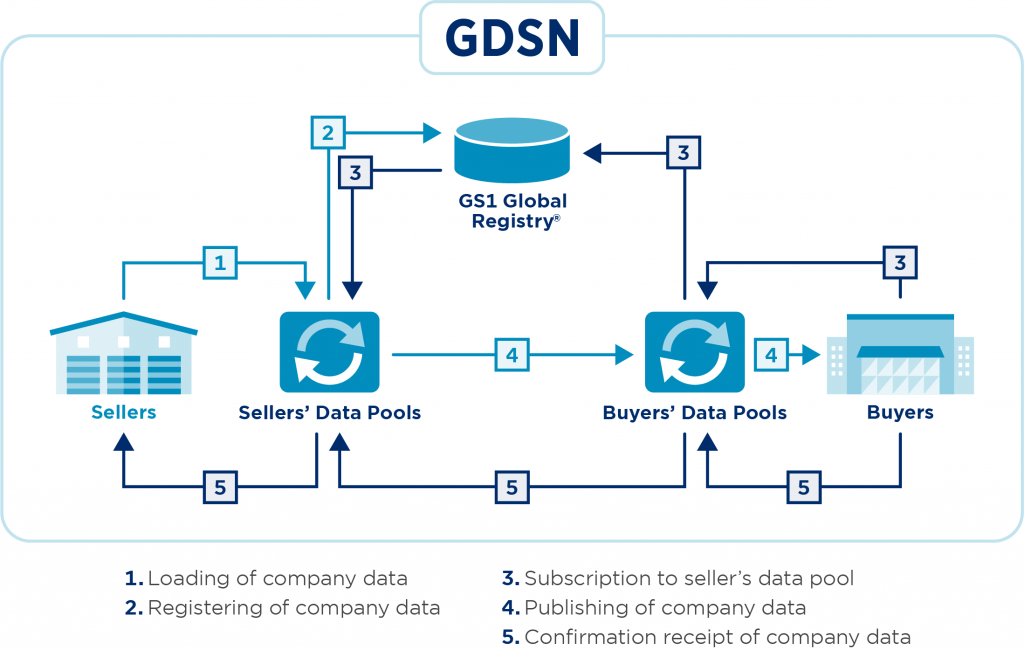
GDSN is a network of GS1-certified data pools linked through the GS1 Global Registry.
A brand manufacturer uploads product data to one data pool.
That pool validates the data against GS1 standards, registers the item in the Global Registry, and delivers it to the data pools of retailers and distributors that subscribed to it.
GS1 documents how the network moves data between those parties.
What changes for the manufacturer is the number of places a product specification lives. Instead of one spreadsheet per retailer plus the email threads correcting them, there is one record.
A packaging change, a revised net weight, an updated allergen attribute: publish once, and subscribers get it.
The data follows the GS1 Global Data Model, which defines the foundational attributes needed to list, store, move and sell a product.
At minimum, manufacturers exchange Global Trade Item Numbers (GTINs) for products and Global Location Numbers (GLNs) for locations, alongside dimensions, weight, packaging hierarchy, classification and minimum order quantities.
If any of those terms are new, the Commport glossary defines them in plain language, and GDSN 101 walks through the basics.
What a GDSN Publication Typically Contains
Attribute group | Examples | Why the retailer needs it |
Identification | GTIN, GLN, brand owner, target market | Matches your item to their item master |
Physical | Height, width, depth, gross weight, net content | Slotting, pallet planning, freight rating |
Packaging hierarchy | Each, inner pack, case, pallet | Ordering units and receiving accuracy |
Classification | GPC brick code, category attributes | Where the product sits in the assortment |
Regulatory | Allergens, nutrition, UDI, hazardous flags | Label compliance and recall readiness |
Commercial | Order minimums, availability dates, price basis | Ordering windows and launch timing |
The exact attribute set varies by category and target market. A frozen dessert publishes different fields than a surgical instrument. What stays constant is the mechanism.
How Does a Brand Manufacturer Connect to Trading Partners?
GDSN runs on a publish-and-subscribe model. Five steps complete one exchange:
- You load validated product and company data into your certified data pool.
- Your data pool registers the item with the GS1 Global Registry, using the GTIN and GLN as the index.
- A retailer subscribes through its own data pool. The subscription routes through the Global Registry back to your pool.
- Your data pool matches the publication against the subscription and sends the record to the retailer’s data pool.
- The retailer reviews the data and returns a confirmation message, which closes the loop.
You choose your data pool, and the retailer chooses theirs. Certified pools hold production connections to every other certified pool, so you do not have to join whichever provider your customer picked. Commport’s GDSN guide covers the message flow in more detail, and why retailers subscribe to a GDSN datapool explains the same exchange from the buying side.
Not sure which GDSN Datapool fits your retailer list?
Compare GDSN datapool providers side by side
Compare GDSN ProvidersWhat Does a GS1-certified GDSN Datapool Actually Do?
Every trading partner in GDSN connects through a certified datapool. Certification is not a badge.
It is an interoperability test.
A pool has to meet GS1 standards and prove it can exchange messages with the rest of the network before it goes into production.
Three practical consequences follow for a manufacturer:
- You are not locked into your customer’s provider, so a retailer mandate does not force a migration.
- Validation happens before publication, so errors surface inside your pool rather than in the retailer’s item setup queue.
- Adding a new retailer becomes a subscription rather than a new integration project.
Cost, attribute coverage, onboarding support, and regional reach vary between pools.
Those differences, not the certification itself, are what you evaluate. What is a GDSN data pool? Let us break down the components in more depth.
What Benefits Do Brand Manufacturers Get From GDSN?
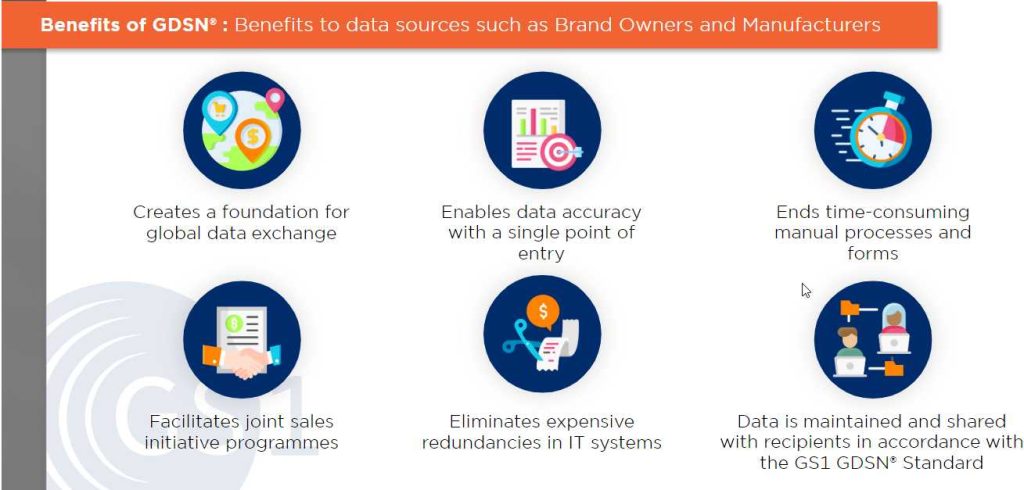
Benefit | What changes operationally | Primary source |
Fewer chargebacks | Retailer item master is fed from your published record, so dimension, pack count and price mismatches have fewer places to start | GS1 US, GLN in chargeback and rebate processes |
Faster listings | Item setup begins as soon as complete validated data lands, with no back and forth to complete missing fields | GS1, GDSN benefits |
Consistent data across channels | Every partner reads the same attribute values, which reduces disputes over what was ordered | GS1 UK knowledge hub |
Tighter logistics coordination | Accurate weights and dimensions feed freight rating, pallet building and slotting decisions | GS1 UK knowledge hub |
Regulatory and retailer compliance | Category attribute requirements ship inside the same publication rather than in side documents | GS1, Global Data Model |
1. Fewer Chargebacks and Less Manual Correction
Retailer chargebacks tied to product data usually trace to a small set of causes: a dimension that does not match the case received, a pack count that differs from the purchase order, or pricing that moved without the retailer’s file moving with it.
GS1 US publishes a quick start guide on using GLNs in trace, chargeback and rebate processes for exactly this reason.
The penalty amount is the visible cost.
The larger one is the hours your customer service and master data teams spend reconciling after the fact, month after month, on errors that a validated record would have caught before publication. Manufacturers already running EDI see the same pattern on the transaction side, covered in how EDI improves data accuracy.
2. Faster Listings and Shelf Readiness
Retailers cannot start item setup until they hold complete, validated data.
GDSN delivers it in a format their systems already accept, which removes the delay that usually sits between a signed listing and a live SKU.
GS1 documents faster activation across sales channels as one of the network’s main outcomes for suppliers.
3. One Product Description Across Every Channel
Standardized attributes mean the case dimensions on the retailer’s receiving screen match the ones in your ERP and the ones on the marketplace listing.
GS1 UK’s knowledge hub and Propel’s GDSN glossary entry both point to validation procedures as the reason discrepancies drop.
For clothing brand manufacturers running hundreds of style, color, and size combinations, that consistency decides whether a seasonal launch runs clean or turns into a week of exception handling.
Consumer packaged goods companies get the same effect across a smaller catalogue with higher velocity.
Digital shelf optimization covers how the same record carries through to ecommerce listings.
4. Better Coordination With Logistics and Distribution Partners
Accurate weights and dimensions feed freight rating, pallet building, and warehouse slotting.
When those attributes change in one place, planners, carriers, and distributors work from the same numbers.
The business impact of global data synchronization looks at how that visibility affects planning across the wider supply chain.
5. Compliance that Travels with the Record
Food, pharmaceutical and retail programs each carry their own attribute requirements.
GDSN carries them inside the publication instead of in a separate document set, which matters most when a recall or an audit compresses your response window.
GS1 cites a McKinsey & Company study finding that retailers and brand owners gain in both the near and long term from adopting a standard data model.
Want to Publish your First Product This Quarter?
See how the Commport GS1-certified GDSN Datapool works
Get Started With Commport GDSN Datapool SolutionWhich Brand Manufacturers Use GDSN Today?
1. Food and Beverage Manufacturers
Food and beverage is one of the largest user groups on the network.
Nearly 5,000 foodservice companies exchange data through GDSN, according to Commport’s food and beverage industry analysis.
Fresh produce suppliers have registered 226,226 GTINs and 4,611 GLNs, largely to support recall precision.
Meat and poultry account for 901,065 synchronized GTINs.
Dairy accounts for 691,648. Seafood suppliers maintain 3,491 GLNs, aimed partly at keeping illegal, unreported, and unregulated catch out of the chain.
2. Consumer Packaged Goods Companies
Procter & Gamble integrated GDSN as part of managing hundreds of millions of transactions, orders, and logistics movements across its China supply chain.
The company reported better order, shipping, and receiving accuracy along with lower logistics costs and waste.
CPG brands typically pair the network with a product information system, which 10 reasons GDSN and PIM matter for digital commerce explores in more detail.
3. Clothing Brand Manufacturers and Fashion Businesses
Apparel carries the hardest product data load of any retail category.
SKU counts multiply across style, color, size, and season, and the catalogue turns over several times a year.
GS1 documents Herman Kay’s work with GS1 US to apply RFID across its fulfillment process, which is an adjacent standards program rather than a GDSN deployment.
Fashion and footwear manufacturers that do publish through GDSN use it for style codes, material composition, and seasonal drop timing across wholesale and retail partners.
4. Healthcare Product Manufacturers
Healthcare adoption keeps growing across regions, and GS1 tracks the programs by country.
In Australia, Orion (a Perrigo company), Link Healthcare, and Care Essentials have each published through the network, covered in Commport’s GDSN for healthcare breakdown. Manufacturers subject to UDI requirements can review CommCare GDSN for the healthcare-specific attribute sets.
Working to a retailer or regulator mandate?
Talk to a Commport GDSN specialist about your category
Talk to Our GDSN Specialist TodayHow Do You Choose a GDSN-Certified Datapool?
GS1 US publishes a selection guide covering capabilities, user experience, pricing model and geographic reach. Work through it, then ask six questions that separate providers in practice:
- Does the pool support the specific attribute sets your retailers demand, including regional and category extensions?
- Can it load your existing item data, or will your team rebuild the catalogue by hand?
- Does it connect to your ERP or PIM directly, or only through file drops?
- How is support priced: per item, per publication, or as an annual fee?
- Who has it onboarded in your category, and how long did that onboarding take?
- What happens when a retailer changes its attribute requirements mid-season?
Commport GDSN Datapool has held GS1 certification since 2005 and offers flexible payment options for manufacturers publishing at different volumes.
Commport’s comparison against other GDSN providers sets out where it fits and where other pools may suit you better.
If you are still weighing whether the network applies to a business your size, eight common GDSN myths address the usual objections.
How Does GDSN Work Alongside a PIM System?
The two systems solve different problems, and manufacturers who treat them as alternatives end up with one of two gaps.
PIM | GDSN | |
Primary job | Organize and enrich product data inside your business | Distribute validated product data outside your business |
Audience | Internal teams, your ecommerce site, marketplaces | Retailers, distributors, regulators |
Data shape | Whatever your channels need, including marketing copy and images | GS1 standard attributes |
Trigger for change | An editorial or merchandising update | A publication to subscribed partners |
Failure mode on its own | Rich product data that never reaches trading partners | Compliant data with no marketing depth behind it |
Run both, connected.
The PIM holds the master record.
Automation maps those fields into GDSN format and publishes them, so nobody re-keys attributes into a data pool interface.
GDSN vs PIM compares the two directly, product data syndication covers the distribution layer, and product data enrichment covers what goes into the master record before any of it publishes. WisePIM’s dictionary entry describes the same integration pattern from the PIM side.
If you are still deciding what belongs in the master record, 15 types of product data a PIM can hold is a useful inventory, and how EDI, GDSN and PIM work together shows where transactional data fits alongside product data.
How Do You Keep GDSN Data Quality High?
Publication is easy.
Keeping the record correct twelve months later is the part that decides whether the investment pays back.
- Name people, not committees. One person creates the record, one approves it, one publishes it.
- Appoint a single owner of product data for the business. GS1 US builds its National Data Quality Program around that principle.
- Measure package dimensions and weights physically before the first publication, then communicate them internally and to partners.
- Re-validate on a schedule against GS1 standards and each partner’s rules rather than waiting for a rejection to tell you something moved.
- Treat publication as continuous. Product data changes, so the record has to change with it.
What Slows GDSN Implementations Down?
Four patterns account for most delayed rollouts:
- Publishing before cleaning. Dirty data publishes as dirty data and comes back as rejected files.
- Treating GDSN as a project with an end date. Item data changes constantly, and so does the retailer attribute list.
- Skipping the final validation check against GS1 standards, which turns one submission into three.
- Leaving measurement to guesswork. A tape measure disagreement between your warehouse and the retailer’s distribution center costs far more than the ten minutes it takes to remeasure.
Commport’s four-step GDSN implementation walkthrough sequences the work, and GDSN for suppliers covers what changes on your side once you are live.
Conclusion
If a retailer has already mandated GDSN, the sequence is short.
Clean the item data, choose a certified data pool, publish a pilot set of GTINs, and read what comes back.
Errors caught on twenty items are cheap.
Errors caught on two thousand are not.
If no mandate has landed yet, the case rests on what you currently spend correcting product data after the fact: chargeback totals, hours in master data reconciliation, and the gap between a signed listing and a live SKU.
Those three numbers usually decide it faster than any feature comparison.
Commport GDSN Datapool has held GS1 certification since 2005 and connects to the same Global Registry every other certified pool uses, so your retailers do not have to change providers for you to start publishing.
The full library of GDSN and datapool resources covers guides, whitepapers, and category-specific material, and 100 benefits of GDSN by industry maps outcomes to individual sectors.
Commport GDSN Datapool - #1 GDSN Datapool Provider in North America
Download: GDSN Buyers Guide
Empower your business with global data synchronization; download our GDSN Buyer's Guide today and take the first step towards streamlined, accurate, and compliant product data management.
Frequently Asked Questions
GDSN is a network of GS1-certified data pools linked by the GS1 Global Registry. A brand manufacturer publishes one validated product record into its chosen data pool, and every retailer subscribed to that item receives the record automatically through their own pool, including every subsequent change.
A GDSN-certified data pool is a provider that GS1 has tested for standards compliance and interoperability with every other certified pool. More than 50 operate globally. Manufacturers can choose any of them, regardless of which pool their retailers use, because certified pools maintain production connections to each other.
Most product data chargebacks come from mismatched dimensions, weights, pack counts or prices between supplier and retailer systems. GDSN feeds the retailer item master from your published record and validates attributes before they leave your data pool, so those mismatches have fewer opportunities to appear.
Yes, because retailers cannot begin item setup without complete, validated data. GDSN delivers it in a format their systems already accept, which removes the request and resend cycle. The gain shows up between a signed listing agreement and a live SKU rather than during negotiation.
No. Certified data pools hold production connections to every other certified pool, so a manufacturer on one pool can publish to a retailer subscribed through another. Choose your pool on cost, attribute coverage, integration options and support rather than on your largest customer’s choice.
PIM manages and enriches product data inside your business. GDSN distributes standardized data to trading partners outside it. Connected, the PIM holds the master record and automation maps those fields into GDSN format for publication, which removes duplicate entry and keeps internal and external data aligned.
Timelines depend on catalogue size and how clean the item data already is, not on the network itself. Manufacturers with measured dimensions and a single owner of product data move quickly. Those cleaning attributes during onboarding spend most of their time on cleanup rather than publication.
Company size is not the deciding factor. Nomoo, a small German ice cream producer, supplies more than 2,000 outlets from one central product record. The economics turn on how many trading partners you serve and how much you spend correcting product data after a retailer rejects it.