


Introduction to GDSN for Retailers
Understanding GDSN for retailers begins with recognizing that major players like Kroger, Walmart, Amazon, and other retailers rely on this network for product data management.
With more than 50 GS1-certified data pools available, this system has become essential infrastructure for modern retail operations.
The GDSN meaning centers on standardized product information exchange between suppliers and retailers. It enables automated, accurate product data synchronization through GS1 GDSN standards.
Major retailers, for instance GDSN Walmart implementations, use this system to reduce manual data entry and accelerate time-to-market.
In this blog, we’ll explore how GDSN data pools work, their key benefits for retailers, and what you should consider when subscribing to a GS1-certified GDSN data pool provider.
Key Takeaways
- GDSN eliminates manual data entry errors – Automated validation reduces data errors by 25% and increases operational efficiency by 30%, saving retailers $25-50 billion annually in manual entry costs.
- Faster product launches drive competitive advantage – Retailers cut time-to-market from 4-8 weeks to just 2 weeks while increasing new product introductions by 50% without additional staff.
- One data pool connects to all suppliers – A single GDSN subscription provides access to 7,500+ trading partners across 25 countries, regardless of which data pools suppliers use.
- Real-time synchronization improves supply chain efficiency – Companies report 64% faster processing times, $2.2 million in annual transportation savings, and 30% reduction in inventory errors.
- Choose certified providers carefully – Evaluate GS1-certified data pools based on industry experience, integration capabilities, and pricing models to avoid costly implementations costs.
What is GDSN and How Does It Work?
Introduced by GS1 in 2004.
The Global Data Synchronization Network is an internet-based, interconnected network of interoperable data pools governed by GS1 standards. This network enables companies worldwide to exchange standardized product master data with their trading partners.
The system addresses a fundamental challenge in retail: sharing accurate, up-to-date product information among manufacturers, distributors, and retailers who operate with different systems and processes.
The network supports high data quality through authoritative data sources, real-time synchronization, and standardized data formatting.
Rather than manually entering product information for each trading partner, businesses upload their data once to a certified data pool, which then synchronizes this information across all connected partners.
How GDSN Data Pools Connect Trading Partners
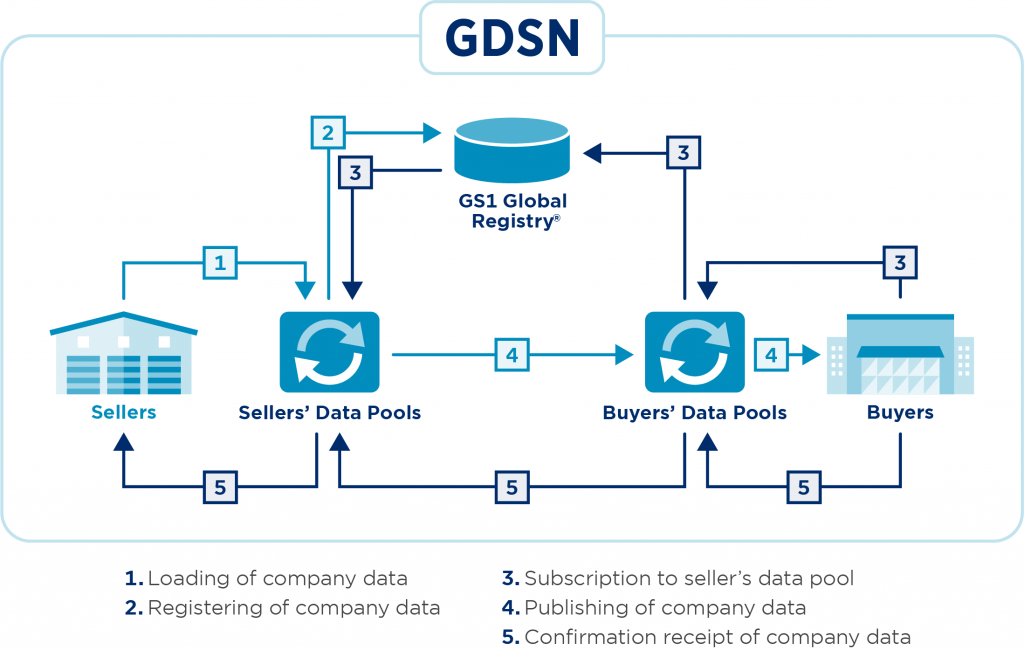
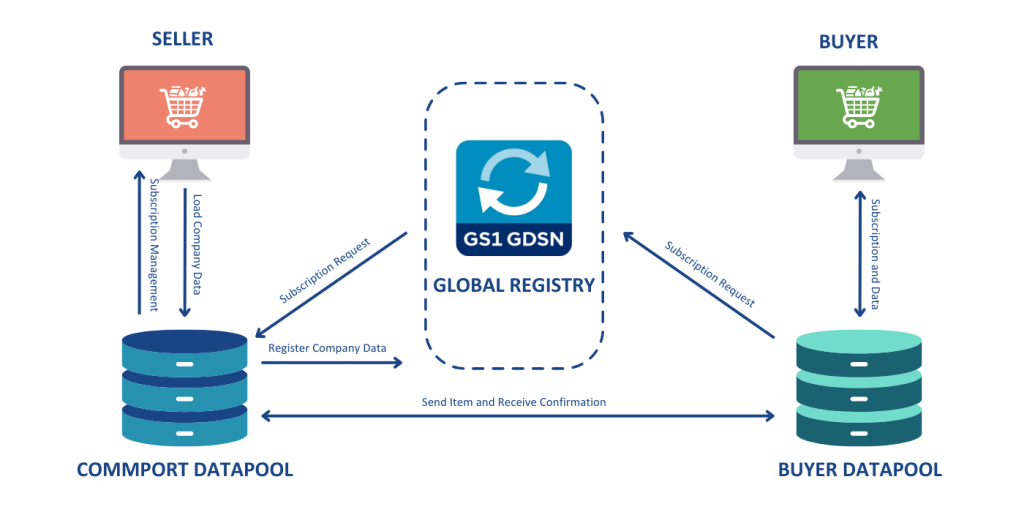
GDSN operates using a publish-subscribe pattern between two trading partners, each registered with and accessing the network via a data pool.
The GS1 Global Registry serves as the directory, pointing to the data pool where data is housed and matching subscriptions to registrations to facilitate synchronization.
The process works systematically.
A manufacturer selects from around 50 data pools worldwide and registers in the Global Registry.
After receiving data in the GS1 “Notification” format, the data pool validates it against applicable GDSN rules.
On the other side, a retailer subscribes to specific data through their chosen data pool, which can differ from the manufacturer’s pool.
The retailer specifies which data to receive, whether all products from a target market, certain product groups, or specific items from a manufacturer.
When the Global Registry identifies a “pub-sub match,” data flows from the manufacturer’s pool to the retailer’s pool.
The retailer can then send confirmation of successful receipt or request data corrections using the GS1 “Confirmation” format.
The Role of GS1 Standards in GDSN
GS1 standards provide the universal language for this exchange.
The GS1 data model contains over 700 attributes, with varying numbers used depending on the product or supply chain.
These standards include the Global Trade Item Number (GTIN) for products, Global Location Number (GLN) for legal entities, and Global Product Classification (GPC).
Each item and entity receives unique, universal recognition, which proves critical for managing data across different markets and languages.
Key Benefits of GDSN for Retailers
1. Accurate Product Data from Suppliers
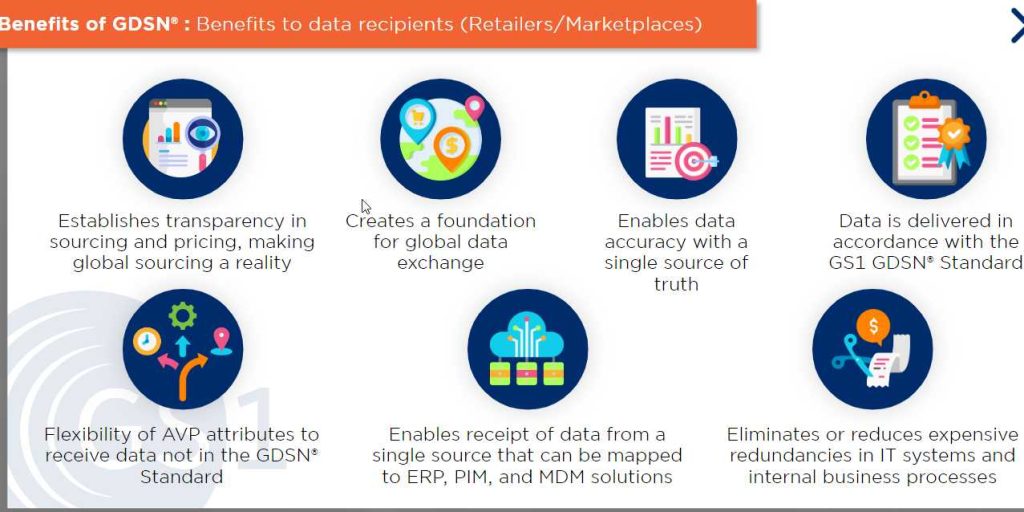
Retailers receive precise, standardized product information directly from GDSN suppliers through automated validation systems.
Real-time validation against ensures format consistency and eliminates errors before data enters your database. This means weight, dimensions, brand names, and GTINs arrive in identical formats across all suppliers, reducing discrepancies in product listings.
The validation process tests data against GS1 standards and recipient-specific requirements, with over 10,000 data quality checks ensuring accuracy from the source. As a result, you maintain high-quality, standardized data that improves the customer experience across all channels.
2. Reduced Manual Data Entry and Errors
Manual data entry carries error rates of around 5 to 10%, which multiply across thousands of SKUs.
GDSN for retailers addresses this by automating data synchronization, cutting manual processes that plague traditional product onboarding.
Businesses subscribing to the GDSN network report a 25% reduction in data errors and a 30% increase in operational efficiency.
The financial impact proves substantial. Manual entry mistakes cost the CPG and retail industries between $25-50 billion annually.
Besides eliminating these costs, automation frees up employee time spent on repetitive tasks.
McKinsey found that employees spend 45% of their time on manual jobs that could be automated.
3. Faster Time-to-Market for New Products
Speed matters in competitive retail environments.
GDSN cuts time-to-market from weeks to days through streamlined data sharing.
One of the Commport’s customers improved speed to shelf from 4-8 weeks down to just 2 weeks while increasing new item introductions by 50% with no additional headcount.
Clean, standardized data reduces rejection rates that slow traditional onboarding processes.
Instead of weeks of back-and-forth communication resolving data issues, GDSN-compliant submissions typically process within days.
4. Improved Supply Chain Efficiency
Accurate product attributes deliver measurable operational improvements.
Companies report 64% faster processing times, $2.2 million in annual transportation savings, and a 30% reduction in inventory errors.
Distribution networks benefit from faster information transfer, improving from 5-6 days to 2 days.
5. Better Collaboration with GDSN Suppliers
Real-time data synchronization means suppliers can update product details instantly, and trading partners worldwide receive changes immediately.
This continuous harmonization maintains data accuracy across all systems without manual intervention.
The standardized platform provides reliable data exchange, reducing the time retailers spend managing supplier item setup.
How Retailers Use GDSN Datapools
1. Receiving Standardized Product Information
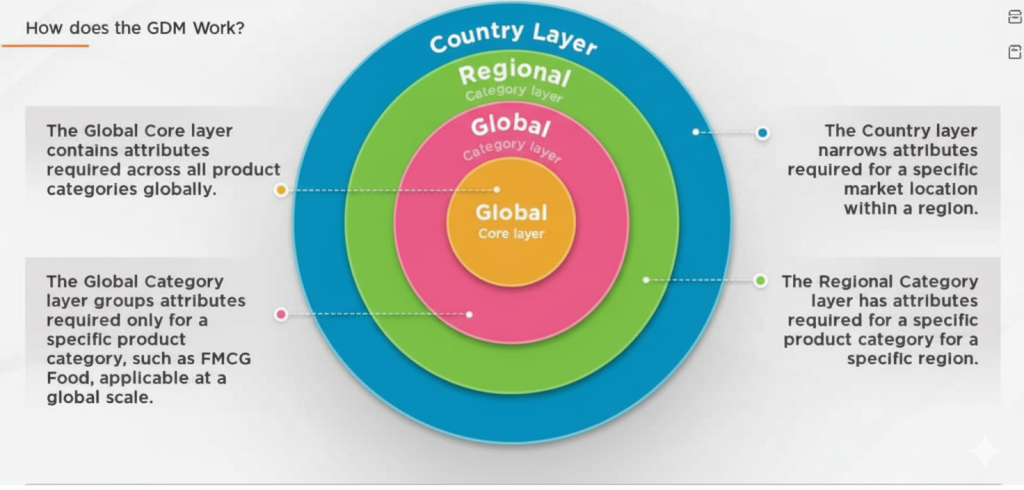
Data recipients access suppliers’ product information through certified data pools where attributes are stored and continuously updated.
The GS1 Global Data Model structures this information across four distinct layers: Global Core attributes, Global Category attributes, Regional Category attributes, and Country/Local attributes.
This layered approach clarifies technical terminology and helps data senders deliver accurate content from the start.
2. Managing Data from Multiple Suppliers
You need only one GDSN data pool connection to reach all trading partners.
Your chosen data pool doesn’t need to match your suppliers’ selections.
This flexibility means seamless data synchronization across 25 countries.
Solutions like Commport GS1 Certified GDSN Datapool help both suppliers and retailers with real-time product data that helps manage, 7,500+ GDSN partners enrich, and distribute to marketplaces.
3. Validating Product Attributes Automatically
Buyers use GDSN attributes for internal validation and B2B process support.
According to certified providers, real-time validation runs against over 10,000 data quality checks.
Data pools verify supplier information against GS1 standards and your specific requirements to ensure format consistency.
4. Syncing Data Across Internal Systems
Integration connects to Enterprise Resource Planning systems, Item Master Files, and Vendor Master Files on the demand side.
Data pools offer multiple connectivity methods: machine-to-machine interfaces, spreadsheet loads, or graphical user interfaces.
Seamless connections with e-commerce and ERP platforms enable effortless data exchange.
What to Consider When Subscribing to a GDSN Datapool
1. Choosing a Certified Datapool Provider
Selecting from 50 GS1-certified GDSN datapools worldwide requires careful evaluation. GS1 standards ensure you need only one data pool to connect with all trading partners, regardless of which pools they use.
Focus on these selection criteria during evaluation: support capabilities and experience with implementations in your industry, technical compatibility with your preferred data loading methods (spreadsheet uploads, machine-to-machine connections, or GUI interfaces), validation services performed before transmission, and pricing structure. Experienced providers should share best practices from successful implementations in your sector.
Commport GDSN Datapool has been a GS1-certified provider since 2005. Helps both suppliers and retailers with real-time product data that helps manage, enrich, and distribute to marketplaces.
2. Understanding Costs and Pricing Models
Pricing models vary significantly across providers. Some base fees on company revenue, others consider active SKU count or data recipient numbers.
Revenue-based pricing, used by some GDSN providers, results in contracts approaching $1 million annually for what functions as commodity technology.
These costs often push new, niche, or direct-to-consumer brands to opt out entirely.
However, Commport offers the most flexible and affordable pricing plans. We beat any price. That’s why Commport GDSN datapool is trusted by over 3000+ brands worldwide.
3. Integration with Existing Retail Systems
Optimal results occur when integrating GDSN with Product Information Management systems.
Your PIM serves as the single source of truth while the GDSN datapool handles standardization and synchronization.
Several pools provide APIs or dedicated connectors enabling automated data flows between systems.
Conclusion
GDSN subscription offers retailers a competitive advantage through automated product data management and reduced operational costs.
Without doubt, major players like Walmart and Kroger have already proven their effectiveness in streamlining supply chains and accelerating product launches.
Before choosing a datapool provider, make sure to evaluate certification status, integration capabilities, and pricing models carefully.
The right GDSN partner will transform your product onboarding process and strengthen supplier relationships for long-term growth.
Commport GDSN Datapool - #1 GDSN Datapool Provider in North America
Download: GDSN Buyers Guide
Empower your business with global data synchronization; download our GDSN Buyer's Guide today and take the first step towards streamlined, accurate, and compliant product data management.
Frequently Asked Questions
The Global Data Synchronization Network (GDSN) is an internet-based network of interoperable data pools governed by GS1 standards. It enables companies worldwide to exchange standardized product master data with their trading partners, ensuring accurate and consistent product information across the supply chain.
GDSN helps companies maintain accurate and consistent product details, manage inventory efficiently, optimize order fulfillment, and ensure supply chain efficiency. It also reduces manual data entry errors by 25%, increases operational efficiency by 30%, and accelerates time-to-market for new products from weeks to just days.
A GDSN data pool is a certified service provider that stores and validates product information according to GS1 standards. It acts as an intermediary that connects trading partners, allowing manufacturers and retailers to exchange standardized product data even if they use different data pools.
Any company that needs to send or receive product information can benefit from subscribing to a GDSN data pool. This includes manufacturers, suppliers, distributors, and retailers who want to synchronize product content with their trading partners and maintain reliable data across all markets.
GDSN enables real-time data synchronization, allowing suppliers to update product details instantly while trading partners receive changes immediately. This continuous harmonization maintains data accuracy across all systems without manual intervention, reducing the time spent on supplier item setup and improving overall supply chain efficiency.