


EDI Maps: Testing vs Production Data
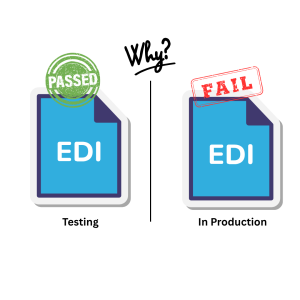
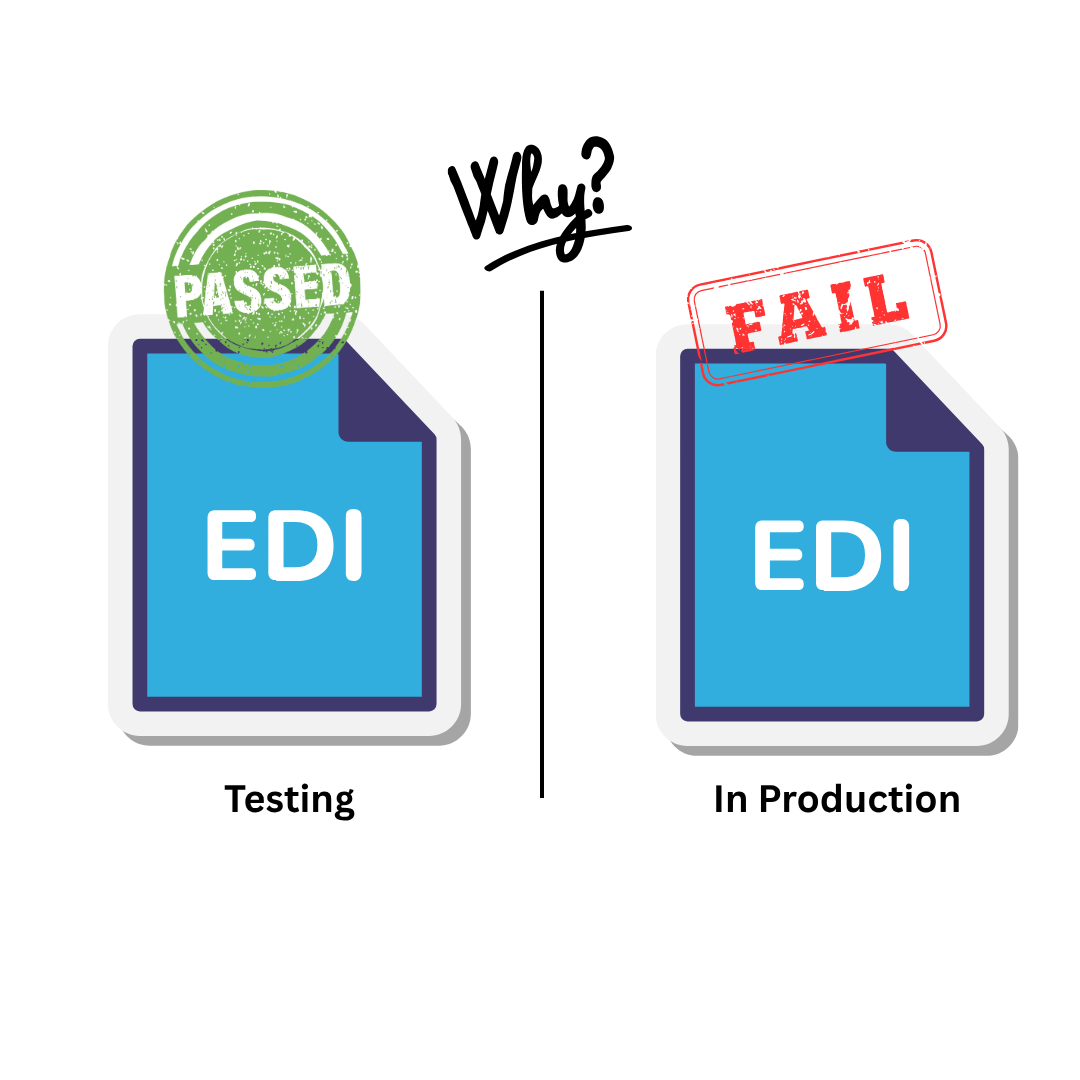
EDI mapping passes tests because they check syntax and structure against clean, static sample files. Production fails because live trading partner data brings partner-specific rules, partial shipments, price changes, backorders, and rounding differences that test files never simulate. Closing the gap means testing real historical data, full transaction chains, and each partner’s implementation guide.
Key Takeaways
- Test environments use clean, static data that masks real-world complexity: Production handles partner variations, price changes, backorders, and edge cases that standard test files never simulate.
- Technical validation doesn’t equal business validity: A transaction can pass all syntax checks yet be completely wrong financially, causing inventory errors, invoicing failures, and shipment disruptions.
- Partner-specific requirements create hidden complexity: In one widely cited example, an automotive manufacturer needed 47 different mapping variations for the same transaction type across its supplier base, and each partner imposes its own rules beyond EDI standards.
- Use real historical production data for testing: Dummy data masks SKU mismatches, pricing errors and master data problems that only surface with actual product catalogs and trading partner codes.
- Test complete transaction chains, not isolated documents: Validate the full workflow from purchase order through shipment notice to invoice, ensuring data flows correctly across your entire system.
- Implement exception-based monitoring in production: Real-time alerting that surfaces genuine deviations with context enables faster resolution than sorting through generic validation flags.
Test vs Production: The Hidden Gap
The gap between passing tests and production success isn’t a technical problem.
It’s a business logic problem.
Organizations that bridge this gap validate against both EDI standards and partner specifications while building test scenarios that mirror actual operational workflows.
Your EDI mapping tests pass every validation check, yet production data still breaks.
We’ve seen this: files clear syntax validation, mapping looks perfect during testing, and then live transactions fail with real trading partner data.
The most overlooked risk is this: a file can pass EDI syntax yet be wrong from a financial or business standpoint.
The EDI software market, projected to reach USD 5.30 billion by 2032, attracts significant organizational investment in EDI mapping tools and X12 mapping capabilities.
But mapping errors don’t just fail a file.
They leak into inventory, invoicing, and shipping.
In this blog, we’ll uncover why standard tests miss production realities and how to build validation that works.
The Gap Between Test Environment and Production Reality
Test Files Show Perfect Structure, Production Shows Chaos
Test environments operate at a fundamentally different scale than production systems.
They typically involve fewer users, more flexibility to experiment, and controlled data sets designed to confirm things work.
Production environments must handle heavy workloads, maintain high stability, and process transactions without delays.
This structural mismatch creates the first gap.
The data itself tells the story.
Development environments usually contain minimal amounts of data that get wiped regularly and bear little resemblance to actual production data.
QA environments may include outlandish data samples with long names to test edge cases, but these artificial extremes miss the subtle variations that break real transactions.
Testing proves the pipes work. Production proves whether your data and processes can flow through them.
Production brings hundreds of orders at once.
Addresses appear in different formats. Item codes change in one system but not another.
Promotions alter pack sizes halfway through the month.
The tidy world that testing relied on disappears when real business operations begin.
Why Standard Test Files Miss Real Trading Partner Variations
A single retailer may require a unique variation of what should be a standard EDI 850 purchase order.
In one widely cited industry example, an automotive manufacturer found that it needed 47 different mapping variations for the same transaction type across its supplier base.
This complexity multiplies across every transaction in your EDI mapping document workflow.
Standard test files assume uniformity, but real X12 mapping scenarios require customization.
A standard EDI 850 purchase order looks different depending on which retailer sends it. Walmart, Target, Amazon, and Home Depot each require different field arrangements, segment qualifiers, and conditional logic within the same transaction set.
Your EDI mapping tools might validate perfectly against the baseline X12 standard, yet fail against partner-specific requirements.
The most common EDI testing mistake that causes production failures is using dummy data rather than real trading partner item numbers, ship-to codes, and production pricing.
Dummy data masks the mapping and master data mismatches that only appear with actual product catalog entries.
Real data testing that surfaces a SKU mismatch before go-live costs one configuration correction; the same mismatch found in production costs missed shipments, out-of-stock shelves, and chargebacks.
The False Confidence of Technical Validation Alone
Most EDI failures don’t happen during development.
They happen in production.
Organizations invest heavily in EDI mapping processes, integration platforms, and testing environments, yet production failures continue to disrupt business operations.
Traditional EDI testing confirms structure.
Modern EDI validation must confirm syntax rules, standards compliance, control numbers, trading partner rules, customer-specific business rules, and transaction relationships.
Technical validation alone creates false confidence because it checks format without verifying business logic.
Testing usually proves that the integration works.
The syntax is correct, the mappings behave exactly as the specification says they should, and the transactions follow the rules.
But testing rarely looks like anything in the real world.
Testing tends to use clean examples: a neat purchase order with a perfect address, GTINs that exist everywhere, and units of measure that line up in every system.
Production doesn’t behave like that.
What changes in production isn’t the message itself or the integration.
What changes is everything around it.
This gap between technical correctness and business reality is where your EDI mapping software validation ends, and your production problems begin.
Commport EDI Translation and Mapping Services
Comes with a built-in VAN network, help you map and translate any document into a standardized EDI document. 100% EDI Compliance Guaranteed.
Book a Free Consultation TodayWhat EDI Mapping Tests Actually Validate (And What They Don't)
Understanding what your EDI mapping tools check requires separating technical correctness from business validity. Most organizations find this difference too late, after certified transactions fail in production with real partner data.
Syntax Validation vs Business Logic Validation
Syntax testing verifies that EDI documents conform to the correct format and structure as defined by EDI standards, checking proper use of delimiters, segment order, and data element positioning.
This validation catches structural problems but says nothing about whether the content makes business sense.
Semantic testing goes beyond syntax and ensures that document content is meaningful and logically correct, verifying that data elements contain valid values and that relationships between different parts of the document are consistent.
The problem is that input validation operates at your application boundaries, checking that values are numbers or positive integers.
Business validation relies on business rules that your input layer cannot and should not handle.
You might pass syntax validation on an EDI 810 invoice, yet the invoice could reference an incorrect PO line number that matches the required format but points to the wrong item.
Technical validation alone creates a file that’s structurally perfect yet financially wrong.
Field Mapping Accuracy vs Data Transformation Rules
Field mapping defines precise relationships between data fields in your X12 mapping configurations.
Transformation means changing or modifying incoming data according to business requirements.
For example, your incoming date arrives in MMDDYY format, but your target system requires DDMMYYYY.
You need transformation logic using predefined functions within your EDI mapping software.
Transformation rules are conditions specified in the mapping, such as directing source field xx to target field yy when xx exceeds a certain threshold.
Organizations validate that fields map correctly without testing whether transformation rules execute properly under different conditions.
A date field might map to the right location yet fail transformation when the source data contains edge cases like leap years or century transitions.
Single Scenario Testing vs Multi-Partner Data Scenarios
Retailers don’t test just one happy-path transaction.
They test multiple scenarios because each one stresses different parts of your EDI mapping logic.
A single-line purchase order tests acknowledgment generation, while a multi-line PO tests whether your pack structure correctly groups items across cartons.
A partial shipment tests whether your system can flag reduced quantities. Each scenario validates a different code path, and passing one doesn’t guarantee passing others.
Testing only happy-path transactions with complete, accurate, and perfectly formatted data misses real-life complexity.
Strong EDI testing should include negative scenarios such as missing required data, invalid codes, subscriber and patient mismatches, duplicate claims, and formatting errors.
Partner-specific requirements add another layer, since many trading partners impose their own rules beyond EDI standards.
These requirements complicate the implementation process, especially when you have multiple partners working simultaneously.
Static Test Data vs Dynamic Production Edge Cases
Static test data provides reliability by confirming that core features work without accidental breakage.
Dynamic testing weeds out edge cases in code but introduces unpredictability, since tests could fail unexpectedly.
EDI testing software can simulate various scenarios and exceptions that occur during transactions, including missing data, incorrect data or data in the wrong format.
Simulation is fundamentally different from encountering actual production variations. Real testing should use real-life data and uncover issues that stay invisible during configuration.
Common Production Failures That Pass All Mapping Tests
Real-world transactions expose gaps that no amount of EDI mapping testing can predict. These failures pass syntax checks, validate against standards, and look correct until they hit actual business scenarios.
Partial Shipments and Split Orders Break Pack Hierarchies
Split shipments divide a single order into two or more separate deliveries, each shipping to the end destination.
This happens when SKUs aren’t stored at the same fulfillment center or when customers order multiple products that don’t fit into one package.
The EDI 856 advance ship notice tells the buyer what was shipped, when it shipped, and how it was packed.
The buyer cannot settle the order if the invoice doesn’t match the shipment data.
Your X12 mapping may generate pack hierarchies for complete shipments, yet partial orders break the container-to-item relationships your mapping assumes.
Price Changes Between PO and Invoice Create Settlement Errors
Purchase order to invoice settlement, or three-way matching, compares the PO against the shipment notice and invoice.
Most EDI invoice discrepancies happen when the details on the invoice do not match the purchase order, shipment notice, or customer requirements.
Price mismatches represent one of the most common causes.
An estimate widely circulated in the EDI industry suggests retailers can overpay as much as USD 120 to USD 150 per purchase order on preventable issues that include incorrect pricing.
At that rate, an organization sending 100,000 purchase orders each year could lose USD 12 million to USD 15 million.
Peer-reviewed research confirms how common these errors are: a study of a retail distribution center published in the Journal of Operations Management found that 7 percent of a retail chain’s purchase orders were affected by fulfillment errors.
Backorders and Substitutions Trigger Unexpected Acknowledgment Codes
The EDI 855 acknowledgment uses specific line item status codes to communicate order status.
Backorders require code IB, substitutions use IS, and partial shipments with the balance backordered need BP.
Every line item on the original purchase order should receive an explicit ACK status in the 855 response.
If a seller acknowledges some line items but omits others, the buyer cannot determine whether the missing items were accepted, backordered, or rejected.
Your EDI mapping document might generate acknowledgments for accepted orders, yet fail when backorders and substitutions appear.
Optional Segments Become Required in Partner-Specific Implementations
Segments marked as optional in the base X12 specification can become mandatory depending on the implementation guide that you and your trading partner agree to.
Trading partners create specifications to suit their business needs.
Some businesses mark segments as mandatory even when they’re optional per the standard. Some businesses break the X12 standard, and you’ll have to conform to their specification nonetheless.
Date Format and Code List Variations Across Trading Partners
Different trading partners impose their own rules beyond EDI standards.
Code list changes or different meanings for equivalent data fields cause mapping failures.
Your EDI mapping validation might pass with standard date formats, yet fail when partners require specific variations.
Rounding and Decimal Precision Issues in Financial Transactions
Electronic invoices from suppliers can include pricing that goes out to three to five decimal places.
Financial calculations using high-precision amounts can result in rounding dilemmas.
Some systems store values with six decimal places but display them as rounded values.
Minute discrepancies sometimes appear as a result of calculating complex values that have been rounded due to tax or quantity values.
Commport EDI Translation and Mapping Services
Comes with a built-in VAN network, help you map and translate any document into a standardized EDI document. 100% EDI Compliance Guaranteed.
Book a Free Consultation TodayBuilding Test Cases That Match Real Production Scenarios
Effective testing requires mapping your test scenarios directly to operational reality, not theoretical transaction flows.
Map Your Actual Business Workflows to Test Scenarios
EDI testing confirms that the full transaction flow works before live business activity begins.
Testing should mimic your actual order and fulfillment processes.
A typical scenario includes verifying purchase orders with correct product IDs, quantities, and pricing.
You also confirm functional acknowledgments and ensure advance ship notice carton information matches the purchase order. Invoice totals must match your accounting system.
Each scenario stresses different parts of your EDI mapping logic. Passing one doesn’t guarantee passing others.
Include Partner-Specific Implementation Guide Requirements
Each trading partner has its own EDI specifications, formats, and acknowledgment expectations.
A single mismatch can reject an entire shipment or delay payment.
Start by reviewing the trading partner’s implementation guide and onboarding requirements carefully.
Confirm which documents are required and which communication method is needed.
Check which test scenarios are expected, and which approvals are needed before go-live.
The partner implementation guide decides the final mapping.
Certification covers structural verification, content verification, and business rule verification.
Passing structural verification is necessary but not sufficient. Most real certification failures happen in the content and business rule layers.
Test the Full Transaction Chain, Not Individual Documents
Testing needs to be done end-to-end through your EDI portal and back-end ERP.
Confirm that the 850 creates the correct order in the back-end system.
Customer records and item numbers must map correctly. Shipping data should be available to build the 856, and invoice values must flow correctly into the 810.
Use Real Historical Production Data as Test Baseline
Real data testing surfaces SKU mismatches before go-live. Dummy data masks mapping and master data mismatches.
Verify Against Both EDI Standards and Partner Specifications
In addition to standards verification, you must check documents against trading partner specifications. Partners define guidelines that specify required transaction structures, mandatory fields and allowed values.
Commport EDI Translation and Mapping Services
Comes with a built-in VAN network, help you map and translate any document into a standardized EDI document. 100% EDI Compliance Guaranteed.
Book a Free Consultation TodayPreventing the Test-to-Production Gap with EDI Mapping Software
Software capabilities determine whether EDI mapping failures surface as alerts or operational disasters. The difference between monitoring and exception management matters here
Real-Time Monitoring and Exception Alerting in Production
Most EDI solutions provide dashboards showing successful and failed transactions, with alerts for errors.
Exception-based detection goes further by moving routine processing out of operators’ attention and surfacing only genuine deviations, with the context needed to act.
Operators working with genuine exception-based detection find short lists of items needing attention. Alert-based systems require sorting through flags to find what matters.
Version Control and Change Management for Mapping Rules
Version control tracks discrete, deployable versions of every data translation rule between internal systems and trading partners. Not all companies move to newer versions at the same time.
One partner may use X12 4010 while another has transitioned to 5010.
Cloud EDI map version control provides rollback paths and minimizes risk during deployment.
Automated Regression Testing After Partner Updates
Regression testing confirms that critical transactions still map correctly after code set updates.
According to vendor-reported figures, organizations that implement automated exception handling see 40 to 46 percent reductions in exception resolution time within the first quarter.
Building Repeatable Test Suites in EDI Mapping Tools
Automation accelerates regression testing by rerunning structured test files through updated maps and collecting differences in real time.
Conclusion
Standard EDI testing confirms syntax, yet production data continues to fail.
We’ve explored why this gap exists: test environments use clean, static data, while production handles partner variations and edge cases.
Technical validation alone cannot catch price mismatches or partner-specific requirements that deviate from base standards.
Your EDI mapping software must validate both structure and business logic.
Build test cases using real historical data and include partner-specific implementation guides.
Test complete transaction chains rather than isolated documents.
Understand that a file can pass every technical check yet still be financially wrong. Production reality demands more than syntax validation.
Commport EDI Solutions
Need Help? Download: EDI Buyers Guide
Unlock the full potential of your supply chain with our comprehensive EDI Buyer's Guide — your first step towards seamless, efficient, and error-free transactions
Frequently Asked Questions
EDI transactions often fail in production because standard mapping tests validate technical structure and syntax, but they don’t account for real-world business scenarios. Test environments use clean, controlled data, while production handles partner-specific variations, edge cases like partial shipments, price changes between purchase orders and invoices, and dynamic business conditions that testing environments don’t replicate.
Syntax validation checks that EDI documents conform to the correct format, structure, delimiters and segment order as defined by EDI standards. Business logic validation goes deeper to ensure the content is meaningful and correct from a business perspective, verifying that data values make sense, relationships between document parts are consistent, and transactions align with actual business rules and partner requirements.
Use real historical production data instead of dummy test files, include partner-specific implementation guide requirements in your test scenarios, test the complete transaction chain rather than isolated documents, and validate against both EDI standards and individual partner specifications. Map your test cases directly to actual business workflows, including scenarios like backorders, partial shipments and substitutions.
Common failures include partial shipments that break pack hierarchies, price changes between purchase orders and invoices that create reconciliation errors, backorders and substitutions that trigger unexpected acknowledgment codes, optional segments that become required in partner-specific implementations, date format variations across trading partners, and rounding or decimal precision issues in financial transactions.
Traditional EDI onboarding, including end-to-end testing, can take up to six to eight weeks per trading partner, though this varies significantly based on the complexity of transactions and how quickly trading partners can make corrections. The timeline includes setup, mapping builds, testing cycles and go-live preparation. While this may seem lengthy, thorough end-to-end testing significantly reduces production issues compared to faster but less comprehensive testing methods.