


Key Takeaways
- The date is July 20, 2028, and it is now statutory. Congress directed the FDA not to enforce before that date, so the deadline no longer moves on FDA discretion alone.
- Seven CTEs, not eight. Harvesting, Cooling, Initial Packing, First Land-Based Receiving, Shipping, Receiving and Transformation. Older guidance citing Growing and Creating reflects the 2020 proposed rule.
- The Traceability Lot Code is the spine. GS1 US recommends building it from a GTIN plus the batch or lot number, carried at pack level in the EDI 856 ASN.
- GDSN supplies the product identity the TLC points at. Commodity description, country of origin, net content and pack configuration are KDEs at several CTEs, and they need to match across every partner system.
- Records live for two years. The rule sets a two-year retention period from the date each record is created, which shapes archive design as much as transaction design.
What is the FSMA Food Traceability Rule?
The FSMA Food Traceability Rule (21 CFR Part 1, Subpart S) requires any business that manufactures, processes, packs or holds a food on the FDA Food Traceability List to record Key Data Elements at seven Critical Tracking Events, tie them to a Traceability Lot Code, and hand those records to the FDA within 24 hours of a request. Compliance is due July 20, 2028.
Introduction
Once your product appears on the Food Traceability List, none of the rules is optional. What is optional is how you build it. Most food businesses already move purchase orders, ship notices, and invoices electronically. The Food Traceability Rule asks those same messages to carry a few more fields, consistently, across every partner in the chain. That is an integration problem before it is a compliance problem, which is why EDI and GDSN sit at the center of most workable answers.
This guide covers what the rule requires, who it covers, the seven Critical Tracking Events and their Key Data Elements, how the Traceability Lot Code threads them together, and the FDA supply chain examples that show the rule applied to real product flows. It then maps each requirement to the EDI transactions and GDSN attributes that carry it, using the GS1 US FSMA 204 EDI recommendations as the technical reference.
Why Food Traceability Compliance Matters
|
Figure |
What it measures |
Source |
|
48 million |
Americans who get sick from a foodborne illness each year, with 128,000 hospitalisations and 3,000 deaths |
|
|
USD 17.6 billion |
Economic burden of the 15 leading foodborne pathogens in the United States, in 2018 dollars, up from USD 15.5 billion in 2013 |
|
|
24 hours |
Window to make traceability records available after an FDA request, unless the FDA agrees to a longer period |
|
|
July 20, 2028 |
Compliance date, extended 30 months from January 20, 2026 and then fixed by congressional directive |
|
|
23 entries |
Foods on the Food Traceability List, from soft cheeses through fresh-cut produce to bivalve shellfish |
|
|
2 years |
Retention period for every record the rule requires, from the date the record is created |
What Does the FDA Food Traceability Rule Actually Require?
The rule, formally titled Requirements for Additional Traceability Records for Certain Foods, was announced by the FDA on November 15, 2022 and published in the Federal Register on November 21, 2022. It took effect January 20, 2023, and implements Section 204(d) of the FDA Food Safety Modernization Act. It applies to domestic and foreign firms alike, anywhere along the farm-to-table chain, provided they handle a listed food for United States consumption.
Six obligations sit at the core:
- Record the Key Data Elements attached to each Critical Tracking Event you perform.
- Assign and carry a Traceability Lot Code for each traceability lot of a listed food.
- Maintain a written traceability plan covering your procedures, your FTL products, your lot code method, a named contact, and a farm map where one applies.
- Make all required records available to the FDA within 24 hours of a request, or within a longer period the FDA agrees to.
- Pass the required KDEs forward to the next entity in the chain so downstream partners can meet their own obligations.
- Keep every record for two years from the date it was created.
Compliance date: July 20, 2028
The original date was January 20, 2026. In August 2025, the FDA proposed a 30-month extension to July 20, 2028. In November 2025, the Continuing Appropriations, Agriculture, Legislative Branch, Military Construction and Veterans Affairs, and Extensions Act of 2026 directed the FDA not to enforce the rule before that same date, and the FDA has stated it intends to comply.
Congress went further. The Congressional Research Service reports that the Senate Appropriations Committee barred the FDA from spending funds to delay enforcement past July 20, 2028, and asked for an inspection and compliance roadmap. Treat the date as fixed and plan backwards from it.
Does the Rule Apply to Canadian Exporters?
Yes. The Canadian Food Inspection Agency has told Canadian companies in supply chains for food exported to the United States that FSMA 204 applies to them and that the compliance date has moved to July 20, 2028. If you ship a listed food into the United States from Canada, you carry the same KDE obligations as a domestic supplier, and your American customers will ask you to prove it well before the deadline.
Not sure which CTEs your operation performs?
A Commport specialist will walk your product flows, map the CTEs you conduct, and show you which KDEs your current EDI messages already carry.
Book an FSMA Readiness ReviewWho Must Comply? The Food Traceability List Explained
What is the Food Traceability List?
The Food Traceability List names the foods that carry the extra recordkeeping duties in Subpart S. The FDA built it with a risk-ranking model that weighed outbreak frequency, illness severity and how hard each commodity is to trace. The list holds 23 entries and applies to listed foods and to any food containing a listed food as an ingredient, provided that ingredient stays in the listed form.
That last clause carries more weight than its length suggests. A sandwich is not on the list. A sandwich made with fresh tomatoes and fresh leafy greens is covered, because the listed foods remain fresh inside it. Conversely, canned tomatoes leave the list, because canning changes the form. The test is always the form of the ingredient, not the name of the finished product. The current list comes from the FDA Food Traceability List memorandum dated September 4, 2024, which supersedes the March 2024 version.
The Full Food Traceability List: all 23 Entries
|
Group |
FTL entry |
Scope and exclusions |
|
Cheese |
Cheese from pasteurised milk, fresh soft or soft unripened |
Cottage, chevre, cream cheese, mascarpone, ricotta, queso blanco, queso fresco, queso de crema, queso de puna. Excludes frozen, previously frozen, shelf stable and aseptically packaged. |
|
Cheese |
Cheese from pasteurised milk, soft ripened or semi-soft |
Brie, camembert, feta, mozzarella, taleggio, blue, brick, fontina, monterey jack, muenster. Same frozen and shelf-stable exclusions. |
|
Cheese |
Cheese from unpasteurised milk, other than hard cheese |
All non-hard cheeses made with unpasteurised milk. Hard cheese means cheddar, romano, parmesan, colby and caciocavallo siciliano. |
|
Eggs |
Shell eggs |
Eggs of the domesticated chicken only. |
|
Nut butters |
Nut butters |
All tree nut and peanut butters, in every form, including shelf stable, refrigerated and frozen. Excludes soy and seed butters. |
|
Produce |
Cucumbers (fresh) |
All varieties. |
|
Produce |
Herbs (fresh) |
Parsley, cilantro, basil and others. Herbs listed in 21 CFR 112.2(a)(1), such as dill, are exempt under 1.1305(e). |
|
Produce |
Leafy greens (fresh) |
Arugula, chard, chicory, endive, escarole, kale, lettuces, pak choi, sorrel, spinach, watercress. Excludes whole head cabbage and tree-grown leaves. |
|
Produce |
Leafy greens (fresh-cut) |
Single and mixed greens. |
|
Produce |
Melons (fresh) |
Cantaloupe, honeydew, muskmelon, watermelon and others. |
|
Produce |
Peppers (fresh) |
All varieties. |
|
Produce |
Sprouts (fresh) |
All varieties regardless of seed source, including sprouted grains, nuts and seeds. |
|
Produce |
Tomatoes (fresh) |
All varieties. |
|
Produce |
Tropical tree fruits (fresh) |
Mango, papaya, mamey, guava, lychee, jackfruit, starfruit. Excludes banana, pineapple, citrus, avocado and coconut. |
|
Produce |
Fruits (fresh-cut) |
All types. Fruits listed in 112.2(a)(1) are exempt under 1.1305(e). |
|
Produce |
Vegetables other than leafy greens (fresh-cut) |
All types. Vegetables listed in 112.2(a)(1) are exempt under 1.1305(e). |
|
Seafood |
Finfish, histamine-producing species |
Fresh, frozen and previously frozen. Tuna, mahi mahi, mackerel, amberjack, jack, swordfish, yellowtail. |
|
Seafood |
Finfish, species potentially contaminated with ciguatoxin |
Fresh, frozen and previously frozen. Grouper, barracuda, snapper. |
|
Seafood |
Finfish, species not associated with histamine or ciguatoxin |
Fresh, frozen and previously frozen. Cod, haddock, Alaska pollock, salmon, tilapia, trout. Siluriformes such as catfish are excluded. |
|
Seafood |
Smoked finfish |
Refrigerated, frozen and previously frozen. Cold smoked and hot smoked. |
|
Seafood |
Crustaceans |
Fresh, frozen and previously frozen. Shrimp, crab, lobster, crayfish. |
|
Seafood |
Molluscan shellfish, bivalves |
Fresh, frozen and previously frozen. Oysters, clams, mussels. Excludes scallop adductor muscle. Shellfish under the National Shellfish Sanitation Program are exempt under 1.1305(f). |
|
Prepared |
Ready-to-eat deli salads (refrigerated) |
Egg, potato, pasta and seafood salads, including those frozen at some point before retail. Excludes meat salads. |
If you are uncertain whether a specific product falls within the scope, the FDA maintains an exemptions tool linked from the Food Traceability Final Rule page. The rule carries full and partial exemptions for small producers, small retail food establishments and restaurants, farms selling direct to consumers, and foods that undergo certain processing. The FDA frequently asked questions page handles most edge cases.
One practical note on scope management. Whether a given SKU is covered depends on attributes you already publish: commodity, product form, pack configuration, and whether the item was previously frozen. Those attributes live in your product data, which is why teams running a GS1-certified GDSN datapool can flag FTL coverage as a data field rather than a spreadsheet somebody maintains by hand. Commport covers the same ground for wider product data hygiene in its guide to product master data management.
Get a Free FSMA 204 Readiness Check
A Commport specialist will review your trading-partner data flows and work with you towards compliance.
What are Critical Tracking Events and Key Data Elements?
Define CTE and KDE
A Critical Tracking Event is a point in the supply chain where the rule requires you to capture traceability records. A Key Data Element is a specific field you must record at that event. The final rule defines seven CTEs: Harvesting, Cooling, Initial Packing, First Land-Based Receiving, Shipping, Receiving and Transformation. Every KDE must link back to a Traceability Lot Code.
The 7 CTEs and the KDEs Each One Requires
|
Critical Tracking Event |
Who performs it |
Required Key Data Elements |
|
Harvesting |
Farms harvesting a listed raw agricultural commodity other than shell eggs |
Location description for the growing area, including field or growing area name. Commodity and, where applicable, variety. Quantity and unit of measure. Harvest date. Business name and contact for the harvester. |
|
Cooling (before initial packing) |
Whoever cools a listed RAC before it is initially packed |
Location description for the cooling site. Commodity and variety. Quantity and unit of measure. Date of cooling. Location description for the growing area. |
|
Initial Packing |
The first packer of a listed RAC other than food from a fishing vessel |
Traceability Lot Code assigned here. TLC source and, if used, TLC source reference. Commodity and variety. Quantity and unit of measure. Date of packing. Product description. Location description for the harvest and cooling steps. Reference to the harvest and cooling records. |
|
First Land-Based Receiving |
The first land-based receiver of a listed food from a fishing vessel |
TLC assigned here. TLC source and reference. Species and, where applicable, acceptable market name. Harvest date range and locations. Quantity and unit of measure. Date of receipt. Name and contact for the vessel or harvester. |
|
Shipping |
Anyone shipping a listed food to another covered entity |
TLC and TLC source or reference. Product description. Quantity and unit of measure. Ship date. Location description for the immediate subsequent recipient and for the location from which the food was shipped. Reference document type and number. |
|
Receiving |
Anyone receiving a listed food from another covered entity |
TLC and TLC source or reference. Product description. Quantity and unit of measure. Date of receipt. Location description for the immediate previous source and for where the food was received. Reference document type and number. |
|
Transformation |
Anyone who manufactures, processes or otherwise changes a listed food, or creates a listed food from other inputs |
New TLC assigned. TLC source and reference. Product description and quantity for both inputs and outputs. Date transformation completed. Location description where it happened. Reference document type and number. |
The KDE lists above summarise the regulation. Work from the regulation text itself when you build your record schema, because several KDEs carry conditions the summary form cannot hold. Sprouts, for example, add KDEs covering seed growing, conditioning, packing and supply that no other commodity requires.
How KDEs Must be Linked, and Why EDI Qualifies
The FDA does not mandate a technology. It requires that the KDEs for a traceability lot can be linked. You may keep them together in a database record, in one row of an electronic sortable spreadsheet, in an electronic message such as an EDI transaction, or printed on the same commercial document such as a bill of lading. The Traceability Lot Code is the identifier that ties them together across systems.
An EDI 856 ASN satisfies the linking requirement in a single structured message, and GS1 US has published explicit recommendations for where each Shipping CTE KDE belongs inside the X12 hierarchy. Nothing in the rule requires you to abandon records you already keep. You supplement them.
What the 24-hour Requirement Actually Says
This one is widely misquoted, including in the earlier version of this article. Two separate obligations sit underneath it.
- All required records: available to the FDA within 24 hours of a request, or within some reasonable time the FDA agrees to. This can arise during a routine inspection as well as during an outbreak.
- The electronic sortable spreadsheet: required only when the FDA needs it to prevent or mitigate a foodborne illness outbreak, support a recall, or otherwise address a threat to public health. Certain smaller entities are exempt from the spreadsheet format and may supply the same information in another electronic or paper form.
A request made by phone still starts the 24-hour clock. The FDA will confirm in writing on request, but the deadline runs from the phone call. The FDA publishes a spreadsheet template on the rule webpage, which is worth mapping your extract against now rather than during an investigation.
See If Your Industry Is In Scope
Exemptions exist for very small producers, certain farm operations, and specific transformation scenarios, but they are narrowly defined. Most mid-market and enterprise food businesses are in scope.
What is a Traceability Lot Code, and When do you Assign One?
Define Traceability Lot Code
A Traceability Lot Code is a descriptor, usually alphanumeric, that uniquely identifies a traceability lot within the records of the firm that assigned it. Once assigned, it stays with the food through the supply chain and changes only at transformation. GS1 US recommends building the TLC from a GTIN plus the batch or lot number of the food.
The TLC is what makes a traceback possible. Without a stable identifier travelling with the product, the FDA cannot connect a record held by a retailer to a record held by a packer four steps upstream. Every KDE you capture attaches to a TLC, which is why getting TLC assignment and propagation right matters more than any other single design decision.
The Four Events that Trigger TLC Assignment
- Initial Packing. When you first pack a listed raw agricultural commodity that did not come from a fishing vessel.
- First Land-Based Receiving. When you are the first land-based receiver of a listed food obtained from a fishing vessel.
- When you manufacture, process or otherwise change a listed food into a new product.
- Receiving from an exempt supplier. When you receive a listed food from someone who assigned no TLC because they are exempt. Retail food establishments and restaurants are not required to assign in this case.
Outside those four events, you cannot change the TLC. You carry the one you received. That constraint is the point: a TLC that mutates as goods move is no more useful than no TLC at all.
What is a TLC Source, and What is a TLC Source Reference?
The TLC source is the physical location where the TLC was assigned: the packing house, the land-based receiving site, or the processing facility. You describe it with a location description, or you can supply a TLC source reference instead. Per the GS1 US Global Location Number recommendations for FSMA 204, an acceptable reference includes an FDA facility registration number, a Global Location Number, or a web address that resolves to the location details.
How to Build a TLC With GS1 Standards
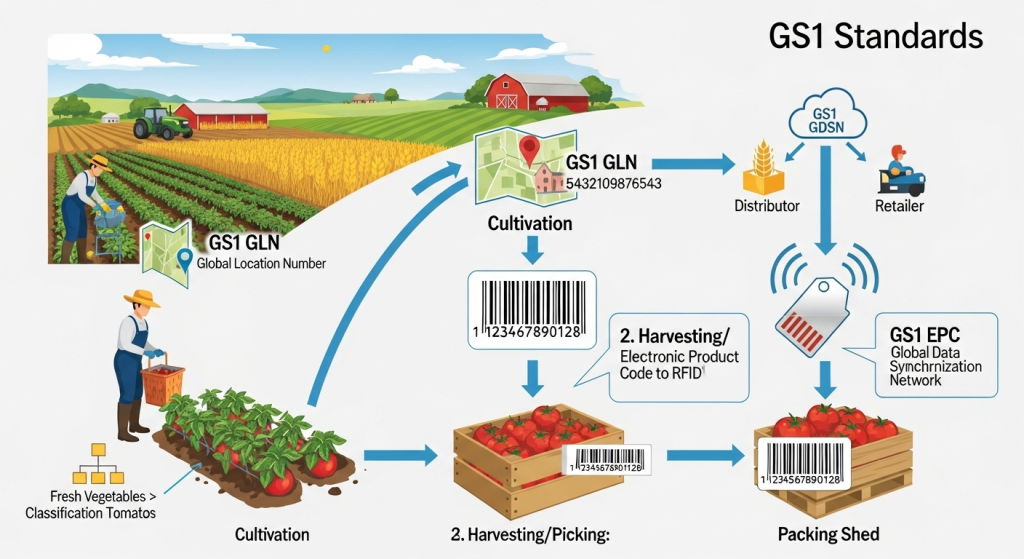
GS1 standards are voluntary, and the FDA prescribes no format. They are nonetheless the practical default, because your trading partners already speak them and because a GS1-based TLC scans, transmits and reconciles without translation. The building blocks:
- A Global Trade Item Number identifying the product. GS1 US recommends the TLC carry both the GTIN and the batch or lot number, submitted at pack level in the ASN.
- A firm-assigned batch or lot number. This does not have to be globally unique. It has to be unique within your own records.
- A Global Location Number identifying the TLC source, used as the source reference.
- A GS1-128 barcode on cases and pallets, encoding AI (01) for the GTIN, AI (10) for the batch or lot, and AI (11) for the production date. Commport covers the encoding rules in its guide to GS1 Application Identifiers.
- An SSCC on each logistics unit, so a pallet scan returns the full contents. The GS1 SSCC standard pairs the code with the ASN, and Commport explains the labelling side in its guide to shipping labels.
If your receiving systems cannot automatically parse a GS1-128 code, that is the gap to close first. A code nobody can read costs you the same manual handling the rule was meant to remove. For a broader primer, see Commport on GS1 standards and on GS1 Digital Link, which is where product identification is heading after 2027.
Your TLC design decides how hard the next four years are
Commport helps food suppliers structure GS1-based Traceability Lot Codes and carry them through every EDI message and GDSN publication.
Talk to a GDSN and EDI SpecialistHow Does the Rule Work in a Real Supply Chain? FDA Worked Examples
The FDA has published a series of supply chain examples showing the rule applied to specific commodities. They are the closest thing to a compliance test case, and they resolve most of the questions that come up in scoping workshops. The examples below summarise the published set. Read the full documents on the FDA Food Traceability Final Rule page before you finalize a design, since each carries conditions that a summary compresses.
Example 1: Wild-Caught Tuna: Where the Chain Begins at the Dock
Tuna sits on the FTL as a histamine-producing finfish species, in fresh, frozen and previously frozen form. Its raw-consumption use is irrelevant to coverage, a point the previous version of this article got wrong. The fishing vessel itself is not subject to the rule. The chain starts at the first land-based receiver.
|
Stage |
CTE |
What has to happen |
|
Fishing vessel |
None |
Not covered. The first land-based receiver captures vessel name and contact as a KDE on its behalf. |
|
First land-based receiver |
First Land-Based Receiving |
Assigns the TLC. Records TLC source, species, harvest date range and locations, quantity, date of receipt, and vessel or harvester details. |
|
Seafood processor |
Receiving |
Records the TLC received, TLC source, product description, quantity, date of receipt and the immediate previous source. |
|
Seafood processor |
Transformation |
Cutting tuna into fillets is a transformation. Assigns a new TLC and records input and output product descriptions and quantities, date, and location. |
|
Seafood processor |
Shipping |
Transmits the new TLC, TLC source, product description, quantity, ship date, and the immediate subsequent recipient. |
|
Distribution centre |
Receiving and Shipping |
Records both sides and passes the TLC forward unchanged. |
|
Retail food establishment |
Receiving |
Records receiving KDEs against the processor TLC. Does not assign a new one. |
How Commport Automates the Seafood Chain
- The EDI 856 ASN carries the TLC, TLC source, species, quantity, and every other Shipping CTE KDE from processor to distributor to retailer in one structured message.
- The Commport GDSN datapool holds the GTIN-linked product identity that the TLC points at: species, acceptable market name, net content, unit of measure, country of origin.
- Records land in a searchable archive, so a phone request from an investigator does not turn into a two-day scramble across three systems.
Example 2: Fresh Cucumbers: the Farm-Packer Question
Cucumbers are listed as fresh, all varieties. The TLC is assigned at initial packing rather than at the farm, unless the farm is also the initial packer. That combined operation is the common case in produce, and it changes who owns the assignment.
|
Stage |
CTE |
What has to happen |
|
Farm |
Harvesting |
Records growing area location including field name, commodity and variety, quantity, harvest date, and harvester contact details. |
|
Cooling operation |
Cooling |
Records cooling location, commodity and variety, quantity, date of cooling, and the growing area location. |
|
Initial packer |
Initial Packing |
Assigns the TLC. Records TLC source, commodity and variety, product description, quantity, date of packing, and references to the harvest and cooling records. |
|
Distribution centre |
Receiving and Shipping |
Records both sides against the packer TLC. |
|
Retail |
Receiving |
Records receiving KDEs against the packer TLC. |
Farm-packer combined operations
When one operation grows, harvests, cools, initially packs and ships the same fresh cucumbers, that operation assigns the TLC and becomes the TLC source. It carries Harvesting, Cooling and Initial Packing obligations together, including the farm map requirement in the traceability plan. Every downstream receiver links its KDEs to that farm-assigned TLC.
Example 3: Soft Cheese: Transformation Creates the Obligation
Raw milk is not on the FTL, so the dairy farm carries no obligation. The moment milk becomes soft cheese, a listed food exists and the manufacturer becomes the TLC source through the Transformation CTE. The manufacturer records input and output descriptions and quantities, the date, the location, and the new TLC, then carries that TLC into every outbound ASN.
Deli salads: two scenarios that behave differently
- Deli salad made with fresh-cut celery and onions. Both inputs are listed as fresh-cut vegetables other than leafy greens. The processor records Receiving KDEs for each input, Transformation KDEs including the input TLCs and a new output TLC, and Shipping KDEs when the salad moves.
- Tuna salad made with canned tuna. Canning removes tuna from the list, so the salad maker records no Receiving KDEs for it. The finished refrigerated deli salad is still listed, so Transformation and Shipping KDEs still apply. The seafood processor that canned the tuna records Receiving KDEs for the fresh fish but needs no Shipping KDEs for the canned output.
The pattern generalises. Obligations attach to the form of the food at each step, not to the identity of the business. A non-listed input can produce a listed output, and a listed input can produce a non-listed output. Map your bill of materials against the list before you map your transactions.
Other Scenarios the FDA Has Addressed
|
Scenario |
How the rule applies |
|
Aquacultured tilapia cut into fillets |
A RAC that was never previously packed. The processor records Initial Packing KDEs rather than Transformation KDEs, assigns the TLC, and is the TLC source. |
|
Canned tomatoes |
The processor records Receiving KDEs for the fresh tomatoes. Canning removes the product from the list, so no Shipping KDEs are needed and downstream receivers are outside scope. Written agreements under 1.1305(d)(6) can relieve the upstream KDEs, but the traceability plan still applies. |
|
Fresh tomatoes into sandwich wraps versus meal kits |
Sandwich wraps containing sliced fresh tomatoes are covered, so the processor records Receiving, Transformation and Shipping KDEs. Meal kits with whole fresh tomatoes shipped direct to consumers need Receiving KDEs only, since consumers are not covered entities. |
|
Imported mangoes |
An importer that never takes physical possession is outside scope. An importer that does take possession records Receiving and Shipping KDEs. |
|
Shell egg operations |
An in-line operation with no commingling is the TLC source and records Initial Packing and Shipping KDEs. An in-line farm with an on-site USDA plant processing all eggs is exempt under 1.1305(d)(2). An off-line processor sending some eggs to table market must comply for those. Commingling exemptions under 1.1305(h)(2) relieve KDEs but not the traceability plan. |
|
Peanut butter crackers |
Peanuts and salt are not listed. The peanut butter processor creates a listed food, so it records Transformation and Shipping KDEs and assigns a TLC. The cracker manufacturer records Receiving KDEs for the nut butter plus Transformation and Shipping KDEs for the crackers, which are covered because they contain nut butter in the listed form. |
|
Fresh-cut apples |
Whole apples are not listed. Cutting them creates fresh-cut fruit, which is. Transformation is triggered under 1.1350(a)(2), a new TLC is assigned, and everyone downstream records Receiving and Shipping KDEs. |
|
Melons aggregated at a food hub |
The food hub is the initial packer and TLC source. It assigns the TLC, records Initial Packing KDEs, and captures growing area descriptions for every farm contributing to the lot. |
|
Dual jurisdiction facility |
A shared receiving room is not exempt, so Receiving KDEs apply to all soft cheese received. The FDA-regulated production line records Transformation and Shipping KDEs. The area under exclusive USDA jurisdiction is exempt under 1.1305(g). |
Automate KDE capture across every CTE
The use of EDI and GDSN records the right data at the right step. Find out how today!
How does EDI automate FSMA Food Traceability Compliance?
EDI and FSMA 204
EDI moves Key Data Elements between trading partners as structured, machine-readable messages instead of email attachments and PDFs. The FDA accepts an electronic message as a valid KDE linking method. The EDI 856 Advance Ship Notice is the primary vehicle, carrying the Traceability Lot Code, product description, quantity, ship date and both trading partner locations in one transaction.
The reason EDI matters here is arithmetic. A mid-sized distributor might receive listed foods from two hundred suppliers and ship to four hundred customers. Every Shipping and Receiving CTE needs six or seven fields captured accurately and linked to a lot code. Doing that by hand across six hundred relationships is where compliance programmes fail, and it is why EDI compliance problems and traceability problems tend to show up in the same operations.
Commport offers three delivery models, and all three support FSMA KDE fields. Commport Integrated EDI connects directly to your ERP for enterprise volumes. Commport Cloud EDI gives smaller suppliers a browser-based route with built-in label generation. Commport EDI Outsourcing hands day-to-day management to Commport, which suits teams without EDI staff. Suppliers still working from paper documents can convert them with Commport Doc2EDI.
What EDI Contributes to a Traceability Programme
- Captures CTE data at the moment the event happens, rather than reconstructing it later from paperwork.
- Carries the TLC and TLC source inside standard transaction sets, at the pack level GS1 US recommends.
- Produces auditable records with timestamps and acknowledgements, which is what the FDA means by a linked record. EDI 997 reporting flags files a partner never acknowledged, before a gap becomes a compliance finding.
- Makes the 24-hour response achievable, because records are already indexed by TLC rather than sitting in an inbox.
- Feeds ERP, WMS and inventory systems through ERP integrations, so traceability data lands where operations staff already work. Warehouse management and inventory management both consume the same lot-level data.
- Moves between partners over the Commport Value Added Network. If VANs are new to you, start with what an EDI VAN is or the fuller Value Added Network guide.
- Supports ANSI X12 and UN/EDIFACT, which matters for cross-border food chains. See the EDI standards resources.
- Onboards your partner community through community enablement and EDI translation and mapping services, which is usually the long pole in a 2028 timeline.
For sector context, Commport covers how EDI is used in the food and beverage industry and the wider role of EDI in supply chain management. Records held under this rule are business-critical for two years, so infrastructure matters too: Commport is SOC 2 Type II certified.
What Role Does GDSN Play in Food Traceability Compliance?
GDSN and FSMA 204
The Global Data Synchronization Network keeps product data consistent between trading partners. Several KDEs are product attributes rather than event data: commodity description, variety, country of origin, net content, unit of measure and pack configuration. GDSN makes sure every partner references the same values against the same GTIN, so a TLC resolves to one product identity rather than four conflicting ones.
This is the part teams underestimate. EDI moves the event. GDSN defines what the event is about. If your GTIN describes a 5 kg case in one partner system and a 4.54 kg case in another, your quantity KDE is wrong in one of them, and you will not find out until an investigator asks. Commport GDSN is GS1-certified and lets suppliers publish and maintain GTIN-linked product data to every retail and foodservice partner through one connection.
Alongside GDSN, Commport PIM manages product data internally, and Commport Product Syndication distributes it to channels that sit outside the GDSN network. The distinction between the two is covered in GDSN versus PIM, and the case for running both appears in ten reasons GDSN and PIM matter for digital commerce.
What GDSN Contributes to a Traceability Programme
- Establishes one authoritative GTIN per listed item, which is the anchor for every TLC.
- Synchronises product attributes across partner systems through the GS1 GDSN network, so KDEs agree on both sides of a transaction.
- Holds commodity description, country of origin, allergen data and net content, several of which are KDEs at more than one CTE. GS1 US maps FSMA product description KDEs directly to GDSN and Global Data Model fields.
- Cuts the data mismatches that drive deductions, returns and chargebacks. Commport covers the commercial side in benefits of GDSN and GDSN for brand manufacturers.
- Narrows recall scope. Lot-level identification against a synchronised GTIN lets you pull the affected lots rather than the whole SKU.
- Supports the three GS1 keys the rule leans on: GTINs for products, GLNs for locations, SSCCs for logistics units. Commport unpacks the wider set in decoding product identifiers.
For adoption context in this sector, see how GDSN is used in the food and beverage industry, and for where the wider stack is heading, supply chain technology trends.
Which EDI Transactions Carry Food Traceability Rule Data?
One clarification before the table. GS1 US has published detailed recommendations for the EDI 856 ASN against the Shipping CTE. The other transactions below carry traceability-relevant data and support the surrounding workflow, but they are not a substitute for the ASN. Treat the 856 as the compliance vehicle and the rest as supporting infrastructure. The EDI ANSI X12 transaction list and the UN/EDIFACT transaction list cover the full sets.
|
Transaction |
Role |
Traceability data carried |
|
Primary vehicle for the Shipping CTE |
TLC as GTIN plus batch or lot at pack level, product description, quantity and unit of measure, ship date, ship-from and ship-to identification, SSCC. This is the transaction GS1 US mapped field by field. |
|
|
EDI 850 Purchase Order |
Supporting |
GTIN-based product specification, quantity, requested delivery date. Establishes the product identity the traceability chain will reference. |
|
EDI 855 PO Acknowledgment |
Supporting |
Confirms product details and delivery commitments, setting the expected record against which receipt is reconciled. |
|
EDI 810 Invoice |
Supporting |
GTINs, quantities, lot references and partner locations. Provides a financial audit trail alongside the traceability record. |
|
EDI 214 Carrier Shipment Status |
Supporting |
Carrier and shipment tracking, location updates, delivery confirmation. Links the TLC to physical movement. |
|
EDI 940 Warehouse Shipping Order |
Supporting |
Warehouse-level shipping instructions including lot detail for fulfilment. |
|
EDI 944 Warehouse Stock Transfer Receipt |
Supporting |
Receipt confirmation at warehouse level, tied to lot and quantity. |
|
EDI 753 Request for Routing Instructions |
Supporting |
Connects logistics routing to specific lots, supporting chain-of-custody documentation. |
|
EDI 830 Planning Schedule |
Supporting |
Forecast production volumes for listed commodities, useful for capacity planning against lot volumes. |
|
Assurance layer |
Confirms a partner received and accepted the transaction. Without it you cannot prove a KDE handoff actually happened. |
If you are choosing which transactions to implement first, Commport ranks the practical order in top EDI document types to integrate and automate. For teams new to the terminology, the glossary of terms is a faster route than the standards documents.
Ready to Connect your trading partners?
Commport's managed EDI and GDSN data pool gets you live with retailers, distributors, and the FDA-ready format.
Which GDSN Product Attributes Support FSMA Traceability?
|
Attribute |
Why the rule needs it |
|
The product identifier the TLC is built on. GS1 US recommends the TLC carry the GTIN plus batch or lot number. |
|
|
Identifies farms, packing houses and facilities. Serves as the TLC source reference and satisfies location description KDEs. |
|
|
Commodity and variety |
Required as a KDE at Harvesting, Cooling and Initial Packing. Variety is required where it applies. |
|
Product description |
Required at Initial Packing, Shipping, Receiving and Transformation. GS1 US maps this KDE set to GDSN and Global Data Model fields. |
|
Country or region of origin |
Supports geographic traceability back to source and appears in location description KDEs. |
|
Net content and net weight |
Underpins the quantity and unit of measure KDEs at every event involving shipment or receipt. |
|
Unit of measure and pack configuration |
Determines how quantity is expressed and reconciled between partners. Mismatches here corrupt the quantity KDE silently. |
|
Product form: fresh, fresh-cut, frozen, previously frozen |
Decides FTL coverage outright. Fresh and fresh-cut forms are listed for most produce, while some frozen and shelf-stable forms are excluded. |
|
Allergen information |
Relevant to ready-to-eat and transformed foods and to the transformation record set. |
|
Brand and trade name |
Supports identification in distribution and retail systems linked to lot records. |
|
Packaging type and hierarchy |
Supports case-level and pallet-level tracking through GS1-128 and SSCC labelling. |
|
FTL coverage flag |
A local attribute marking an item as FTL-regulated, so ordering and receiving workflows can screen automatically rather than relying on operator knowledge. |
One caution. AI crawlers and, more importantly, partner integration teams cannot read attributes that only exist inside a rendered dashboard. Publish them through GDSN and manage them through product data management so they exist as data, not as screen output.
Why Start Now Rather than in 2027?
Two years sounds generous until you count the dependencies. Mapping transactions is the short part. Onboarding a partner community, agreeing lot code formats with suppliers who have never assigned one, and reconciling product data that has drifted for a decade are the parts that take quarters rather than weeks. The businesses that will be comfortable in July 2028 are the ones treating 2026 as the design year.
|
What you gain |
What it looks like in practice |
|
Narrower recalls |
Lot-level TLC traceability lets you withdraw the affected lots instead of every case of the SKU. The difference between a targeted recall and a precautionary one is usually measured in six figures. |
|
A 24-hour response you can actually make |
Records indexed by TLC and already in an extractable format. The FDA publishes a sortable spreadsheet template; map your extract to it now and test it before anyone asks. |
|
Trading partner confidence |
Retailers and foodservice operators are working through their own 2028 readiness and will ask suppliers to demonstrate KDE capability. Being able to answer early is a commercial advantage as much as a compliance one. |
|
Lower manual handling |
The same automation that satisfies the rule removes re-keying from receiving and shipping. Commport documents the operational effects across its customer case studies. |
|
Cleaner product data everywhere |
GDSN synchronisation fixes the mismatches that cause deductions and returns. The compliance driver funds a data cleanup the business needed anyway. |
|
Real supply chain visibility |
Knowing which lot sits where, from growing area to shelf, is useful well beyond food safety. It shortens investigations, improves rotation, and sharpens forecasting. |
|
Infrastructure that survives the next rule |
Standards-based EDI and GDSN adapt as requirements change. FSMA 204 will not be the last traceability mandate, and 2D barcode transition is already underway. |
A Realistic Sequence for the Next 24 Months
- Run every SKU against the 23 FTL entries, checking product form rather than product name. Flag coverage as a data attribute.
- Map your CTEs. Identify which of the seven events your operation actually performs. Most businesses perform two or three, not all seven.
- Gap-check your KDEs. For each CTE, compare required fields against what your current documents already carry. The gap is usually smaller than expected and concentrated in TLC and location description.
- Fix product data first. Synchronize GTINs, net content, pack configuration and country of origin through GDSN before you wire transactions, so the transactions reference something stable.
- Design the TLC. Settle on GTIN plus batch or lot, decide your TLC source reference method, and confirm your labels encode it.
- Extend your EDI. Add TLC and remaining KDEs to the 856 ASN at pack level, then to receiving processing.
- Onboard partners. Start with the suppliers and customers representing most of your listed volume. This step takes the longest and cannot be compressed at the end.
- Write the traceability plan. Procedures, FTL product identification, lot code method, named contact, farm map if applicable.
- Run a mock traceback against the FDA spreadsheet template. Time it. Fix whatever took longer than a few hours.
Two years is a design timeline, not a waiting period
Commport has run B2B integration for food supply chains since 1985. Bring us your product list and your partner list, and we will show you the gap between where you are and what July 2028 requires.
Request an FSMA Compliance AssessmentConclusion
Food traceability systems powered by GS1 standards have transformed modern food supply chains. Throughout this blog, we explored how these standards create a common language that connects every stakeholder from farm to fork. GTINs, GLNs, and SSCCs work together as foundational elements that enable precise tracking of products, locations, and logistics units across the entire supply chain.
Business benefits extend far beyond regulatory compliance. Companies like IPC/Subway demonstrated substantial cost savings, approximately $1.3 million annually, while significantly reducing inventory processing time. Warehouse operators likewise experienced 21% shorter lead times when implementing these standards, proving their operational value.
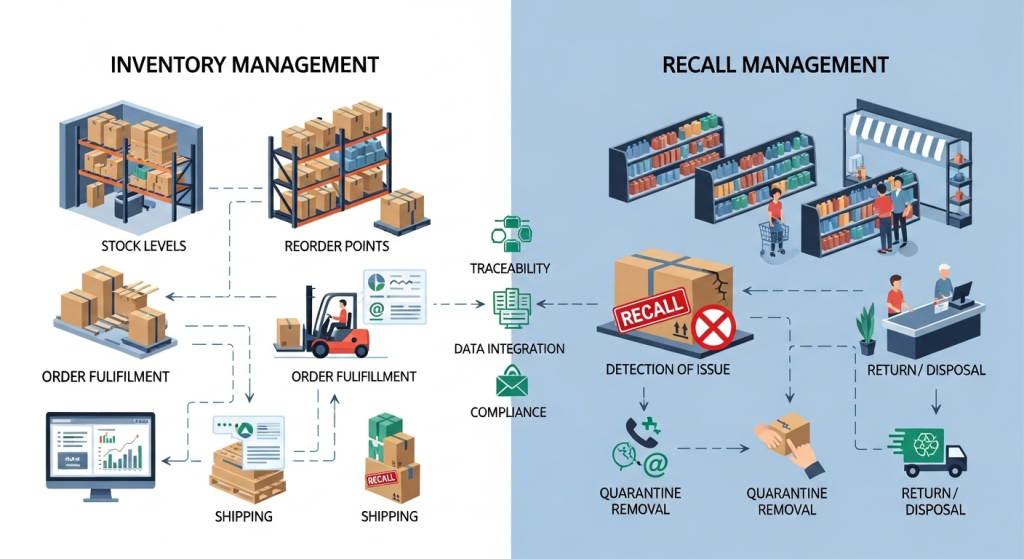
Recall management stands out as a critical advantage of standardized traceability systems. During food safety incidents, GS1 standards help companies quickly identify affected products, determine their location, and remove them from circulation. This rapid response capability protects both consumers and brand reputation during crises.
Advanced technologies like 2D barcodes and digital product passports further enhance traceability efforts. These tools provide consumers with unprecedented access to product information, supporting allergen awareness and enabling verification of sustainability claims. Consequently, brands that embrace transparency build stronger relationships with increasingly informed consumers.
FSMA Rule 204 compliance will soon become mandatory, making now the perfect time for food businesses to implement robust traceability systems. GS1 EDI standards and GDSN provide the framework needed to meet these requirements while simultaneously improving operational efficiency.
Undoubtedly, food traceability represents more than just a regulatory obligation, it has become a business imperative. Companies that embrace these technologies create safer food systems, build consumer trust, and position themselves competitively in an industry where transparency increasingly drives purchasing decisions.
Commport EDI and GDSN Solutions
Download: GDSN Buyers Guide
Empower your business with global data synchronization; download our GDSN Buyer's Guide today and take the first step towards streamlined, accurate, and compliant product data management.
Frequently Asked Questions
The FSMA Food Traceability Rule, codified at 21 CFR Part 1 Subpart S, requires businesses that manufacture, process, pack or hold foods on the FDA Food Traceability List to record Key Data Elements at each Critical Tracking Event they perform, link them to a Traceability Lot Code, and make the records available to the FDA within 24 hours of a request. Compliance is due July 20, 2028.
July 20, 2028. The original date was January 20, 2026. The FDA proposed a 30-month extension in August 2025, and in November 2025 the Continuing Appropriations Act of 2026 directed the FDA not to enforce the rule before July 20, 2028. The FDA has said it intends to comply. Congress has since barred the agency from spending funds to delay enforcement past that date.
Any domestic or foreign business that manufactures, processes, packs or holds a food on the Food Traceability List for United States consumption. That covers farms, packers, processors, distributors, wholesalers, importers who take physical possession, retail food establishments and restaurants. Full and partial exemptions apply to small producers, small retailers and restaurants, direct-to-consumer farms, and foods that undergo certain processing.
Harvesting, Cooling before initial packing, Initial Packing, First Land-Based Receiving for food from a fishing vessel, Shipping, Receiving and Transformation. Guidance that lists eight CTEs including Growing and Creating reflects the 2020 proposed rule. The final rule renamed Growing to Harvesting and merged Creating into Transformation.
A Traceability Lot Code is a descriptor, usually alphanumeric, that uniquely identifies a traceability lot within the assigning firm records. You assign one at Initial Packing, at First Land-Based Receiving, at Transformation, or when you receive a listed food from an exempt entity that assigned none. Outside those four situations the code cannot change. GS1 US recommends building it from a GTIN plus batch or lot number.
All required records must be available within 24 hours of an FDA request, or within a longer period the FDA agrees to. A separate requirement applies during an outbreak, recall or other public health threat: the information must be supplied as an electronic sortable spreadsheet within the same window. Certain smaller entities are exempt from the spreadsheet format but must still supply the information. A request made by phone starts the clock.
EDI moves Key Data Elements between partners as structured electronic messages, which the FDA accepts as a valid method of linking KDEs. The EDI 856 Advance Ship Notice is the primary vehicle for the Shipping CTE, carrying the Traceability Lot Code, product description, quantity, ship date and both partner locations. GS1 US has published field-level recommendations for mapping FSMA 204 KDEs into X12 transactions.
EDI carries the event. GDSN defines the product the event refers to. Commodity description, variety, country of origin, net content and pack configuration are Key Data Elements, and they must match across every partner system for the record to hold up. A GS1-certified GDSN datapool publishes those attributes once against a single GTIN, so a Traceability Lot Code resolves to one product identity rather than several conflicting versions.
The list holds 23 entries: three cheese categories other than hard cheese, shell eggs, nut butters, fresh cucumbers, herbs, leafy greens, melons, peppers, sprouts, tomatoes and tropical tree fruits, fresh-cut leafy greens, fresh-cut fruits, fresh-cut vegetables other than leafy greens, three finfish categories, smoked finfish, crustaceans, bivalve molluscan shellfish, and refrigerated ready-to-eat deli salads. Foods containing a listed food as an ingredient are covered if that ingredient stays in the listed form.
Two years from the date each record was created. Records may be original paper, electronic, or true copies such as scans or photographs. They do not have to be stored on site, and another firm may maintain them on your behalf, but you remain responsible for producing them within 24 hours of an FDA request.
Yes. The Canadian Food Inspection Agency has notified Canadian companies in supply chains for food exported to the United States that the rule applies to them and that the compliance date is July 20, 2028. Canadian suppliers carry the same KDE obligations as domestic ones, and American customers will typically request evidence of readiness well before the deadline.