


Introduction to EDI AI Agents
Quick Answer
AI agents improve EDI document validation by autonomously checking syntax, structure, and trading partner rules in real time, before a transaction is transmitted. Instead of waiting for a downstream rejection or chargeback, the agent flags missing segments, anomalous values, and compliance gaps at the point of creation, cutting partner onboarding time from 6-12 weeks to under 1-2 days and reducing labor costs by 30-60% (Commport client implementation data, 2026).
Traditional EDI systems struggle with manual data mapping, rigid formats, and error-prone processing that create bottlenecks and slow partner onboarding.
AI agents for business transform these operations by autonomously validating documents, standardizing data, and detecting errors in real time.
Through AI agents integration with existing EDI infrastructure, companies eliminate manual constraints that previously limited scalability.
In this blog, we’ll explore what autonomous AI agents are, how they improve EDI document validation, and the best AI agents for optimizing data quality management.
Key Takeaways
- AI agents reduce EDI onboarding time from 6-12 weeks to under 1 or 2 days through automated data mapping and intelligent format validation across X12 and EDIFACT standards.
- Real-time validation prevents costly errors before transmission, with AI detecting anomalies, missing segments, and compliance issues that traditionally caused rejected transactions and chargebacks.
- Businesses achieve 30-60% labor cost reductions and up to 75% fewer financial errors by implementing AI-powered EDI systems that automate validation, cleansing, and standardization processes.
- Machine learning enables predictive error detection and dynamic schema adaptation, allowing systems to learn from historical patterns and automatically adjust to trading partner requirements without manual intervention.
- AI agents provide continuous data quality monitoring across systems, ensuring consistent, clean data flows while automatically handling duplicate detection, missing field enrichment, and cross-system validation.
Traditional EDI Document Validation Challenges
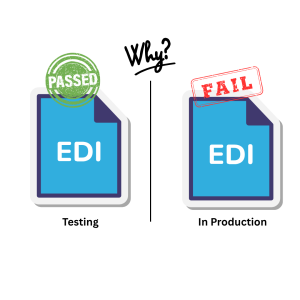
EDI validation operates in an automated, rule-driven environment where systems expect strict adherence to syntax rules and trading partner specifications.
A single incorrect data element can trigger rejected transactions, compliance penalties, and payment issues.
When receiving systems encounter supply chain delays or structurally imperfect transactions, problems cascade quickly: orders fail to load into ERP systems, invoices are rejected, shipments are delayed, and chargebacks are triggered.
1. Manual Data Mapping and Format Inconsistencies
Data mapping remains one of the most persistent friction points in EDI operations.
Businesses exchange information across various file types, including XML, CSV, JSON, EDIFACT, and ANSI formats.
When one system cannot understand another’s format, communication breaks down entirely.
Manual data entry introduces typos, transposed numbers, and formatting inconsistencies that disrupt business processes.
These errors accumulate rapidly when processing large volumes of documents, creating a compounding effect that damages operational efficiency.
Trading partners frequently deviate from standard formats by agreeing on variations for their specific needs.
Each partner brings unique integration specifications tailored to specific business processes, including custom fields, validation rules, and communication protocols.
Maintaining current EDI maps presents a significant challenge owing to frequent updates.
Many retailers change requirements regularly, potentially resulting in hundreds of map changes annually. Internal system changes compound this issue further.
When businesses implement new ERP systems, they must modify file formats accordingly.
Older EDI formats such as EDIFACT were not designed to be human-readable, making error detection and correction particularly challenging.
Manual error detection consumes time, drives up expenses, and still results in errors slipping through.
2. Error-Prone Transaction Processing
Validation errors occur at multiple levels within EDI transactions.
Missing required segments, invalid code values, incorrect data type usage, improper segment sequencing, and incorrect date formats rank among the most frequent issues.
Although these errors may appear minor, they cause entire files to be rejected across the EDI network.
Business rule validation evaluates whether data makes logical sense within broader processes.
A transaction may be technically correct but operationally wrong. These checks prevent financial discrepancies, fulfillment mistakes, and reconciliation issues.
Without automated validation against business rules, missing fields, formatting issues, and incorrect values reach partners and cause downstream problems.
Data quality issues disrupt the mapping process when source data contains errors or missing fields.
Software compatibility creates additional complications since not all systems handle EDI transactions smoothly, leading to integration issues.
3. Slow Partner Onboarding and Compliance Issues
Traditional EDI onboarding takes 6 to 12 weeks per partner owing to manual processes and repeated testing cycles.
If a new trading partner represents $50,000 in monthly order volume and onboarding takes 10 weeks instead of a few days, that equals $100,000+ in delayed revenue per partner.
Multiply that across multiple new retailers, seasonal onboarding spikes, or expansion into new markets, and the impact compounds quickly.
Delays typically stem from manual mapping, repeated testing cycles, lack of standardization, and limited visibility into errors.
Each onboarding becomes a custom project instead of a repeatable process.
When key details like connection requirements, document specs, or testing milestones live in separate files and inboxes, tracking progress becomes increasingly difficult.
Teams duplicate work, re-enter the same data, and manage updates across disconnected systems.
Compliance failures trigger immediate financial consequences.
Retailers and large trading partners issue chargebacks for incorrect document formatting, missing or inaccurate data, late ASN submissions, duplicate transactions, and invalid product information.
Beyond direct fees, chargebacks consume valuable staff time for research, disputes, and remediation.
What Are AI Agents and How They Work in EDI Systems
AI agents represent autonomous software components that make decisions at specific steps within workflows without requiring human intervention.
Unlike traditional rule-based automation that follows predetermined paths, AI agents evaluate context, reason across millions of records, and choose between possible actions based on real-time data.
These agents use multiple tools, including vector search, document intelligence, data analytics, web crawling, and API calls to gather information and make informed decisions.
Autonomous AI Agents in EDI Workflows
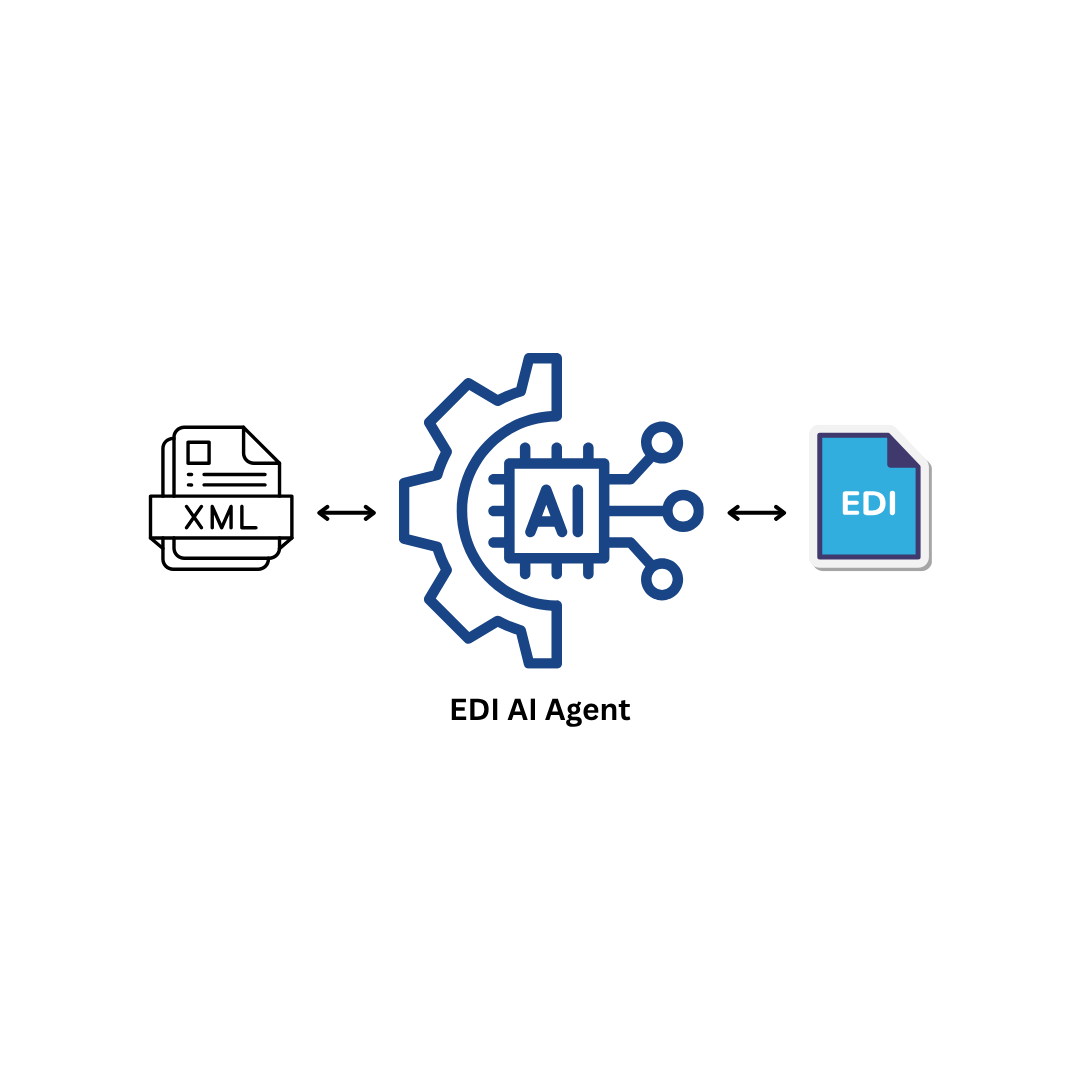
Agentic EDI integrates autonomous AI agents into EDI systems, enabling them to interpret, act on, and optimize data in real time rather than simply exchanging structured information.
These systems make decisions based on contextual data, adapt workflows dynamically, collaborate with other agents or humans, and learn from outcomes to improve over time.
This shift mirrors the broader trend of agentic AI, where systems operate with a degree of autonomy capable of initiating actions and collaborating across complex enterprise environments.
When AI agents reach a decision step in an EDI workflow, they receive current workflow context, including data processed so far, the state of connected systems, and defined decision parameters.
The agent then calls whatever tools it needs to gather additional context, runs reasoning logic across all available information, and returns a decision with a confidence score and justification log. In effect, decision quality directly correlates to the breadth of information accessible through these tools.
Enterprises deploying AI agents with multi-tool architectures achieve 3.5 times higher decision accuracy compared to single-tool implementations
AI agents autonomously validate supplier credentials against third-party databases, check compliance with regulatory and contractual standards, initiate onboarding workflows, and flag anomalies.
When risks are detected, systems autonomously reroute orders, notify stakeholders, or trigger contingency plans without human intervention.
For instance, agents detect anomalies in pricing, quantities, or payment terms by cross-referencing invoices with contracts, purchase orders, and delivery receipts, then flag or resolve discrepancies autonomously.
Machine Learning for Pattern Recognition
Machine learning algorithms identify trends in transactional data, allowing businesses to predict demand swings, spot supplier risks, and optimize inventory levels.
AI models trained on historical transaction documents recognize when supplier custom segments deviate from standard syntax, flagging and fixing issues before transactions reach trading partners.
The system learns from each correction, gradually reducing human intervention and shortening onboarding time for new partners.
AI agents integrate with demand planning tools and external data sources such as market trends to predict demand shifts, collaborate with suppliers to adjust production schedules, and automatically update procurement plans and inventory targets.
These models learn from outcomes, including delivery delays or payment disputes, constantly refining rules to reduce friction.
Real-Time Validation and Error Detection
Machine learning algorithms monitor transaction flows in real time, spotting anomalies such as missing segments, invalid identifiers, or inconsistent totals. Instead of reacting to failed transmissions, businesses now predict and prevent them.
AI agents validate documents against retailer-specific rules before transmission, catching issues like wrong carton counts, missing pallet information, and ship dates outside acceptable windows.
By the same token, real-time EDI exchange tracking provides instant insights into transaction status, flagging delays, missing data, or inconsistencies to improve reliability between partners.
How AI Agents Improve EDI Document Validation
AI agents strengthen data accuracy by identifying inconsistencies across transaction histories and checking each document against known requirements.
This creates a more reliable foundation for exchanging critical EDI documents, particularly when dealing with strict standards.
1. Automated Format Validation Across X12 and EDIFACT Standards
The EDI validation system operates as a critical gatekeeper within enterprise integration frameworks, ensuring all transactional data adheres to ANSI X12 and EDIFACT standards.
By leveraging agentic reasoning, it analyzes transaction sets for syntax errors, business logic inconsistencies, and regulatory compliance issues before transmission.
The system reduces manual intervention by identifying discrepancies in segments, loops, and control totals automatically.
AI validation tools check data formats before transmission, and adaptive algorithms learn these requirements for future use, reducing rejections and costly EDI chargebacks.
AI also improves validation by recognizing missing required elements or invalid values. Instead of waiting for file rejection, teams correct issues instantly, reducing rework, streamlining supply chain management, and improving overall compliance.
2. Intelligent Data Mapping Between Trading Partners
AI takes the most time-consuming parts of EDI and turns them into guided, automated workflows.
Instead of manually building maps one field at a time, machine learning models pick up patterns and learn from past transactions, enabling them to suggest accurate mappings automatically.
Machine learning recognizes patterns in data structures to speed partner onboarding, minimize errors, and reduce manual mapping work.
AI can automate the mapping of data fields between different EDI formats and systems, making it easier to integrate with diverse business applications.
For instance, an AI model trained on historical 850 (Purchase Order) and 810 (Invoice) documents can recognize when a supplier’s custom segment deviates from standard X12 syntax, flagging and fixing it before the transaction ever reaches a trading partner.
3. Real-Time Compliance Checking and Regulatory Adherence
Adaptive validation tools ensure compliance with EDI standards, reduce rejections, and learn partner rules for future use.
AI validates document formats automatically, ensuring regulatory adherence.
AI enforces data consistency by auto-validating formats and correcting discrepancies, ensuring high-quality data for every EDI transaction.
4. Predictive Error Detection Before Transmission
AI gives companies the ability to spot potential issues long before they disrupt a transaction.
By analyzing historical data and watching for anomalies, AI-driven systems recognize when something doesn’t look right, such as missing fields or patterns that typically lead to failed documents.
AI proactively scans transaction histories to identify anomalies, preventing costly disruptions before they occur.
AI also strengthens error resolution. Instead of manually tracing the source of a failure, the system recommends likely fixes based on past corrections and known partner requirements.
5. Dynamic Schema Validation and Adaptation
AI-native EDI reduces workload by automating many adjustments that once required manual intervention.
Machine learning models can recognize emerging patterns or structural changes and update mappings or validation rules accordingly.
The reasoning engine for EDI validation is built as a layered decision pipeline that combines context retrieval, policy-aware planning, and output validation before execution.
AI Agents for EDI Data Quality Management
AI agents produce unreliable outputs when fed poor data, and research shows organizations will abandon 60% of AI projects unsupported by quality data through 2026.
The input layer determines whether autonomous ai agents deliver value or create additional problems.
Data quality management addresses this challenge by ensuring EDI systems receive clean, consistent, and complete information.
1. Continuous Data Quality Monitoring Across Systems
AI agents analyze datasets and pipelines continuously, detecting anomalies across freshness, volume, schema, and distribution patterns without relying on static rules.
As data patterns evolve, monitoring adapts accordingly. Data monitoring agents track changes in real time, identifying unexpected spikes, drops, or missing values across datasets.
AI-powered data observability acts as a round-the-clock monitor, flagging issues instantly and delivering accurate updates to dashboards.
Beyond validating individual documents, AI agents provide ongoing data quality monitoring that spans every connected system in the trading partner network.
- Duplicate detection: Agents identify repeated transactions, line items, or partner records before they create double-billing or inventory discrepancies.
- Missing field enrichment: Agents flag or auto-populate required fields using historical patterns and trading partner profiles, reducing manual lookup work.
- Cross-system validation: Agents reconcile data across EDI, ERP, and warehouse systems in real time, catching mismatches before they cascade into shipment or invoicing errors.
- Predictive error detection: Machine learning models trained on historical transaction patterns flag documents likely to fail validation, even when they pass static rule checks.
Businesses running EDI outsourcing services alongside AI-powered validation see compounding benefits: outsourced teams handle exception management while the AI layer prevents most exceptions from occurring in the first place.
2. Automated Data Cleansing and Standardization
AI algorithms automatically cleanse, standardize, and validate data, ensuring consistent information across all platforms.
Machine learning models handle common issues identically: duplicate records, missing values, and inconsistent formats get corrected behind the scenes.
AI enforces data consistency by auto-validating formats and correcting discrepancies, maintaining quality for every EDI transaction.
3. Duplicate Detection and Record Reconciliation
AI-powered deduplication uses fuzzy matching and machine learning to achieve a 98% detection rate while consolidating records 80% faster.
These systems apply normalization before merging, preserve originals for rollbacks, and route low-confidence matches to reviewers with full source lineage.
4. Missing Field Identification and Enrichment
AI agents fill gaps in data by enriching records with verified external sources, delivering 1,500+ enrichment fields including firmographic, technographic, and intent signals. Instead of leaving blanks, AI intelligently estimates missing values based on patterns and context from existing datasets.
5. Cross-System Data Consistency Validation
AI-driven validation platforms detect schema changes, data drift, and format inconsistencies, triggering alerts when quality thresholds are breached.
Cross-validation against external databases and APIs ensures data meets quality, compliance, and operational standards across all connected systems.
Manual EDI vs. Rule-Based Automation vs. AI Agent-Driven EDI
The table below compares the three approaches businesses currently use to manage EDI document validation and data quality, side by side.
Capability | Manual EDI Processing | Rule-Based EDI Automation | AI Agent-Driven EDI |
Partner onboarding time | 6-12 weeks | 2-4 weeks | Under 1-2 days |
Error detection point | After transmission (rejections, chargebacks) | At transmission (static rule checks) | Before transmission (predictive, contextual) |
Format/schema changes | Manual remapping by EDI analyst | Manual rule updates required | Learns and adapts from historical patterns |
Anomaly detection | Not systematic; relies on downstream failures | Limited to predefined thresholds | Continuous monitoring across freshness, volume, and schema drift |
Labor cost impact | Baseline | Moderate reduction | 30-60% reduction (Commport client implementation data, 2026) |
Financial error rate | Baseline | Reduced but rule-bound | Up to 75% fewer errors (Commport client implementation data, 2026) |
Conclusion
AI agents have fundamentally transformed EDI operations from error-prone, manual processes into intelligent, self-correcting systems.
As a result, businesses now validate documents automatically, detect errors before transmission, and onboard partners in days rather than months.
The financial impact proves significant, with companies achieving 30-60% reductions in labor costs and up to 75% fewer financial errors.
AI-native EDI represents more than incremental improvement; it delivers the operational agility modern supply chains demand.
Commport EDI Solutions - #1 EDI Provider in North America
Need Help? Download: Commport's EDI Buyers Guide
Unlock the full potential of your supply chain with our comprehensive EDI Buyer's Guide — your first step towards seamless, efficient, and error-free transactions
Frequently Asked Questions
Yes. AI agents validate EDI documents at the point of creation, checking syntax, segment structure, and trading partner rules before transmission. This catches anomalies, missing segments, and compliance issues that traditionally surfaced only after a partner rejected the transaction.
AI-powered onboarding can reduce setup time from the traditional 6-12 weeks down to under 1-2 days, by automating data mapping and format validation across X12 and EDIFACT standards instead of requiring manual map-by-map configuration.
Rule-based automation checks documents against a fixed set of predefined rules and breaks when formats change. AI agent-driven EDI learns from historical transaction patterns, adapts to schema changes automatically, and can predict likely errors before they occur, rather than only catching errors that match a known rule.
No. AI agents handle the repetitive, pattern-based work of validation, mapping, and anomaly detection, freeing EDI analysts to focus on exception handling, new partner negotiations, and strategic integration decisions rather than manual map maintenance.
AI agents continuously monitor for duplicate transactions, missing or incomplete fields, schema drift, and cross-system mismatches between EDI, ERP, and warehouse data, flagging or correcting issues without waiting for a scheduled audit.
AI agents use dynamic schema adaptation, learning from each trading partner’s historical transaction patterns so the system can adjust to format variations automatically, rather than requiring an EDI analyst to manually rebuild the map.
AI validation agents are typically built to work across ANSI X12 and UN/EDIFACT standards, as well as common interchange formats like XML, CSV, and JSON, allowing one validation layer to cover a mixed trading partner network.
Based on Commport client implementation data across food, retail, and automotive trading networks in 2026, businesses see 30-60% labor cost reductions and up to 75% fewer financial errors after deploying AI-powered EDI validation and standardization.