



Introduction to Value Added Network
You might assume that a value added network is outdated technology, replaced by modern cloud solutions and APIs.
In fact, the vast majority of EDI still occurs via value added networks, and for good reason.
Despite the emergence of alternatives such as Cloud EDI and AS2,
VANs have evolved far beyond simple message routing.
Modern value-added network services now encompass features including message encryption, secure data validation, and comprehensive compliance reporting.
Whether you’re evaluating what a value-added network is for the first time or reconsidering your existing EDI network strategy, understanding why VANs remain essential in 2026 is crucial for your business operations.
In this blog, we’ll explore what makes value-added network solutions indispensable, compare different types of value-added network options, and help you determine the best implementation strategy for your organization.
Key Takeaways
- VANs deliver 99.99% uptime and handle millions of daily transactions, preventing costly revenue losses from system failures or communication breakdowns.
- Single VAN connection eliminates need for individual integrations with thousands of trading partners using different protocols and communication methods.
- Built-in compliance features and audit trails automatically meet strict EDI requirements across retail, healthcare, and manufacturing industries.
- Hybrid approach combining VAN reliability with modern APIs provides maximum flexibility while maintaining established partner relationships.
- Modern cloud-native VANs offer scalability and lower costs while preserving the security and protocol conversion capabilities businesses depend on.
What is a Value-Added Network (VAN) and Why It Still Matters
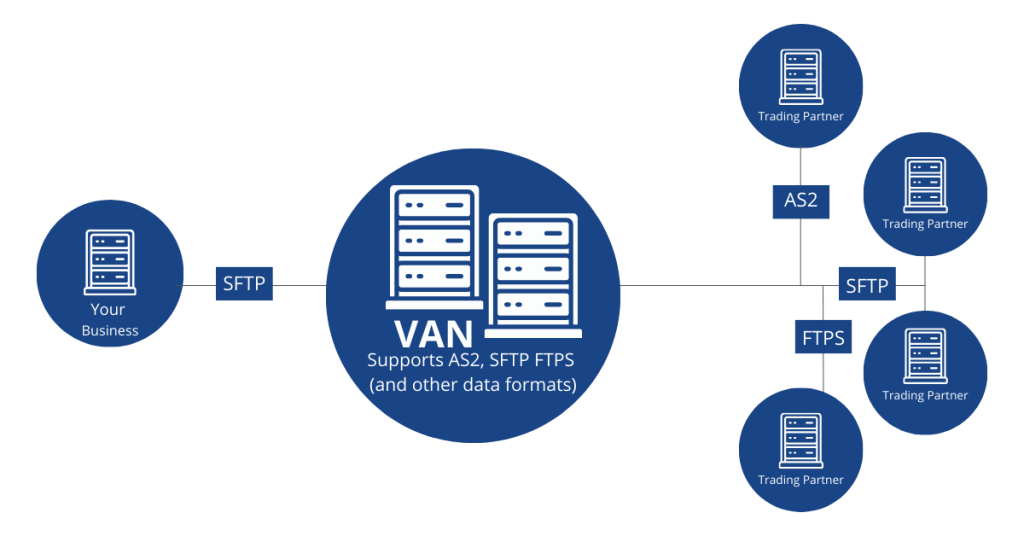
A value-added network in EDI functions as a private business network that enables secure exchange and delivery of electronic data between business partners.
Think of it as a digital post office where your organization receives a dedicated mailbox. Unlike direct connections, this EDI network acts as an intermediary, handling the complex logistics of formatting, routing, and storing business-critical documents.
The core functions extend beyond simple message routing.
Value-added network services include data encryption, message validation, transmission routing, archiving, audit tracking, and reporting.
The receiver picks up the transaction and sends a response if needed.
This mailbox setting operates similarly to email, except it handles standardized structured data rather than unstructured text.
Value Added Networks Role in Modern EDI Ecosystem
Value-added networks connect millions of trading partners who already trust the network.
When you join a value-added network like Commport VAN, you instantly gain access to pre-connected partners, proven communication paths, and high-volume transaction capabilities.
This drastically reduces onboarding time compared to establishing individual connections.
The value-added network enforces EDI standards such as X12 and EDIFACT, ensuring structure, governance, and compliance across global supply chains.
Without a VAN, every partner connection becomes custom, manual, expensive to maintain, and error-prone.
VANs abstract this complexity, saving time and reducing operational risk.
Common Misconception: Value Added Network is Outdated
Many assume value added networks pricing based on kilo-characters are relics from the 1980s when large retailers mandated specific VANs for their suppliers.
Back then, dial-up connections made transactions slow, and reached upwards of USD 0.50 per KC at certain times.
These limitations fueled the perception that VANs belong to the past
Reality: Value Added Networks is Evolving with Cloud and API Integration
Modern value-added network companies have reinvented themselves to remain relevant.
Cloud-native VANs offer scalability, lower upfront costs, and easier access to updates and new features.
Providers now deliver API-driven cloud SaaS services, giving you a dedicated VAN mailbox while providing access to 200 interconnections with VANs and private networks.
Hybrid solutions combine EDI with APIs, Web EDI, and custom portals, allowing interaction with both high-volume trading partners and smaller suppliers through a single integrated platform.
Key Reasons Your Business Still Needs a Value Added Network (VAN) in 2026
1. Managing Thousands of Trading Partners Wth Different Protocols
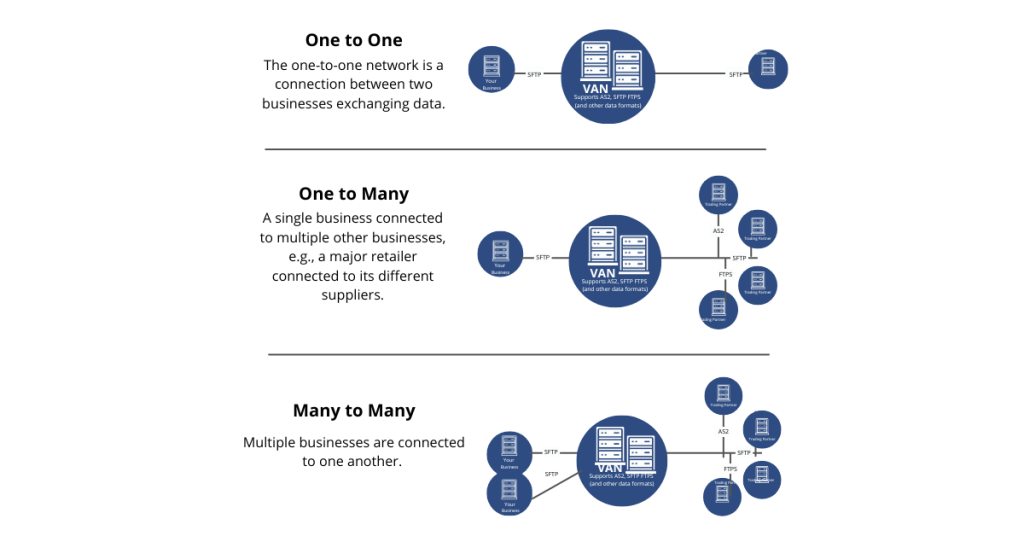
Building direct connections with each trading partner creates a tangled web of integrations.
A single connection to the VAN eliminates the need for individual integrations with each trading partner.
The value-added network handles protocol conversion, transforming SFTP to AS2 or other formats as needed.
This universal adapter approach simplifies what would otherwise require separate technical configurations for every partner relationship.
2. Stricter EDI Compliance Requirements Across industries
Retailers like Walmart, Target, and Amazon require suppliers to be EDI-compliant, meaning they must use Electronic Data Interchange to send and receive orders, invoices, and shipping notifications.
Failure to comply results in chargebacks or processing delays.
VANs help businesses comply with industry regulations and data privacy laws through audit trails and secure data storage.
Besides meeting baseline requirements, value-added network services ensure you stay current as standards evolve across retail, healthcare, and manufacturing sectors.
3. Guaranteed Reliability and Uptime to Prevent Revenue Loss
System crashes or network issues prevent the timely exchange of EDI documents.
Built-in redundancies and secure backups help maintain uninterrupted operations even during outages.
When managing mission-critical supply chain communications, this reliability translates directly to revenue protection.
4. Enhanced Security and Data Integrity in Controlled Environments
Value-added network uses encryption techniques such as SSL/TLS to secure data transmitted over the network.
Robust access controls restrict access to authorized users only, including multi-factor authentication and role-based access controls.
Moreover, encryption measures safeguard sensitive data during transmission, addressing data protection concerns.
Password protection, cryptography, and data integrity checks analyze inbound and outbound messages for errors.
5. Simplified Partner Onboarding at Scale
Traditional EDI onboarding drags out for weeks or even months.
Using proven templates and migration dashboards, onboarding times drop dramatically, with manufacturers seeing reductions by 50% or more
6. Built-in Audit Trails and Compliance Management
VANs record all information that flows through them, creating a ledger of each transaction.
Delivery confirmations and acknowledgment receipts confirm successful transmission.
As shown in regulated industries, full audit trails mean you stay ready for reviews and regulatory requirements without manual tracking overhead.
VAN vs Modern EDI Alternatives: Understanding Your Options
1. VAN vs API Integration: When Each Works Best
APIs enable real-time data exchange, perfect for internal system integration and cloud SaaS applications.
However, APIs require stable Internet access and may not suit compliance regulations for sensitive financial data.
By comparison, EDI through VANs handles bulk document transfers with established standards.
The answer isn’t either/or.
Businesses increasingly use both: EDI for partner communication and APIs for internal data access.
2. VAN vs AS2 and SFTP Direct Connections
AS2 offers fixed upfront costs versus VAN’s per-character pricing model, which ranges from three to twenty cents per document.
AS2 certificates require regular updates across all trading partners, creating an administrative burden. SFTP suits direct communication without intermediaries.
Conversely, VANs support multiple protocols and simplify onboarding, though you sacrifice direct control.
3. VAN vs Cloud EDI: Complementary Not Competing
Cloud platforms enhance VAN capabilities rather than replace them. Cloud-based VANs deliver improved scalability, reduced infrastructure costs, and better accessibility.
4. The Hybrid EDI Model: Combining VAN with Modern Tools
Hybrid integration combines VAN reliability with modern flexibility. Organizations need EDI for partners, APIs for internal systems, and cloud platforms for agility.
5. Key Industries Still Relying on VAN Infrastructure
Retail, manufacturing, healthcare, logistics, and finance benefit most from VANs due to high transaction volumes and strict compliance requirements
Choosing the Right VAN Provider and Implementation Strategy
1. Essential Features of a Modern VAN in 2026
Evaluating value-added network companies requires scrutinizing specific capabilities.
Protocol support stands first; your provider must handle AS2, SFTP, FTP, and API connections.
EDI translation, compliance testing, technical support, and data archiving should be included in the base price rather than as costly add-ons.
Free trading partner onboarding and migration assistance separate quality providers from budget traps.
2. Evaluating Scalability and Integration Capabilities
Partner onboarding speed determines operational agility.
Ask prospective providers whether connections take days or weeks.
Transaction volume flexibility matters equally;
Can the system handle growth without performance degradation?
Verify support for protocol translation when partners use different communication methods.
3. Security Certifications and Compliance Requirements
VANs meet government and financial industry security standards through encryption and digital signature verification.
Password protection, cryptography, and data integrity checks flag transmission errors automatically.
Nonrepudiation features prove documents reached intended parties.
4. SLA Guarantees and Support Quality
Service level agreements should guarantee 99.9% or better uptime.
Commport VAN, #1 Value Added Network in North America with 99.99% Uptime, sends and receives over 140K+ transactions per day.
Verify response times for critical issues and whether support operates via phone, email, or ticketing systems.
5. Total Cost Comparison: VAN vs Direct EDI Management
Kilo-character pricing ranges from three to twenty cents per document, creating unpredictable monthly bills.
Trading partner pricing offers fixed costs regardless of transaction volume.
Watch for hidden setup fees, partner onboarding charges, mapping fees, and data storage costs.
Direct EDI cuts expenses by 90% at high volumes but demands dedicated IT staff.
Conclusion
Value added networks have proven they’re far from obsolete. While modern alternatives like APIs and AS2 connections serve specific purposes, VANs remain unquestionably the backbone of B2B EDI communications for good reason. Their 99.99% uptime, built-in compliance features, and ability to manage thousands of trading partners simultaneously make them indispensable in 2026.
Before choosing between a VAN and direct EDI connections, evaluate your transaction volumes, partner requirements, and compliance needs. All things considered, most organizations benefit from a hybrid approach that combines VAN reliability with modern integration tools for maximum flexibility and efficiency.
Commport VAN, #1 EDI VAN Provider in North America
Download: VAN Buyers Guide
Maximize your business efficiency with the right VAN provider! Grab your free VAN Buyer's Guide and discover the key features and services that will elevate your EDI transactions to the next level.
Make an informed decision today!
Frequently Asked Questions
VANs provide enhanced data security through encryption, guaranteed reliability with 99.99% uptime, and simplified management of multiple trading partners through a single connection. They also offer built-in compliance features, audit trails, and value-added services like protocol conversion and message validation that help streamline business processes and reduce errors.
No, VANs are not outdated. While they originated in the 1980s, modern VANs have evolved significantly by integrating cloud technology, API capabilities, and hybrid solutions. They continue to handle the vast majority of EDI transactions and maintain their relevance by offering scalability, lower upfront costs, and seamless integration with contemporary business tools.
VANs help businesses meet strict industry compliance requirements by enforcing EDI standards like X12 and EDIFACT, maintaining comprehensive audit trails, and providing secure data storage. They ensure adherence to regulations required by major retailers and comply with industry-specific standards in healthcare, finance, and manufacturing sectors.
A VAN is ideal when managing numerous trading partners with different protocols, handling high transaction volumes, or requiring guaranteed uptime and compliance. Direct connections like AS2 or SFTP work better for businesses with few partners and high technical capabilities. Most organizations benefit from a hybrid approach combining both methods.
Key features include comprehensive protocol support (AS2, SFTP, FTP, APIs), EDI translation capabilities, strong security certifications (HIPAA, financial industry standards), guaranteed uptime of 99.9% or higher, responsive technical support, and transparent pricing without hidden fees for partner onboarding or data storage.