


Introduction to EDI ERP Integration Benefits
The connection between EDI and ERP is reshaping business operations at an unprecedented pace.
This growth reflects a fundamental shift in how companies handle transactions.
Without proper ERP and EDI integration, businesses face manual data entry, costly errors, and processing delays.
Consequently, organizations are turning to EDI ERP systems to automate data transfer and boost accuracy.
Here is the list of 15 key benefits of EDI ERP integration that can transform your business efficiency in 2026.
- Automated Data Transfer Between EDI and ERP Systems
- Improved Data Accuracy and Error Reduction
- Faster Order-to-Cash Cycles
- Enhanced Supply Chain Visibility
- Scalability for Growing Transaction Volumes
- Significant Cost Savings and ROI
- Streamlined Order Fulfillment Processes
- Better Inventory Management
- Improved Trading Partner Relationships
- Enhanced Compliance and Audit Trails
- Reduced Processing Time for Business Documents
- Real-Time Data Synchronization
- Better Resource Allocation
- Improved Exception Handling
- Enhanced Business Agility
The integration eliminates manual data entry bottlenecks while providing real-time visibility across your entire supply chain.
Your team shifts from administrative tasks to strategic initiatives, and trading partners benefit from faster response times and reliable document exchange.
With automated exception handling and comprehensive audit trails, you’ll maintain compliance while building a foundation for sustainable growth.
Key Takeaways
- Dramatic cost reduction: Save $1-3 per document with EDI transactions costing under $1 versus $30+ for paper processes
- Superior accuracy: Achieve 99.95-99.99% accuracy rates, making 100 times fewer errors than manual data entry systems
- Accelerated processing: Reduce order processing time by 60-70%, compressing cycles from days to minutes or hours
- Strong ROI performance: Expect 168% average return on investment with payback periods of just 6-12 months
- Effortless scalability: Handle 500% transaction volume spikes during peak periods without additional staffing costs
1. Automated Data Transfer Between EDI and ERP Systems

What This Means for Your Business
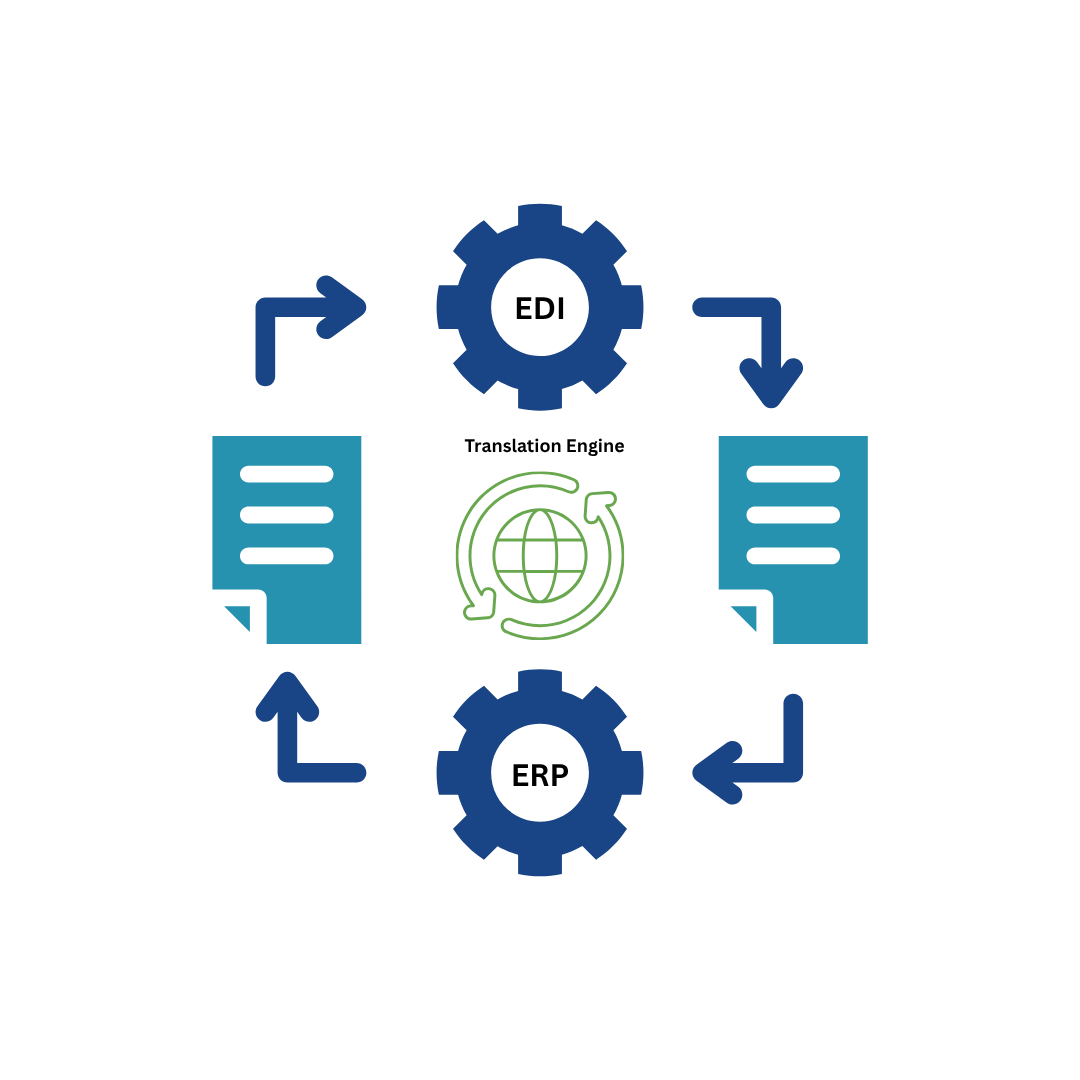
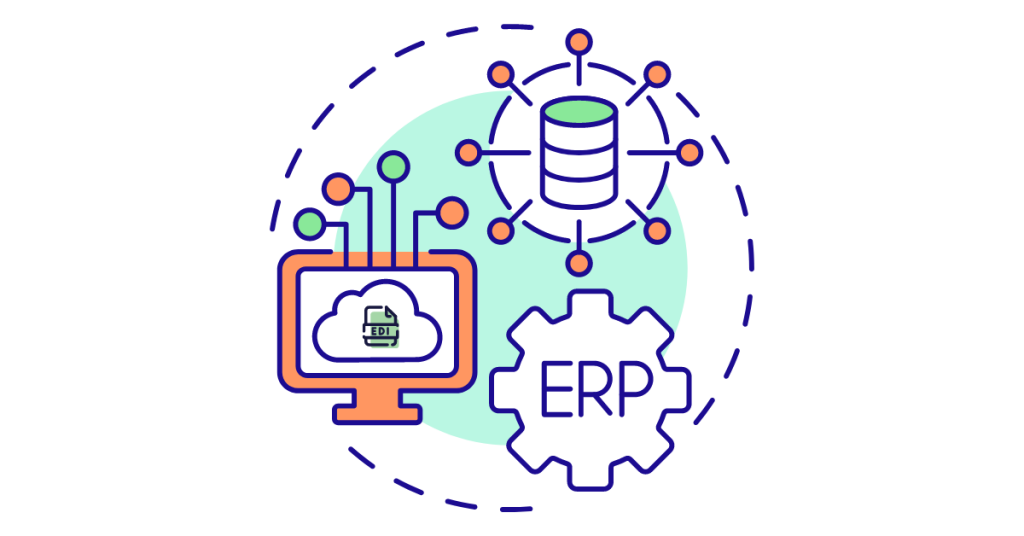
EDI and ERP integration creates bi-directional data flows that send and receive updates between your ERP system and external partners in real time. Purchase orders, invoices, and shipping notices move directly into the systems your teams use without duplicate keying or download-and-reupload work.
Business documents draw directly on existing data from your ERP system. When a purchase order arrives through EDI, it flows into your ERP, triggers an inventory check, creates a fulfillment task, and sends an advance ship notice back to the partner after shipment. This direct connection eliminates the need for manual data transfer between systems.
How It Reduces Manual Work
EDI ERP systems replace imperfect manual processes involving phone calls, paper invoices, faxes, and emails. The automation reduces reliance on these time-consuming methods, resulting in faster turnaround times and fewer mistakes.
Manual communication about invoices and shipments requires substantial employee time. With ERP and EDI integration, orders and invoices flow into your ERP without manual entry. Your staff no longer needs to retype item numbers, quantities, prices, or locations from paper documents or spreadsheets into digital systems.
Measurable Time Savings
The automated processing of orders via EDI. At the same time, operational process costs drop by up to 30%, depending on your industry and initial situation. It reduces process time by 60-70%
These time savings come from eliminating manual data entry and accelerating processing times. Documents move seamlessly in and out of ERP systems, reducing order-to-cash and procure-to-pay cycle times. Touchless automation handles the standard transactions, freeing your team to focus on exceptions that require judgment.
2. Improved Data Accuracy and Error Reduction

Eliminating Human Data Entry Errors
Manual data entry carries inherent risks at every touchpoint. Employees can mistype item numbers, transpose SKUs, or enter incorrect quantities and prices, especially when transaction volume spikes. These mistakes aren’t rare outliers. Human data entry accuracy typically ranges from 96-99%, while Put another way, automated systems make 100 times fewer errors than manual processes. Automated systems achieve 99.95-99.99% accuracy
EDI ERP integration addresses this at the root by linking EDI documents directly with ERP logic. Each field is mapped once and reused consistently across every transaction. No double-handling occurs. No formatting mismatches slip through. The result is clean, reliable records that eliminate the chaos of fragmented data.
Impact on Order Processing
When data moves between platforms manually, small slips become expensive problems. A number lands in the wrong field. A line item disappears. Pricing doesn’t match what was agreed. Companies using EDI see with manual re-keying, less than 1% error rates compared to 30%
ERP and EDI integration removes these pain points from purchase orders, shipping notices, and invoices. Documents flow seamlessly without the bottlenecks that plague manual systems. As a result, businesses avoid chargebacks and penalties that stem from data entry mistakes.
Real-World Accuracy Improvements
The financial stakes are substantial. Organizations spend an average of $15-25 to correct a single data entry error, but indirect costs multiply this figure by 10x or more through delayed payments, compliance penalties, and lost customer trust. For a business processing 10,000 data entries, these corrections drain resources that could drive strategic initiatives.
EDI ERP systems prevent revenue leakage by eliminating errors, inefficiencies, and workflow gaps that cause companies to fail to collect money they’ve earned. The improved accuracy supports stronger compliance, cleaner records, and significantly less rework for operations and finance teams.
3. Faster Order-to-Cash Cycles
How Integration Speeds Up Processing
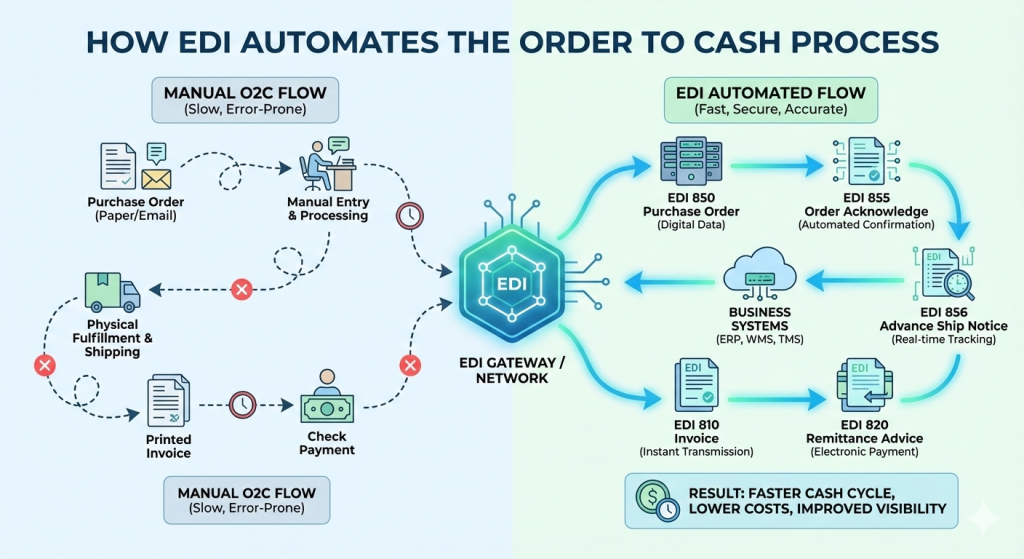
Processing times drop dramatically when EDI and erp systems work together. What takes days through manual methods compresses into minutes or hours. Purchase orders arrive through EDI and flow directly into your ERP, triggering credit checks and stock verification instantly. The system allocates inventory, coordinates with carriers, and sends advance shipping notices without human intervention.
This accelerated transfer speed happens because documents move seamlessly between systems. Orders enter, fulfillment tasks are generated, and confirmations are returned to partners as soon as shipments leave. Companies implementing EDI ERP integration typically see a minimum 35% reduction in transaction costs
Impact on Cash Flow
Invoice generation happens automatically once orders ship, shrinking the gap between delivery and payment collection. Payment-related documents are exchanged instantly, leading to faster cash application and reconciliation. Instead of waiting for manual invoice processing, your system sends invoices immediately and processes electronic payments without delay.
The financial benefits materialize quickly. Custom integrations often replace manual workflows. Enhanced reconciliation allows you to match invoices with payments instantly, while automated remittance advice ensures payments are recorded accurately. This speed improves working capital optimization and provides more liquidity for reinvestment. They pay for themselves within 6-12 months
Reducing Fulfillment Delays
Real-time ERP and EDI integration shortens the entire order-to-cash cycle. Systems act on data the moment it arrives. When a retailer sends a purchase order, the document triggers inventory checks, creates fulfillment tasks, and pushes back confirmations without lag time.
This immediate response prevents revenue leakage, the money companies earn but fail to collect due to workflow gaps. Cycle times shrink because information flows automatically between departments, eliminating bottlenecks that plague manual processes.
4. Enhanced Supply Chain Visibility

Real-Time Transaction Tracking
Visibility improves when EDI data enters the ERP and related systems in a consistent, governed way. Teams can see order status, inventory commitments, invoice progress, and shipment milestones without searching across disconnected tools. Supply chain movements and inventory updates are automatically posted within ERP systems in real-time, providing teams with more accurate updates on the status of purchase orders, invoices, shipments, and more.
EDI and ERP integration creates a single source of truth for managing trading partners and EDI transactions, enabling proactive transaction error identification. Modern EDI solutions often come with built-in dashboards that display real-time order statuses, delivery times, and inventory levels. For instance, when a large retailer sends a purchase order, the electronic document flows straight into an ERP system like SAP or Oracle NetSuite, keeping both sides of the transaction synchronized, with real-time tracking.
Better Decision Making
Current information replaces delayed updates. Leaders make decisions based on what’s happening now rather than what happened hours or days ago. This visibility can help strengthen decision-making and forecasting. Having real-time visibility into the supply chain gives leaders the data they need to make smarter choices, whether adjusting delivery routes, updating forecasts, or renegotiating with vendors.
Organizations that can view system health in real-time are better equipped to make adjustments that avoid errors and performance degradation. Dashboards enable a range of stakeholders, not simply IT staff, to view success rates, order statuses, processing bottlenecks, and transfer failures in real-time.
Monitoring Across Systems
Organizations often lack the needed visibility across integrated workflows. ERP and EDI integration addresses this gap. Teams gain a full view of inventory management, shipment status, and overall supply chain performance. Companies can spot trends, avoid supply chain bottlenecks, and react quickly to changing conditions. Consequently, businesses detect late shipments, incorrect pricing, or inventory shortages before they impact the end customer. cross-platform monitoring capabilities.
5. Scalability for Growing Transaction Volumes

Supporting Business Growth
Growth pressures legacy systems in predictable ways. As companies add business partners, an integrated automated system processes the increased volume of transactions more efficiently and more quickly than manual entry. A scalable EDI and ERP infrastructure handles this growing volume without compromising on performance, speed, or reliability.
A well-configured EDI ERP integration enables businesses to scale without additional staffing costs or processing delays. Transaction volume rises quickly as companies add partners, products, and channels. A strong integration model allows the business to support more exchange activity without multiplying manual tasks or custom code. Scalability depends on process consistency rather than just transaction capacity.
Handling Increased Partner Networks
Partner growth demands flexible infrastructure. Scalable EDI ERP systems make it easier to onboard new trading partners and support their specific EDI requirements. Consequently, businesses can adapt to the specific demands of major retailers without keeping partners waiting.
Standardized templates and transformation logic should be built and reused when possible, with the ability to adjust for partner specifications. A modular approach to integration design that separates functions such as extraction, transformation, and validation enables the reuse of certain components when possible. This approach also simplifies troubleshooting, enabling fixes or customization of certain integration components without affecting the entire integration.
Infrastructure That Scales
Peak demand tests system limits. During peak times like major sales or month-end, in an hour. Message queues act as buffers, collecting data and letting systems process it at a safe speed. Meanwhile, cloud EDI technology spins up extra resources only when needed, keeping costs low while maintaining speed. Transaction volume can jump 500%
ERP and EDI integration built with growth in mind addresses how systems handle additional business partners and greater transaction loads.
6. Significant Cost Savings and ROI

Reducing Operational Costs
The financial impact of EDI and ERP integration shows up immediately in transaction costs. When factoring in labor and materials, an EDI transaction costs less than $1. For organizations processing thousands of documents monthly, these savings compound rapidly. EDI transactions save companies $1 to $3 per document, translating to substantial annual reductions. Processing a paper purchase order costs over $30
ERP systems that provide accurate real-time information help manufacturing companies reduce operational costs by 23% and administration costs by 22%. These reductions stem from eliminating paper, printing, postage, and document storage expenses. Specifically, EDI ERP integration cuts the handling costs of organizing, sorting, and distributing paper documents by storing and manipulating data electronically.
Labor Cost Reduction
Staff time represents one of the largest cost centers in transaction processing. Calculate the hours saved by automating manual data entry. For example, two employees spending 10 hours per week on manual order input at $25 per hour save $26,000 annually. That calculation breaks down to 20 hours per week multiplied by 52 weeks at $25 per hour.
Commport EDI ERP Integration Services make your integration project hassle-free. Our EDI solutions easily integrate with all major ERP software, helping customers with custom integrations since 1985.
Modern edi erp systems that automate mapping, validation, and acknowledgments can trim 30-50% from processing time. Consequently, businesses scale without additional staffing costs or processing delays.
Long-Term Financial Benefits
The, with a payback period of about 3.7 years. Organizations more than double their initial investment. Best-in-class EDI cost per transaction falls below $0.30, excluding internal labor. The average ROI for an ERP implementation reaches 168%
Modernizing the integration layer delivers cost reductions of 30-60% by eliminating batch processing inefficiencies and compliance penalties. These savings create a more scalable foundation for future growth.
7. Streamlined Order Fulfillment Processes
Automated Purchase Order Processing
Orders from multiple channels automatically capture in your ERP system, reducing manual entry errors. For B2B transactions, EDI and ERP integration enables orders from retail or commercial clients to flow straight into the ERP. The purchase order arrives as an EDI 850, your system sends back an EDI 855 acknowledgment to confirm receipt, then generates an EDI 856 advance shipping notice describing shipment contents, followed by an EDI 810 invoice.
This automated sequence eliminates manual re-keying. Key business documents flow directly between ERP systems, shortening your order-to-cash cycle. Once Partner A updates their ERP with order details, the EDI system automatically communicates this information to Partner B’s ERP without any manual input.
Faster Shipping and Delivery
EDI ERP systems track inventory availability in real-time, adjusting quantities as orders arrive. This prevents overselling and allows for fast response to customer orders. After an order is captured, your ERP automates the picking, packing, and shipping procedures, speeding up order processing so you can satisfy consumer demands more efficiently.
Real-time tracking of shipment information keeps you in the loop throughout the process. The integration provides accurate delivery estimates and ensures seamless order fulfillment from procurement to shipping. Integrated ERP workflows help companies respond faster because systems act on data as soon as it arrives.
Customer Satisfaction Impact
Harvard Business Review suggests that minimizing human touch points for customer interactions improves satisfaction and loyalty. Companies with high customer satisfaction levels achieve than companies with lower satisfaction. B2B companies with good customer satisfaction see reductions of 10-20% in cost to serve and up to 15% growth in revenues, with operating margins up to 6% higher
Customers expect speed and accuracy. When you continually provide positive experiences, they are more likely to buy from you and not your competitors.
8. Better Inventory Management
Inventory Updates in Real-Time
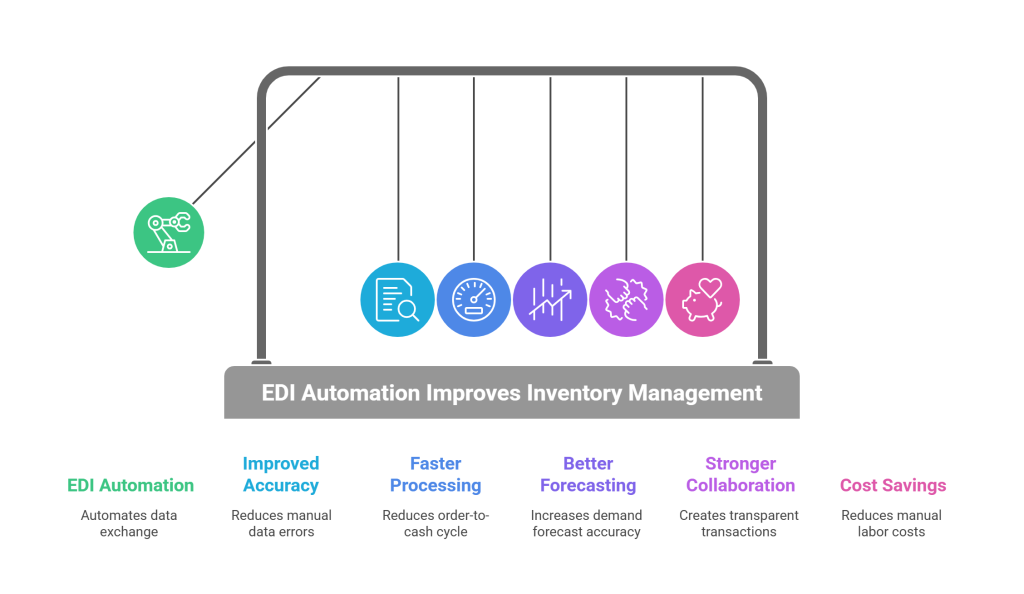
Supply chain movements and inventory updates are posted automatically within ERP systems in real-time. EDI enables companies to track inventory levels instantly by automatically sharing data across platforms. Whether a product sells online or in-store, EDI and ERP integration updates inventory records immediately, reducing the risk of overselling.
The EDI 947 Warehouse Inventory Adjustment document communicates changes in inventory levels within a warehouse. Upon receiving an EDI 947, the trading partner updates their inventory management system to reflect new inventory levels. This ensures both the warehouse and the trading partner maintain accurate and up-to-date information about stock quantities.
Preventing Stock Discrepancies
The EDI 947 helps identify discrepancies between physical and recorded inventory counts. By promptly communicating these discrepancies, trading partners can investigate the causes of variances, such as errors in receiving, shipping, or data entry, and take corrective action.
Strong EDI ERP systems against predefined rules. Quantities, units of measure, item identifiers, and locations are checked before inventory updates are accepted or transmitted. This validation protects downstream processes and builds confidence that inventory data can be trusted across departments. It validates incoming and outgoing inventory data
Optimizing Warehouse Operations
With EDI data feeding reliable inventory positions into ERP and planning tools, organizations make better decisions about what to produce, what to reorder, and when to replenish. Teams can anticipate needs based on shared inventory visibility with customers and suppliers.
When inventory visibility improves, businesses no longer need to overstock as insurance against bad data. EDI and ERP integration supports leaner inventory strategies by providing confidence that reported data is accurate and current.
9. Improved Trading Partner Relationships

Faster Response Times
EDI enables seamless communication between manufacturers and their trading partners in a standardized digital format. Traditional paper-based processes or manual data entry methods create slow turnaround times. When purchase orders, invoices, shipping notices, and inventory updates are exchanged automatically through EDI and ERP integration, partners receive responses in minutes rather than days, automating the exchange of critical business documents
Real-time document transmission reduces delays and minimizes errors such as incorrect order quantities or pricing discrepancies. EDI software provides, allowing trading partners to monitor order statuses, inventory levels, and shipment details instantly. Consequently, manufacturers and their partners can proactively address potential disruptions, ensuring smoother operation, real-time tracking, and updates
Reliable Document Exchange
ERP and EDI integration ensures all document exchanges adhere to compliance requirements and industry standards, reducing compliance risks. This standardization makes it easier for manufacturers to work with multiple partners across different industries. Partners receive consistent, accurate information formatted to their specifications, eliminating confusion from incompatible systems.
Building Trust Through Accuracy
Accuracy helps build trust and reliability among trading partners. With EDI ERP systems in place, manufacturers and their trading partners can focus on strategic initiatives rather than getting bogged down by manual administrative tasks. This shift fosters deeper collaboration, allowing both parties to explore opportunities for innovation, cost reductions, and improved product offerings.
10. Enhanced Compliance and Audit Trails

Meeting Regulatory Requirements
Finance leaders face pressure to reduce risk and ensure every transaction is traceable. Auditors expect direct documentation access, not a scavenger hunt through spreadsheets, email threads, and ERP exports. The automatic documentation of all transactions can simplify audit processes and compliance reviews, helping organizations meet regulatory requirements.
EDI and ERP integration systems touch sensitive financial and operational data. Organizations need visibility into what was received, how it was transformed, where it was sent, and whether it succeeded. Audit logs should capture user actions, timestamps, protocol details, IP addresses, and transmission metadata. Records must be or deletion, which protects against internal risk and supports regulatory requirements such as SOX and industry-specific mandates, protected from retroactive alteration
Comprehensive Transaction Logging
An audit-ready EDI ERP system delivers complete traceability of every document: who sent it, when, through which protocol, and whether it was successfully received. Every EDI transaction must flow directly into systems such as NetSuite, SAP, Oracle, Infor, or Microsoft Dynamics, with each handoff logged and traceable. Detailed audit trails and change logs capture every action taken within the ERP system, providing a comprehensive record of compliance-related activities for internal reviews and external audits.
Auditors often request documentation years after transactions occurred. An effective system provides immediate access to recent activity. Searchable exports with timestamped retrieval logs allow teams to answer audit questions in minutes, not hours. Secure archives retained for 7+ years
Data Governance Benefits
Comprehensive audit trails are useful in maintaining and demonstrating compliance in the case of a regulatory review or partner disagreement. Real-time dashboards provide a view of compliance-related metrics and key performance indicators, enabling managers to quickly identify and address potential issues. Automated compliance monitoring and alert systems can notify managers of potential issues or deviations from established policies, enabling proactive remediation. Consequently, an audit-ready EDI environment reduces friction across the organization.
11. Reduced Processing Time for Business Documents
Invoice Processing Speed
After a shipment is delivered, the supplier sends an EDI 810 invoice to the buyer for payment. This document includes invoice numbers, purchase order references, product SKUs, quantities, prices, taxes, discounts, and payment terms. Automating invoicing with EDI 810s streamlines accounts payable workflows, reducing the time required to manually match invoices with purchase orders and shipping documents.
Invoice cycle time targets same-day submission from shipment to invoice. Edi and ERP integration generates invoices automatically as soon as shipments close, matching retailer formats and timing requirements. Electronic reconciliation identifies and resolves discrepancies quickly, ensuring payments are made accurately and on time.
Purchase Order Turnaround
The EDI 850 purchase order eliminates manual data entry when buyers place orders with suppliers. When a retailer sends an EDI 850, details such as SKUs, pricing, and quantities populate automatically in your ERP. From there, the ERP triggers pick and pack workflows.
Order processing time from retailer PO receipt to ERP insert should target under 5 minutes. Traditional EDI systems with batch scheduling can delay purchase orders by an hour or more through cascading delays.
Shipping Notice Automation
Once products are ready to ship, suppliers send an EDI 856 advance shipping notice to buyers. This document provides shipment tracking numbers, carrier information, expected delivery dates, detailed carton contents, and special handling instructions. ASNs help warehouses optimize receiving processes, reducing the time required to check in and put away incoming goods. Real-time EDI ERP systems handle each document the moment it arrives, eliminating queue accumulation.
12. Real-Time Data Synchronization

Instant ERP Updates
Orders, invoices, and shipping updates flow into the ERP automatically, reducing delays and helping teams stay aligned. When a large retailer sends a purchase order, the electronic document flows straight into an ERP system like SAP or Oracle. to provide real-time data synchronization, automated validation, and full visibility across all trading partner transactions. Modern EDI solutions use APIs
Integration enables seamless data flow, allowing EDI transactions to be processed automatically within the ERP system. The ERP system data reflects the most accurate inventory levels, order status, and relevant financial information based on real-time EDI transactions.
Eliminating Data Lag
Event-driven systems update all systems right away when something happens, like a new order. This removes delays and stops data silos. Integrated edi erp workflows help companies respond faster because systems act on data as soon as it arrives.
API-first platforms connect directly to ERP systems through lightweight integrations, enabling seamless integration with internal and external data sources. This ensures accurate, real-time updates across the supply chain.
System-Wide Consistency
With instant data sync, all transactions, customer updates, and operations appear immediately across systems. Teams can see the same information fast, which stops mistakes, saves time, and makes work easier. Consequently, EDI and ERP integration keep every system updated in real time.
13. Better Resource Allocation

Freeing Up Staff Time
Employees spend up to 30% of their time on manual data entry in outdated ERP systems. That translates to nearly 12 hours per week lost to repetitive tasks. EDI and ERP integration eliminates this drain by automating document processing, which frees employees to focus on higher-value tasks.
Manual workflows demand constant attention. Staff members copy data between systems, verify entries, and reconcile discrepancies. These activities consume resources without adding strategic value. As a result, organizations struggle to allocate talent where it matters most.
Focusing on Strategic Tasks
ERP-EDI integration lowers human involvement in routine processes. Instead of rekeying purchase orders or matching invoices, teams can analyze supplier performance, negotiate better terms, or improve customer relationships. This shift from administrative work to strategic initiatives creates measurable business impact.
Automation isn’t just about speed. It redirects human capability toward problem-solving and innovation. Consequently, companies using EDI ERP systems position their workforce for activities that drive growth rather than maintenance.
Reducing Administrative Burden
Streamlined workflows let staff focus on tasks that require judgment and expertise. Administrative overhead decreases as systems handle document exchange, validation, and error detection automatically. Organizations reduce operational costs while improving team productivity. Better collaboration with suppliers and trading partners emerges when teams spend less time on paperwork and more time building relationships.
14. Improved Exception Handling
Automated Error Detection
Even mature EDI environments face errors such as invalid values, missing fields, or failed system updates. Without structured exception handling, those issues can disrupt downstream ERP processing and create operational delays. Mid-market manufacturers processing 50,000 EDI transactions monthly typically see 3-5% of inbound transactions arrive malformed, translating to 1,500-2,500 problematic records each month.
Centralized monitoring and alerts make it easier to isolate problems before they affect larger business processes. Traditional batch processing creates a 4-hour average delay in detecting issues. In contrast, event-driven EDI and ERP systems process errors in real-time, flagging discrepancies the moment they occur.
Faster Problem Resolution
Manual correction of malformed EDI transactions consumed approximately 1,000 hours monthly for one manufacturer, with each fix taking 25-40 minutes. Automated exception handling changes this drastically. Modern edi erp systems achieve 97.3% auto-fix accuracy, reducing detection-to-correction time to just 12 seconds.
Specifically, automated solutions eliminated 840 hours of monthly manual work, achieving an 84% auto-fix rate by month three. Dead-letter queues with error reporting ensure failed messages don’t simply vanish, preventing compliance holes and missing orders.
Reducing Downstream Disruptions
Manual error correction introduced secondary errors in 8% of cases. ERP and EDI integration with automated exception handling reduced this to 0%. Automated alerts enable teams to spot issues in seconds rather than days, preventing errors from cascading into larger, more costly problems.
15. Enhanced Business Agility
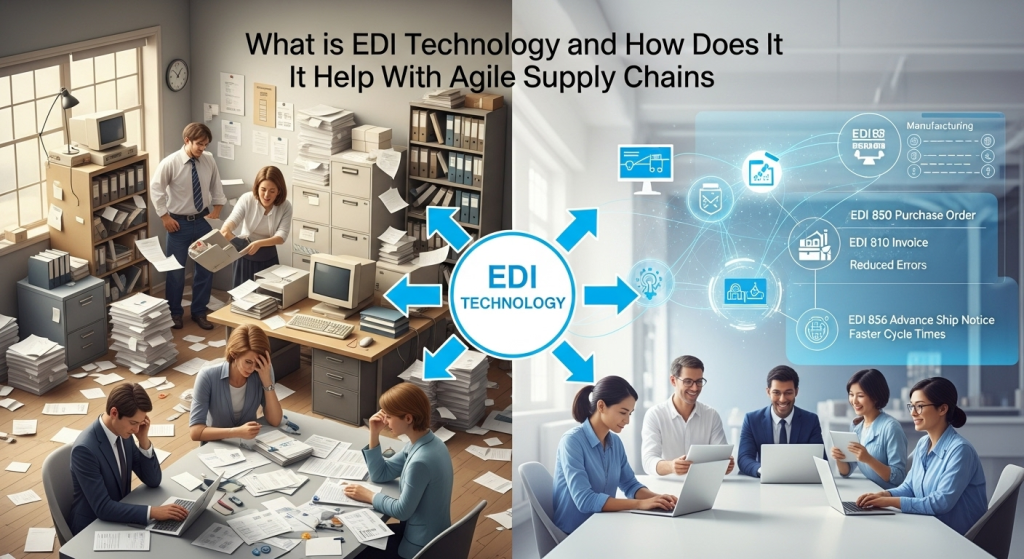
Adapting to Market Changes
Modern EDI systems integrated with ERP platforms provide better business insights and make analytics easier. Companies make decisions faster and respond more quickly to changes in market or customer demands. Real-time decision-making keeps organizations agile in response to market shifts.
Due to instant visibility across operations, managers adjust production schedules, update forecasts, or renegotiate vendor terms based on current conditions rather than outdated reports. This responsiveness separates agile competitors from those constrained by rigid systems.
Quick Partner Onboarding
Extended onboarding delays revenue. In fact, 44% of companies report that onboarding takes one week to one month, while 16% need more than a month. Innovative edi erp systems onboard partners four times faster than traditional approaches. Adding a new trading partner takes days, not months, with automated systems.
Commport EDI ERP Integration Services make your integration project hassle-free. Our EDI solutions easily integrate with all major ERP software. Helping our customers with custom integrations since 1985.
EDI simplifies the onboarding of new business partners worldwide because it provides a shared business language that ensures consistent communication across systems and borders.
Competitive Advantage
Organizations treating EDI as a strategic infrastructure achieve compliance accuracy of 99.9%. Faster processing speeds improve operational agility, allowing businesses to scale smarter and keep customers satisfied.
Conclusion
EDI and ERP integration transforms how businesses handle transactions, from order processing to invoice collection. The numbers speak for themselves: 60-70% faster processing times, 168% average ROI, and accuracy rates exceeding 99.95%. Equally important, you’ll eliminate costly manual errors while freeing your team to focus on strategic work rather than data entry.
Commport EDI ERP Integration Services make your integration project hassle-free, with EDI solutions that easily integrate with all major ERP software and custom integration expertise since 1985—get started today! The investment pays for itself within 6-12 months, and the operational improvements continue delivering value for years. Your competitors are already automating their workflows. The question isn’t whether to integrate EDI with your ERP, but how quickly you can implement it.
Commport EDI ERP Integrations
Need Help? Download: Commport's EDI Buyers Guide
Unlock the full potential of your supply chain with our comprehensive EDI Buyer's Guide — your first step towards seamless, efficient, and error-free transactions
Frequently Asked Questions
EDI integration with ERP creates an automatic connection between your EDI platform and ERP system, allowing business documents like purchase orders, invoices, and shipping notices to flow seamlessly between systems without manual data entry. This eliminates the need to manually transfer information from EDI software into your ERP and vice versa.
Integration eliminates human data entry mistakes by automating the transfer of transaction data between systems. Automated systems achieve accuracy rates of 99.95-99.99%, compared to 96-99% with manual entry, resulting in 100 times fewer errors and significantly reducing costly corrections.
Businesses typically see 60-70% faster processing times, with transactions that previously took days now completing in minutes or hours. The integration automates order processing, invoice generation, and shipping notifications, freeing staff from repetitive administrative tasks to focus on strategic activities.
Most organizations see their integration investment pay for itself within 6-12 months. The average ROI reaches 168%, driven by reduced transaction costs (from $30+ per paper document to less than $1 for EDI), lower labor expenses, and operational cost reductions of 23-30%.
Yes, integrated systems are designed to scale efficiently, handling transaction volume spikes of up to 500% during peak periods without requiring additional staff or causing processing delays. This scalability supports business expansion and growing partner networks without compromising performance.