


Introduction to Supply Chain vs Value Chain
Understanding supply chain versus value chain can explain why a BMW X3 commands a 20% price premium over a Ford Escape Titanium, even though both vehicles offer nearly identical horsepower (248 and 250, respectively), passenger volume, and cargo space.
The difference comes down to perceived value, and that’s where these two concepts diverge.
While the supply chain deals with building the product and getting it to the consumer.
The value chain looks for ways to enhance the product’s value as it moves along that supply chain.
In other words, one focuses on efficient delivery, whereas the other concentrates on customer perception and value creation.
We’ll break down the difference between value chain and supply chain, explore how each operates, and show you how they work together to drive business success.
Key Takeaways
- Supply chains focus on operational flow – managing the physical movement of goods from raw materials to customers through planning, sourcing, manufacturing, delivery, and returns
- Value chains emphasize strategic value creation – analyzing every business activity to identify where and how each step adds worth that customers will pay for
- Different objectives drive each approach – supply chains prioritize cost-effectiveness, speed, and reliability, while value chains aim to enhance customer experience and competitive advantage
- Both systems are complementary, not competing – supply chain activities form a subset of the broader value chain, with one handling execution while the other focuses on strategic enhancement
- Integration delivers superior results – companies with advanced supply chain capabilities are 23% more profitable, but combining both frameworks maximizes profit margins and builds lasting competitive advantage
What is a Supply Chain?
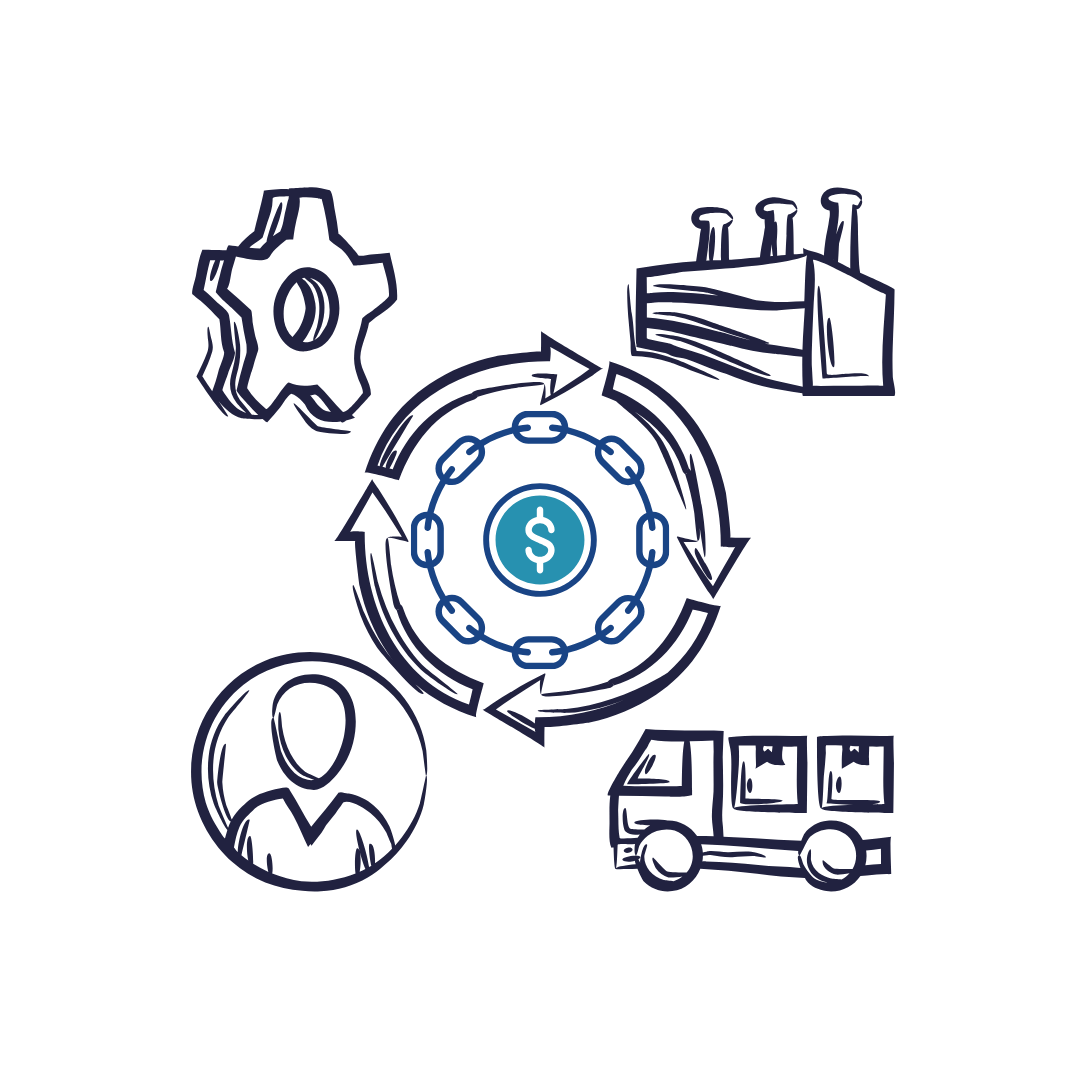
Supply chain management coordinates the production flow from sourcing raw materials to delivering finished products.
In essence, it integrates supply and demand management within and across companies, connecting suppliers, manufacturers, distributors, retailers, and customers into one network.
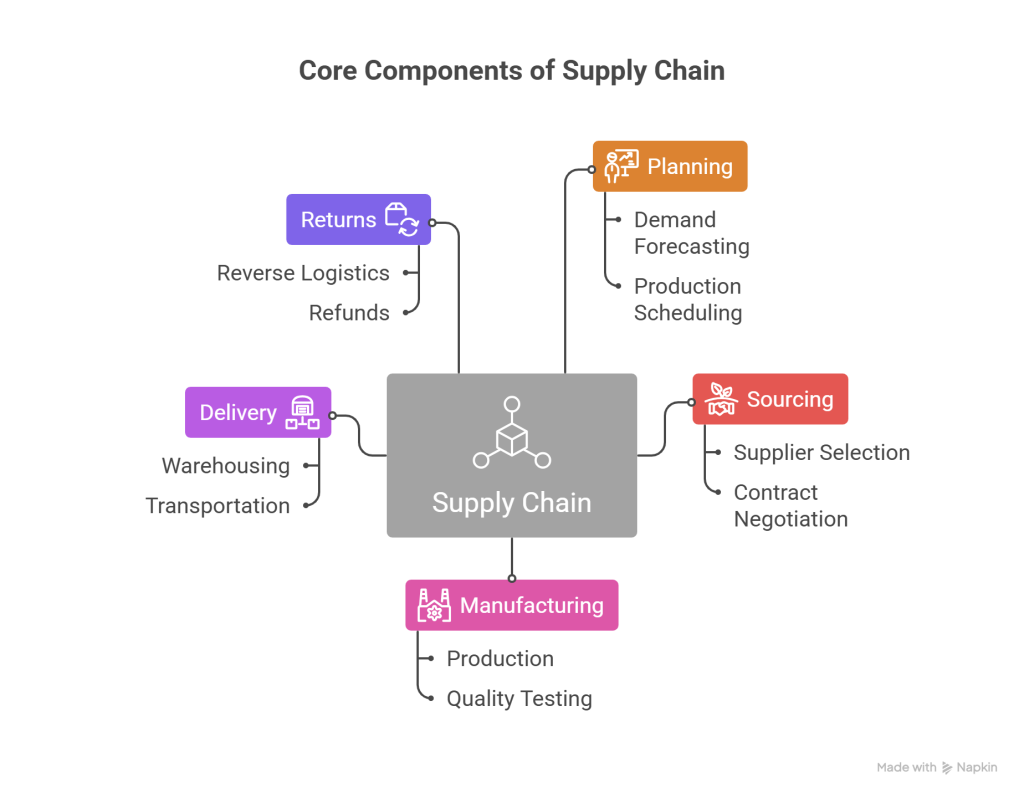
Core Components of Supply Chain
The supply chain operates through five interconnected components:
- Planning – Forecasting demand based on historical data, projected sales, and market conditions to determine production schedules and inventory levels
- Sourcing – Selecting suppliers, negotiating contracts, ordering materials, and managing supplier relationships
- Manufacturing – Transforming raw materials into finished products through production, quality testing, and packaging
- Delivery – Warehousing inventory, processing orders, coordinating transportation, and managing final distribution to customers
- Returns – Handling defective, damaged, or unwanted products through reverse logistics and issuing refunds
Three critical flows move through these components.
Physical flow involves the movement and storage of goods from manufacturing to sale.
Information flow contains product references, supplier data, and transportation details that keep operations running smoothly.
Financial flow tracks money movement between all parties, accounting for different currencies and customs duties across international chains.
Supply Chain Management Goals
Organizations with advanced SCM capabilities were than their peers 23% more profitable.
Supply chain management aims to minimize costs, waste, and time in the production cycle while maintaining inventory control to meet demand without oversupply or stock-outs.
Risk mitigation through diversified supplier networks and contingency planning protects against disruptions.
Real-World Supply Chain Example
Starbucks works with 300,000 coffee growers worldwide to source its beans. Before your latte reaches the counter, supply chain professionals forecast demand, negotiate with these growers, coordinate bean transportation across continents, manage roasting and packaging operations, distribute products to warehouses, and finally deliver to individual store locations.
What is a Value Chain?
A value chain breaks down every activity that goes into creating and delivering a product or service, from initial design to the customer’s hands.
Unlike flow-focused approaches, this framework examines where and how each step adds worth to the final offering.
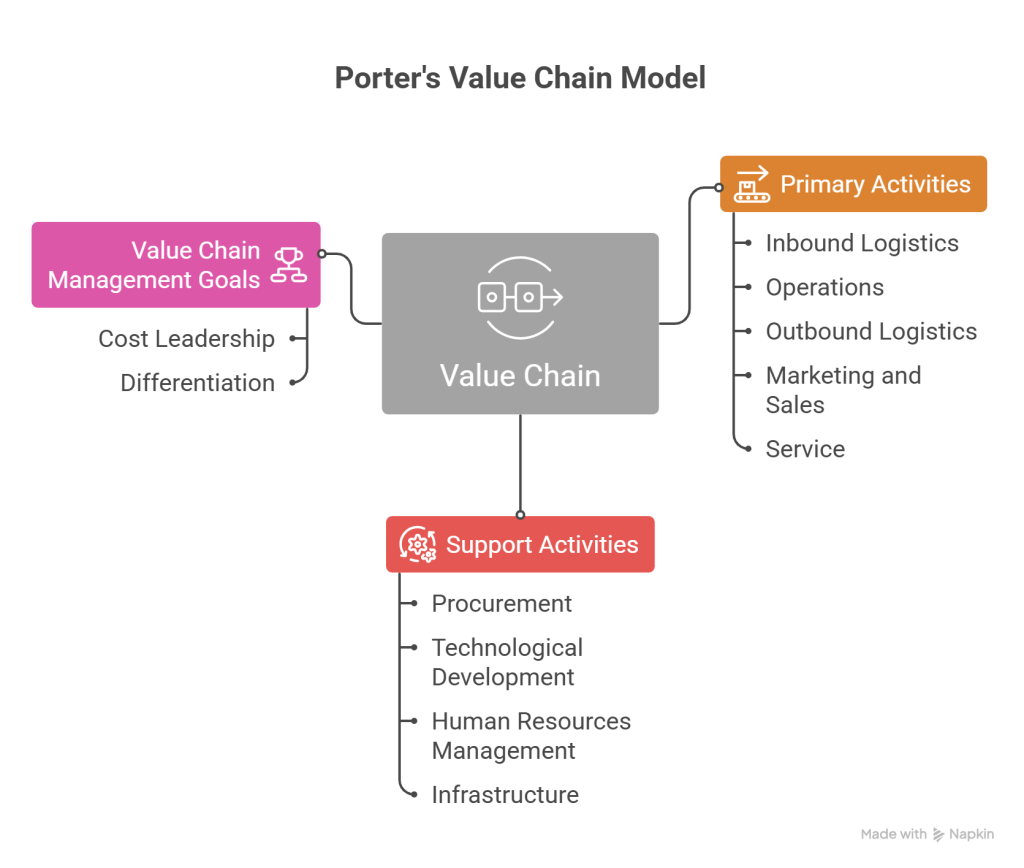
Porter's Value Chain Model Explained
Harvard Business School Professor Michael Porter introduced the value chain concept in his 1985 book, Competitive Advantage: Creating and Sustaining Superior Performance.
According to Porter, competitive advantage stems from discrete activities a firm performs rather than viewing the business. The overarching goal centers on delivering maximum value for the least cost to create a competitive advantage.
Porter split business activities into two categories: primary and support. Each activity represents a step where value gets added, and analyzing these interactions reveals optimization opportunities for cost and quality improvements.
Primary Activities in Value Chain
Five components form the primary activities that directly build and sell products:
- Inbound logistics covers receiving, warehousing, and inventory management of raw materials.
- Operations transform input into finished products through assembly, testing, and packaging.
- Outbound logistics distributes final products through order processing and shipping.
- Marketing and sales enhance visibility through advertising, promotion, and pricing strategies.
- Service maintains product value through customer support, repairs, and warranties.
Supporting Activities in the Value Chain
Four support activities boost primary activity efficiency.
- Procurement handles raw material sourcing and vendor relationships.
- Technological development advances research, product design, and process automation.
- Human resources management recruits, trains, and retains employees.
- Infrastructure encompasses planning, accounting, finance, and quality control systems.
Value Chain Management Goals
Value chain analysis pursues two competitive advantages.
- Cost leadership reduces expenses through efficiency gains, producing quality products at lower prices than competitors.
- Differentiation creates unique, valued features that justify premium pricing when higher prices exceed additional costs.
Both strategies aim to maximize profit margins by optimizing how each activity contributes to customer value.
Difference Between Supply Chain and Value Chain
The difference between supply chain and value chain becomes clear when examining their core functions.
Supply chain deals with, whereas the value chain looks for ways to enhance product value at each stage, building products and getting them to consumers.
1. Focus and Perspective
Supply chain thinking concentrates on operational execution, figuring out how products get made and shipped.
On the other hand, the value chain focuses on internal alignment, examining how each activity contributes to delivering something customers will pay for.
Supply chains are externally oriented, coordinating vendors, logistics, and distribution.
Value chains are internally focused, concentrating on design, marketing, and service to enhance competitive advantage.
2. Process and Activities
Supply chains are operational management processes, mostly logistical. They handle sourcing, manufacturing, warehousing, and delivery.
Value chains are business management processes, mostly analytical. They encompass R&D, operations, sales, and customer support.
3. Objectives and Metrics
Supply chain management focuses on manufacturing and distribution cost-effectiveness, speed, and reliability.
Value chain management aims to enhance customer experience, creating a competitive advantage. Supply chains track cost per order, lead time, and inventory turnover.
Value chains measure customer retention, product margins, and brand perception.
4. Starting Point and Flow Direction
Supply chains primarily focus on the physical exchange of goods, overlooking how immaterial value gets generated.
Value chains cover all business activities, whether material or immaterial, that create customer value.
5. Strategic vs Operational Orientation
Supply chain thinking is tactical, about accomplishing manufacturing and distribution tasks efficiently at low cost.
Value chain processes gather information to discover what customers value and figure out how to imbue products with those qualities.
How Supply Chain and Value Chain Work Together
Though distinct in purpose, supply chain and value chain operate as interrelated and complementary systems. In reality, one cannot function effectively without the other.
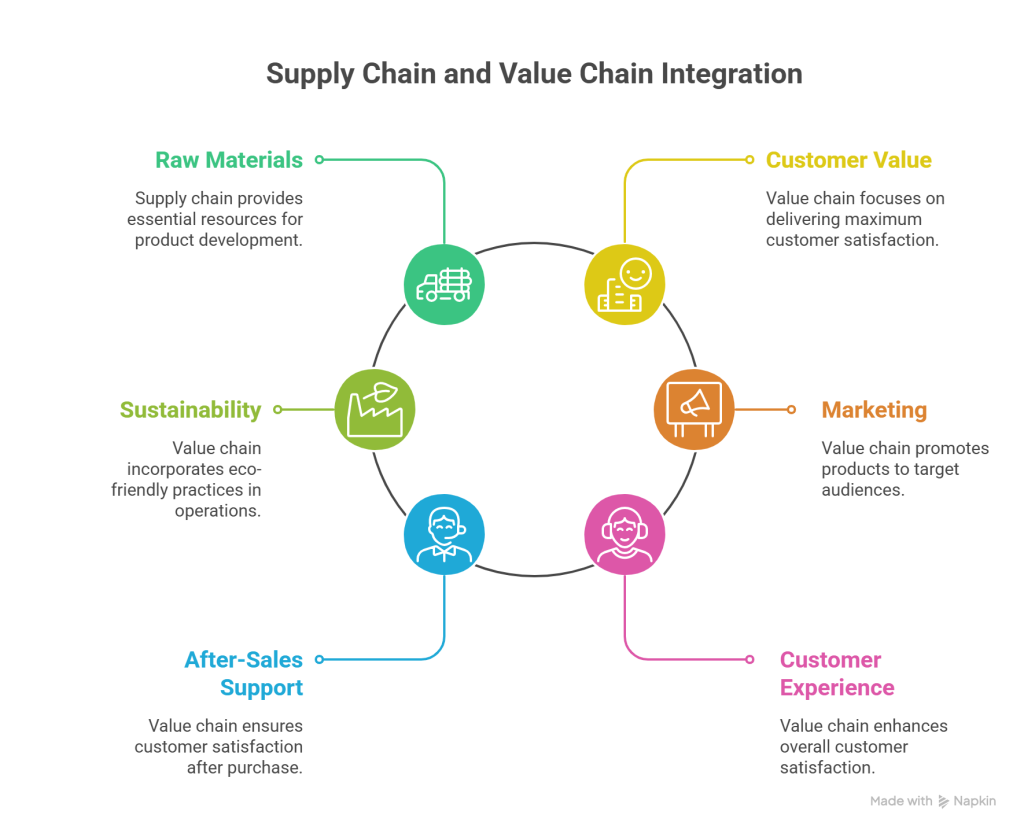
Integration Points Between Both Chains
Supply chains provide the raw materials and resources needed for product development, while value chains determine how to deliver maximum customer value with these products. Without a resilient supply chain, value chains fail to function properly. Correspondingly, an inefficient value chain produces suboptimal products that miss customer needs.
Accordingly, all supply chain activities form a subset of the broader value chain. Value chains encompass processes beyond logistics, including sustainability measures, marketing, after-sales support, and customer experience.
Optimizing Supply Chain for Value Creation
Once value chain teams identify enhancement opportunities, supply chains typically execute them. In inbound logistics, value chain thinking motivates suppliers for just-in-time delivery, reducing inventory management burden.
For manufacturing, adding value means reducing costs while improving quality through technology, automation, and sustainable practices like recycled materials. In outbound logistics, value addition ensures goods reach customers efficiently through optimized shipping routes, strategic fulfillment centers, and last-mile delivery improvements.
Real-World Application: From Flow to Value
A bottleneck in order fulfillment damages customer perception.
Commport B2B Network Solutions for the Supply Chain Industry. Explore Now Trusted by Over 6000+ Brands Worldwide. Combining both disciplines increases profitability, builds brand credibility, and provides a competitive advantage.
Supply Chain vs Value Chain: Complete Comparison Table
Comparison Criteria | Supply Chain | Value Chain |
Core Definition | Coordinates production flow from sourcing raw materials to delivering finished products; integrates supply and demand management | Breaks down every activity that goes into creating and delivering a product or service, examining where and how each step adds worth |
Primary Focus | Building products and getting them to consumers | Enhancing product value at each stage |
Perspective | Externally oriented – coordinating vendors, logistics, and distribution | Internally focused – concentrating on design, marketing, and service to enhance competitive advantage |
Process Type | Operational management processes, mostly logistical | Business management processes, mostly analytical |
Key Activities | Sourcing, manufacturing, warehousing, and delivery | R&D, operations, sales, and customer support |
Main Components | 1. Planning2. Sourcing3. Manufacturing4. Delivery5. Returns | Primary Activities:1. Inbound logistics2. Operations3. Outbound logistics4. Marketing and sales5. ServiceSupport Activities:1. Procurement2. Technological development3. Human resources management4. Infrastructure |
Primary Objectives | Cost-effectiveness, speed, and reliability in manufacturing and distribution | Enhance customer experience and create competitive advantage |
Key Metrics | Cost per order, lead time, and inventory turnover | Customer retention, product margins, and brand perception |
Strategic Orientation | Tactical – accomplishing manufacturing and distribution tasks efficiently at low cost | Strategic – discovering what customers value and how to imbue products with those qualities |
Scope of Coverage | Primarily focuses on physical exchange of goods | Covers all business activities, whether material or immaterial, that create customer value |
Management Goals | Minimize costs, waste, and time in production cycle; maintain inventory control; risk mitigation through diversified supplier networks | Cost leadership (reducing expenses through efficiency) or differentiation (creating unique features that justify premium pricing) |
Profitability Impact | Organizations with advanced SCM capabilities were 23% more profitable than peers | Maximizes profit margins by optimizing how each activity contributes to customer value |
Relationship to Each Other | Provides raw materials and resources needed for product development | Determines how to deliver maximum customer value with products from supply chain |
Conclusion
The supply chain versus value chain debate isn’t about choosing one over the other.
Both systems work together to drive business success. Your supply chain handles the operational mechanics of production and delivery, while your value chain identifies where to create competitive advantage.
Trusted by Over 6000+ Brands Worldwide. Explore Now Commport B2B Network Solutions for the Supply Chain Industry to optimize both frameworks.
After all, companies that master this integration don’t just deliver products efficiently, they deliver value that customers willingly pay premium prices for.
Commport B2B Network Solutions for Supply Chain Operations
Top 30 KPIs you should track to improve your supply chain efficiency.
Commport business analytics solutions can help you track these metrics continuously with real-time data insights and dashboards.
Download NowFrequently Asked Questions
The supply chain focuses on building products and getting them to consumers through operational processes like sourcing, manufacturing, and delivery. The value chain examines how each business activity adds worth to the final product, focusing on creating competitive advantage through enhanced customer value and strategic differentiation.
No, supply chain and value chain are complementary systems that work together. Without a resilient supply chain, value chains cannot function properly, and without an efficient value chain, products may fail to meet customer needs. All supply chain activities actually form a subset of the broader value chain.
The five interconnected components are: Planning (forecasting demand and production schedules), Sourcing (selecting suppliers and ordering materials), Manufacturing (transforming raw materials into finished products), Delivery (warehousing and distributing to customers), and Returns (handling defective or unwanted products through reverse logistics).
Value chain analysis pursues competitive advantage through two strategies: cost leadership, which reduces expenses through efficiency gains to produce quality products at lower prices, and differentiation, which creates unique features that justify premium pricing. Both strategies maximize profit margins by optimizing how each activity contributes to customer value.
Supply chains track operational metrics like cost per order, lead time, and inventory turnover to measure efficiency and reliability. Value chains measure strategic metrics such as customer retention, product margins, and brand perception to assess how well the business creates and delivers customer value.