


Per-Transaction vs Kilocharacter
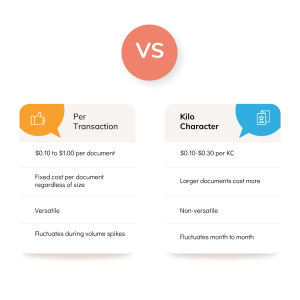
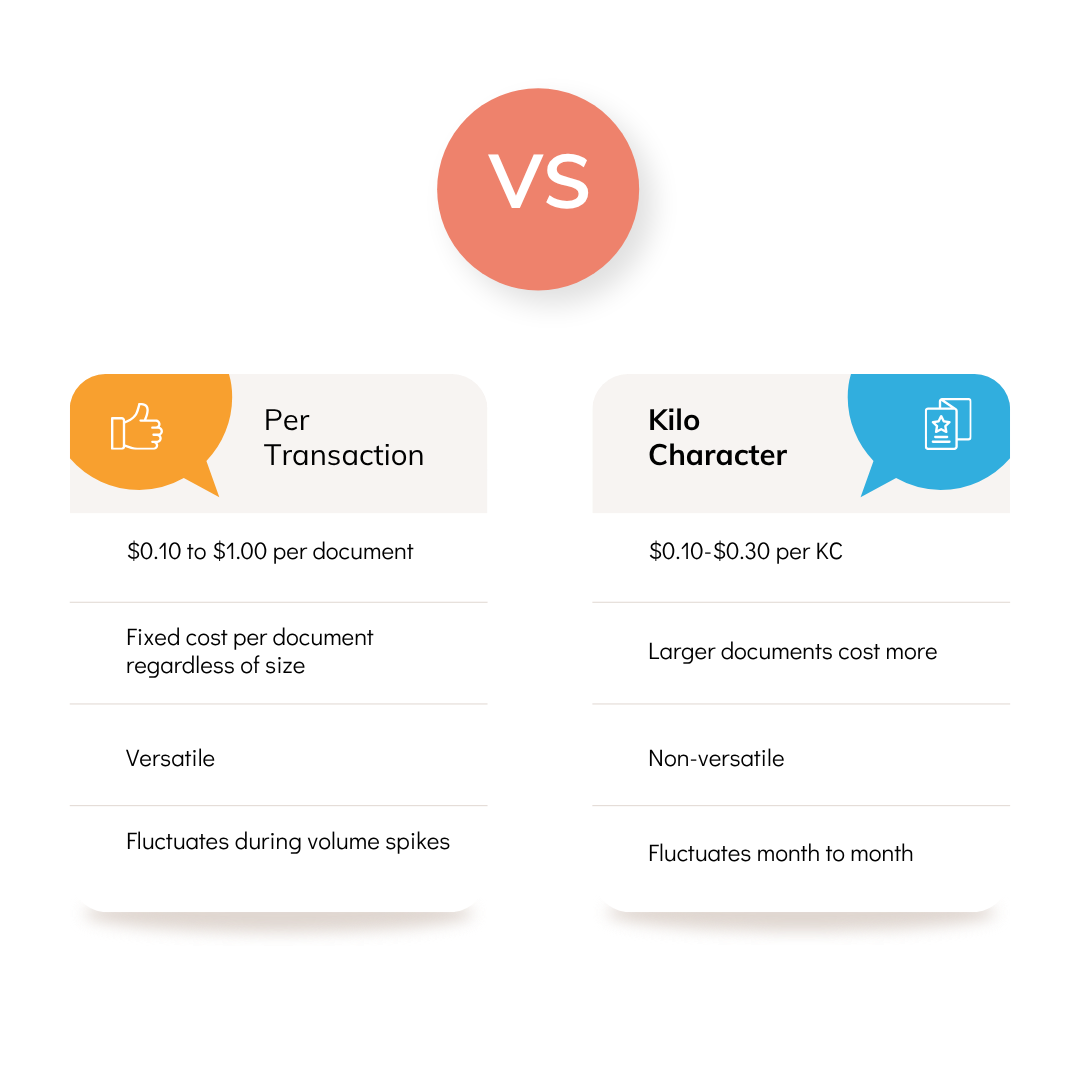
Neither model wins outright. Per-transaction pricing ($0.10-$1.00 per document) suits pilot projects with light, unpredictable volume. Kilocharacter pricing ($0.10-$0.30 per KC) can work for a handful of stable, low-activity partners
Key Takeaways
- Per-transaction pricing ($0.10-$1.00 per document) works best for pilot projects with unpredictable, minimal volumes, but costs spike dramatically during growth, when you can least afford it.
- Kilocharacter pricing charges by data volume (1 KC = 1,024 characters) at $0.10-$0.30 per KC, making larger documents cost more even when supporting the same business process.
- Calculate your true cost by dividing total monthly EDI expenses by total documents. If your effective cost exceeds $1.00 per document or bills fluctuate wildly month to month, you’re likely overpaying.
- Ask providers what happens when you double volume or add ten partners. This question reveals hidden costs and scalability issues that don’t appear in initial proposals.
Comparison Table: Per-Transaction vs Kilocharacter EDI Billing Models
The right EDI pricing model depends on your transaction volume, document complexity, and growth plans. Modern flat-rate models increasingly eliminate the billing surprises that plague traditional approaches, offering predictable costs regardless of seasonal spikes or partner additions.
| Attribute | Per-Transaction Pricing | Kilocharacter (KC) Pricing |
| What Gets Charged | Each EDI document exchanged (purchase order, invoice, ASN, acknowledgment) | Data volume transmitted (1 KC = 1,024 characters); every letter, number, delimiter, and space counts |
| Typical Fee Range | $0.10 to $1.00 per document (actual cost often $1.20-$3.00 including hidden fees) | $0.10-$0.30 per KC with tiered discounts |
| Cost Structure | Base fee + per-document charges above defined volume/partner threshold | Usage-based on total character count divided by 1,024 |
| Document Size Impact | Fixed cost per document regardless of size | Larger documents cost more; typical PO (850) = 2-5 KC, Invoice (810) = 1-3 KC, ASN (856) = 5-15 KC |
| Bill Predictability | Unpredictable during volume spikes; grows faster than business activity | Fluctuates unpredictably month to month ($130 one month, $140 next, $120 following) |
| Seasonal Impact | Costs multiply (e.g., 10x when volume increases from 500 to 5,000 documents) | Can triple monthly bill during seasonal peaks without adding new partners |
| Hidden Fee Types | Setup fees, partner onboarding ($100s per partner), map change fees ($500-$2,000), trading partner fees ($10-$50/month each), support tiers, ERP integration fees | KC rounding (bills up to nearest whole KC), envelope fees, mailbox fees ($50-$200/month), minimum KC per message, double-billing (per-KC + per-message) |
| Trading Partner Addition | $3,000-$15,000 annually for 25 partners; several hundred dollars per partner for setup | Same trading partner fees apply; costs increase if new partner requires more detailed documents |
| Best For | Pilot projects or newcomers with very light, unpredictable volumes | Low-volume firms with 4-5 core customers and stable activity at minimal levels |
| Major Drawback | Creates perverse incentive as dependency increases; costs spike during growth when least affordable | Document size variations beyond your control; trading partner specification changes increase costs without adding value |
Per-Transaction Pricing: How It Works and Where Costs Escalate
What Per-Transaction Pricing Actually Charges
Per-transaction pricing bills you for each EDI document exchanged.
Every purchase order, invoice, advance ship notice, and acknowledgment counts as a billable transaction.
The model appears proportional at first glance: more business activity means higher costs, and less activity means lower bills.
In practice, complications emerge quickly.
The definition of a “transaction” varies by provider.
A single purchase order doesn’t always equal one transaction.
Some legacy VANs bill separately for data indicators that signal the beginning of a new transaction within a single file, multiplying your actual document count.
Cost Structure: Base Fees + Per-Document Charges
Blended models combine a flat base fee with per-transaction charges above a defined volume or partner threshold. This delivers predictability at your current size with scalability as you grow.
When Transaction Volume Spikes Costs Fluctuates
Transaction volume is rarely uniform.
A manufacturer that wins a major retail account, runs a seasonal promotion, or shifts from batch to real-time order processing will see EDI bills rise or fall depending on the number of documents exchanged.
Similarly, per-transaction pricing creates a perverse incentive structure.
Transaction volume is often difficult to estimate accurately before going live.
Proposals based on estimated volume frequently understate actual usage, leading to budget surprises in the future.
Common Per-Transaction Fee Ranges by Provider
Per-transaction fees range from $0.10 to $1.00 per document, with tiered pricing creating further variability.
Companies processing fewer than 1,000 transactions might pay between $0.30 and $1 each, while those sending 10,000 or more may pay closer to $0.15.
This makes budgeting difficult when costs shift with each new volume threshold.
Hidden Costs: Setup and Partner Onboarding
Map change fees surface when trading partners update specifications. Some providers include these in the service fee; others bill hourly.
New trading partner setup fees, ERP integration fees priced separately from core EDI service, and support tier fees for faster response times all accumulate over time.
Over a multi-year relationship, these can rival the headline monthly rate.
Trading partner onboarding fees can reach several hundred dollars per partner for setup and testing. These cumulative hidden costs often double or triple advertised per-transaction rates.
Kilocharacter Pricing: Understanding the Data-Based Model
What Counts as a Kilocharacter in EDI
Kilocharacter pricing charges based on data volume transmitted, where 1 KC equals 1,024 characters of EDI data.
Every letter, number, delimiter, and space in your EDI documents counts toward your monthly total.
A single line item on a purchase order might contain 48 characters, and those characters accumulate across every transaction you send or receive.
In practice, a typical purchase order (850) runs 2 to 5 KC, an invoice (810) runs 1 to 3 KC, and an advance ship notice (856) spans 5 to 15 KC.
Add up every character transmitted during the month and divide by 1,024 to get your billable kilocharacter count.
For example, 250,000 characters equals approximately 244 KC.
How Document Size Affects Your Monthly Bill
File size becomes a billing variable you can’t control.
A larger document costs more than a smaller one, even when both support the same business process.
Document size varies depending on trading partners and required data fields.
A manufacturer who adds one retailer requiring richer ASN detail can see a substantially higher monthly bill without sending a single additional document.
Usage can surge during peak seasons, promotional periods, or new trading partner onboarding, causing sudden cost increases with no relationship to the number of documents involved.
Monthly bills fluctuate unpredictably: one month might be $130, the next $140, then drop to $120.
This makes answering the simple question, “How much will EDI cost us each month?”, genuinely difficult.
Fair Kilocharacter Rates vs Legacy Provider Markup
Modern VANs charge $0.10 to $0.30 per KC, with tiered discounts as volume increases.
Fair pricing should be transparent, usage-based, and directly tied to actual usage, without artificial minimums or systematic rounding.
Red flags signal you’re overpaying: systematic rounding up of KC counts, a minimum KC per message regardless of actual size, and charging both per-KC and per-message fees, which amounts to double-billing.
Many providers layer charges for mailbox access, archived data retrieval, and message search on top of usage fees, so the advertised per-KC rate understates true per-transaction cost.
Why Detailed Documents Cost More Under KC Pricing
Kilocharacter pricing originated when bandwidth and storage were genuinely expensive.
EDI documents have grown substantially larger over time: detailed ASNs with full carton and pallet hierarchy, invoices with comprehensive line-item data, acknowledgments with complete status codes.
This generates costs structurally higher and less predictable than the model’s original use case anticipated.
A trading partner can update its implementation guide to require more detailed data, and your cost increases without any relationship to value delivered.
Every byte of data transmitted generates revenue for the provider, yet cloud infrastructure has made bandwidth and storage cheap.
Hidden Costs Associated With Both EDI Pricing Models
1. Mailbox and VAN Access Charges
VAN Mailbox fees range from $50 to $200 per month for each mailbox.
Modern VANs like Commport VAN include unlimited sub-mailboxes at no additional charge.
KC rounds bills up to the nearest whole KC even when files fall slightly below thresholds.
Envelope fees charge for grouping multiple documents in single transmissions.
These systematic rounding practices add unnecessary charges to every transmission.
2. Trading Partner Connection Fees
Trading partner fees cost $50 to $200 per month for each partner.
For businesses with 25 partners, these fees total $3,000 to $5,000 annually.
Interconnect fees apply when sending or receiving documents to trading partners not directly connected to your provider, typically running $0.25 per document.
Trading partner onboarding fees can reach several hundred dollars per partner for setup and testing.
3. Support and Compliance Update Charges
Support fees range from $200 to $1,000 monthly.
Modern VANs like Commport VAN include support as part of base subscriptions.
Compliance and mapping fees cost $200 to $500 per partner.
When trading partners change EDI requirements, some legacy providers charge $500 to $2,000 per mapping change.
Line item overage fees trigger when purchase orders exceed predefined counts.
Which Pricing Model Saves You Money: Decision Framework
Choosing between per-transaction vs kilocharacter models requires understanding your actual usage patterns and growth trajectory, not just current volume.
When Per-Transaction Pricing Works Better
Per-transaction fees make sense for pilot projects or newcomers to EDI with very light, unpredictable volumes. Organizations processing minimal documents monthly can benefit from paying only for actual usage. Transaction fees are easier to understand than KC fees, but costs still fluctuate each month.
When Kilocharacter Pricing Costs Less
For low-volume firms with four or five core customers and stable activity, kilocharacter pricing may be slightly cheaper month to month at minimal activity levels. Any growth, regulatory change requiring richer document detail, or process automation quickly tips the scales toward alternative models. If your trading partner supports direct FTP or AS2, you can bypass the VAN entirely and eliminate kilocharacter charges.
How to Calculate Your True Cost Per Model
Tally all EDI-related expenses from your monthly invoice, including mailbox, onboarding, compliance, and support charges. Total your inbound and outbound documents using a 3-month moving average to smooth seasonal jumps.
Divide total spend by total transactions for your true cost per document.
Questions to Ask Before Choosing a Provider
Ask explicitly:
- “What is my expected all-in monthly cost at current volume, including all fees not in the base rate?”
- Then ask what that cost becomes if transaction volume doubles or you add ten new partners.
Commport offers the best EDI pricing in the industry, with subscription-based, flat-rate, per-transaction, or kilocharacter pricing options that fit your business model.
Conclusion
The per-transaction vs kilocharacter debate doesn’t have a universal winner, but one truth emerged clearly: hidden fees matter more than the headline rate.
Your true cost per document often doubles or triples advertised pricing once you factor in mailbox charges, partner fees, and support tiers.
For most businesses, especially those planning to scale, flat-rate models eliminate the billing surprises that plague both traditional approaches.
Commport offers the best EDI pricing in the industry, with subscription-based, flat-rate, per-transaction, or kilocharacter pricing options that fit your business model.
Calculate your all-in cost across at least three months, then ask providers what happens when you double volume or add ten partners. That answer reveals everything.
Commport EDI Solutions- #1 EDI Provider With Over 6000+ Happy Customers
Need Help? Download: Commport's EDI Buyers Guide
Unlock the full potential of your supply chain with our comprehensive EDI Buyer's Guide — your first step towards seamless, efficient, and error-free transactions
Frequently Asked Questions
EDI charges are fees associated with exchanging electronic business documents between trading partners. These typically include per-transaction fees (ranging from $0.10 to $1.00 per document) or kilocharacter fees ($0.10-$0.30 per KC), along with additional costs like mailbox fees ($50-$200 monthly), trading partner connection fees ($10-$50 per partner monthly), and setup charges that can reach several thousand dollars depending on your provider and business size.
Per-transaction pricing can be particularly challenging for seasonal businesses, as costs multiply directly with volume spikes, potentially increasing tenfold when document volume jumps from 500 to 5,000 during peak seasons. Kilocharacter pricing can triple monthly bills during seasonal peaks without adding new partners. For businesses with significant seasonal fluctuations, flat-rate models often provide more predictable costs and better budget control throughout the year.
To calculate your true cost per document, total all EDI-related expenses from your monthly invoice, including base fees, mailbox charges, partner onboarding costs, compliance fees, and support charges. Then count your total inbound and outbound documents using a 3-month moving average to smooth seasonal variations. Divide your total spend by total transactions to determine your actual cost per document, which often reveals costs significantly higher than advertised rates.
Key warning signs include invoices that fluctuate significantly month-to-month, effective costs exceeding $1.00 per document, multiple line items for overages or surcharges, charges for archive access or message retrieval, trading partner fees exceeding $50 monthly per partner, and systematic rounding practices that inflate usage counts. If your statement contains numerous add-on charges beyond the base rate, it’s time to investigate more transparent pricing alternatives.