


Nutrition and Allergen Attributes
GDSN requires food and beverage suppliers to report the nine major allergens (milk, eggs, fish, crustacean shellfish, tree nuts, wheat, peanuts, soybeans, and sesame) using the Allergen Type Code attribute paired with a Level of Containment Code: Contains, May Contain, Free From, Not Intentionally or Inherently Included, or Undeclared. Every allergen named in the ingredient statement must also appear in the matching allergen field, and the ingredient statement itself must list ingredients in descending order by weight. Getting this structure right is not optional. Undeclared allergens have driven roughly a quarter to more than a third of major U.S. food recalls in recent years, and GDSN certified data pools validate and synchronize this data across trading partners in real time, catching errors before they reach store shelves.
Key Takeaways
- Nine major allergens must be declared: Federal law requires specific declaration of milk, eggs, fish, shellfish, tree nuts, wheat, peanuts, soybeans, and sesame (added in 2023) on all food labels.
- GDSN standardizes allergen reporting globally: The network connects 35,000+ companies through certified data pools, enabling real-time synchronization of nutrition and allergen information across trading partners.
- Proper data structuring prevents costly errors: Use correct Allergen Type Codes with Level of Containment indicators (Contains, May Contain, Free From) and validate data before publishing to avoid rejections.
- Automated validation tools are essential: Allergen checkers compare ingredient lists against declared allergens, catching discrepancies before they reach consumers or trigger regulatory issues.
- Real-time updates maintain compliance: Synchronize allergen data immediately when formulations change, as outdated information can lead to serious health risks and regulatory penalties.
FDA's Food Recall Stats
Undeclared common food allergens pose severe health risks. About one-third of foods reported to the FDA through the Reportable Food Registry as serious health risks involved undeclared allergens between September 2009 and September 2014.
These incidents highlight why accurate allergen data matters for protecting consumers from potentially life-threatening allergic reactions to food
More recent data confirms the pattern has not gone away. A 2026 peer-reviewed analysis of 24,761 FDA food recall records from fiscal years 2013 through 2025 found that undeclared allergens accounted for 27.1 percent of FDA food recalls, with undeclared milk responsible for more than half of all allergen-driven recalls in that window.
The pattern is sharper under USDA oversight: undeclared allergens made up 38.6 percent of USDA Food Safety and Inspection Service recalls over the same period, making allergens the single leading recall cause for meat, poultry, and egg products
The Global Data Synchronization Network (GDSN) plays a critical role in standardizing how vendors report nutrition and major food allergen information. With nine recognized allergens to track and evolving regulatory requirements, getting this data right is not optional.
Understanding GDSN and Regulated Food Data
What is GDSN and Why it Matters
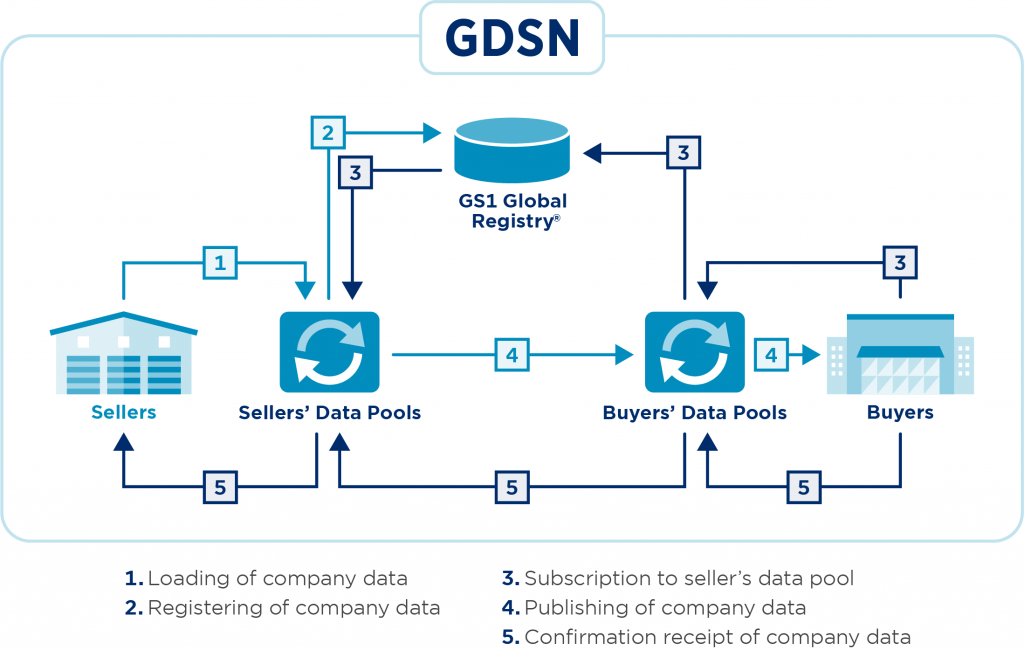
The Global Data Synchronization Network operates as an internet-based network of interoperable data pools governed by GS1 standards. This standardized, secure network connects trading partners through certified data pools, enabling automatic exchange of real-time, synchronized product information. Currently, 44 GDSN-certified data pools connect over 35,000 companies worldwide.
The network functions through a publish-subscribe pattern. When manufacturers upload product data to their chosen GDSN-certified data pool, the information gets validated against GS1 standards. This data then becomes available to authorized trading partners who have subscribed to receive it. The GS1 Global Registry acts as the network directory, holding information about data subscriptions and enabling data pool interoperability.
Global Trade Item Numbers (GTINs) uniquely identify products and their various packaging levels, while Global Location Numbers (GLNs) are 13-digit identifiers that uniquely identify locations or entities within an organization.
Together, these standardized identifiers create a common language that eliminates confusion and reduces errors throughout the food and beverage industry.
The Role of Nutrition and Allergen Data in Food Safety
Food and beverage companies must comply with strict regional and international labeling regulations, such as the Food Safety Modernization Act (FSMA) in the U.S.and allergen laws in the EU.
By synchronizing data through GDSN, you ensure your information stays up to date and compliant across all systems.
GDSN allows companies to electronically share standardized product data that includes weight, dimensions, nutritional information, and allergens.
When data is shared throughout the supply chain, partners can be alerted to product recalls or lapses that require removing products from inventory to maintain safety.
Who Needs to Report to GDSN
USDA food suppliers must report product information to GS1 GDSN for select items purchased for the National School Lunch Program. Vendors awarded contracts after December 31, 2021 must report product information within 20 days after contract award if the contract includes items on the List of Required Products for GS1 GDSN Reporting.
Dot Foods requires all product data to be published via GDSN.
Nearly 5,000 foodservice companies currently exchange data through this network.
Major Food Allergens and Regulatory Requirements
The 9 Major Food Allergens
Federal law defines nine major food allergens that account for the vast majority of severe allergic reactions:
- Milk,
- Eggs,
- Fish (such as bass, flounder, or cod),
- Crustacean shellfish (such as crab, lobster, or shrimp),
- Tree nuts (such as almonds, pecans, or walnuts),
- Wheat,
- Peanuts,
- Soybeans, and
- Sesame.
These allergens require specific declaration on food labels. For fish, crustacean shellfish, and tree nuts, you must identify the exact species or type. A generic “tree nuts” declaration does not meet requirements. You need to specify almonds, walnuts, pecans, or whichever nuts your product contains.
FALCPA and FASTER Act Compliance
Congress passed the Food Allergen Labeling and Consumer Protection Act (FALCPA) in 2004, identifying eight major food allergens that accounted for 90 percent of food allergies at that time.
The legislation addressed a serious public health concern, with approximately 30,000 individuals requiring emergency room treatment and 150 individuals dying each year because of allergic reactions to food.
Sesame became the ninth major food allergen when the FASTER Act was signed on April 23, 2021.
This change took effect on January 1, 2023, impacting roughly 1.6 million people in the U.S. who have a sesame allergy.
All FDA labeling and manufacturing requirements now apply to sesame.
Allergen Labeling Requirements
You must declare each major food allergen on product labels using one of two methods. The allergen source name can appear in parentheses following the ingredient name (lecithin (soy), flour (wheat), whey (milk)), or immediately after the ingredient list in a contains statement.
If you use a Contains statement, it must list all major food allergens present in the product.
Flavoring, coloring, or incidental additives that contain major food allergens must comply with these labeling requirements.
Cross-Contamination and Advisory Statements
Advisory statements like “may contain” or “produced in a facility” remain voluntary. These statements address unavoidable cross-contact when multiple foods are produced in the same facility using shared equipment. However, FDA guidance states that advisory statements cannot substitute for adhering to current good manufacturing practices and must be truthful and not misleading.
Download: GDSN Buyers Guide
Empower your business with global data synchronization; download our GDSN Buyer's Guide today and take the first step towards streamlined, accurate, and compliant product data management.
Structuring Nutrition and Allergen Attributes in GDSN
Mandatory Allergen Fields and Data Hierarchy
GDSN structures allergen data using the Allergen Type Code attribute, which indicates the type of allergen present in your product. This field is repeatable and works together with Level of Containment Code, Allergen Specification Name, and Allergen Specification Agency. The Allergen Type Code has a maximum length of 80 characters and applies to the base unit.
For allergens like fish, milk, shellfish, tree nuts, and wheat, multiple Allergen Type Codes exist. You must select the specific code that matches your ingredient, not just the general category. Mapping these product attributes correctly at the outset prevents rework later.
Ingredient Declaration Formatting
The ingredient statement lists all ingredients in descending order by weight. Since some ingredient statements run longer than the 5,000-character field limit, GDSN allows multiple instances using sequence numbers. Sequence numbers are only required if more than one group is present for the Item ID or if the ingredient statement value exceeds the 5,000-character limit.
Allergen Presence Codes and What They Mean
After selecting the correct Allergen Type Code, you must identify the Level of Containment Code:
- Contains: the allergen is found in the product
- May Contain: the allergen may be found due to potential cross-contamination in shared facilities
- Free From: an analysis verified the allergen is not present
- Not intentionally or inherently included: the allergen was not added during processing and is not naturally found in the product, and no analysis was completed to verify its absence
- Undeclared: you have decided not to declare allergen presence (not recommended.
Free-From Claims and Special Dietary Products
For free-from products like gluten-free or lactose-free items, use the Marketing Information or Free-from quality marks fields to indicate the claim. If oats or wheat are ingredients in a gluten-free product, you must still enter the corresponding allergen codes.
Common Data Quality Errors to Avoid
The allergen checker compares text from the ingredient list field with allergens listed in the Allergen Type field. For example, if almond is listed as an allergen, the tree nuts field must also be included. This applies to lactose in the milk group and gluten-containing grains in the gluten group. These mismatches sit alongside the wider set of product data inconsistencies that stall publication.
Best Practices for GDSN Data Accuracy and Compliance
Data Validation and Quality Checks
Accurate product data requires proactive validation before upload. Out-of-the-box validation rules aligned with GDSN standards catch errors automatically, eliminating manual rule configuration. These checks run at attribute, record, and catalog levels, giving you full visibility into data issues.
Validation summaries help prioritize fixes efficiently across large datasets. The Commport GS1 Certified GDSN Datapool Solution provides automated validation that identifies problems before they reach trading partners, backed by GS1 certification held since 2005.
Keeping Allergen Information Updated
Real-time synchronization reduces manual entry and errors across systems. Validated data supports regulatory compliance, helping avoid rejections and penalties. Update your records as soon as formulation changes occur to maintain accuracy, and push those changes downstream through product data syndication.
Working with Allergen Checkers and Automated Tools
GS1 developed an allergen checker that compares ingredient list text against declared allergen types. Data suppliers receive weekly reports highlighting errors in allergen information. The checker verifies that mandatory allergen fields at the group level match the detailed allergens.
Documentation Requirements for Regulatory Review
USDA Foods Database information serves as acceptable documentation for administrative reviews. Nutrient, ingredient, and allergen attributes must appear at the consumer unit level. If multiple consumer levels exist in your hierarchy, include this content on all applicable levels.
Conclusion
Accurate allergen and nutrition data is not just about compliance. It is about protecting consumers from serious health risks. As this guide shows, GDSN provides the standardized framework you need to get regulated data right across all trading partners. The stakes are too high for manual errors or outdated information. The Commport GS1 Certified GDSN Datapool Solution offers automated validation that catches errors before they become compliance issues.
Commport GDSN Datapool - #1 GDSN Datapool Provider in North America
Download: GDSN Buyers Guide
Empower your business with global data synchronization; download our GDSN Buyer's Guide today and take the first step towards streamlined, accurate, and compliant product data management.
Frequently Asked Questions
GDSN (Global Data Synchronization Network) is an internet-based network of interoperable data pools governed by GS1 standards that connects over 35,000 companies worldwide through 44 certified data pools. It enables automatic exchange of real-time, synchronized product information between trading partners, ensuring that nutrition and allergen data remains accurate and compliant across all systems in the supply chain.
The nine major food allergens recognized by federal law are milk, eggs, fish (such as bass, flounder, or cod), crustacean shellfish (such as crab, lobster, or shrimp), tree nuts (such as almonds, pecans, or walnuts), wheat, peanuts, soybeans, and sesame. Sesame became the ninth major allergen in January 2023 under the FASTER Act.
Allergens must be declared using one of two methods: either the allergen source name appears in parentheses following the ingredient name (such as “lecithin (soy)” or “flour (wheat)”), or all major food allergens are listed immediately after the ingredient list in a “Contains” statement. For fish, crustacean shellfish, and tree nuts, you must identify the exact species or type rather than using generic terms.
The Level of Containment Codes indicate allergen presence: “Contains” means the allergen is found in the product; “May Contain” indicates potential cross-contamination in shared facilities; “Free From” confirms analysis verified the allergen is not present; “Not intentionally or inherently included” means the allergen was not added during processing and is not naturally found in the product; and “Undeclared” indicates you have chosen not to declare allergen presence.
USDA Foods suppliers must report product information to GS1 GDSN for select items purchased for the National School Lunch Program. Vendors awarded contracts after December 31, 2021, must report product information within 20 days after contract award if the contract includes items on the List of Required Products for GS1 GDSN Reporting. Additionally, companies like Dot Foods require all product data to be published via GDSN.