Introduction
The electronics industry’s complex global supply chains demand automated document exchange to support just-in-time manufacturing and error-free operations.
Companies that delay EDI implementation risk losing trading partners and facing competitive disadvantages in an increasingly connected marketplace.
Electronic Data Interchange (EDI) enables the Electronics and Semiconductor Industry to exchange critical documents like purchase orders and invoices directly between systems without manual input.
For electronics manufacturers managing complex global supply chains, EDI transactions automate workflows, reduce errors, and improve coordination with suppliers and partners. In fact, 60%-80% of businesses in the supply chain sector already use EDI.
In this blog, we’ll walk you through exactly how to implement an EDI system in your electronics or semiconductor business, from initial preparation to going live with trading partners.
Key Takeways
- EDI is now mandatory for competitiveness – 60-80% of supply chain businesses already use EDI, making it essential for maintaining trading partnerships and avoiding costly chargebacks.
- Proper preparation determines success – Assess current processes, build cross-functional teams, and map trading partner requirements before selecting technology solutions.
- Choose the right EDI standard for your industry – Use ANSI X12 for North American operations or RosettaNet for semiconductor-specific processes requiring sub-minute response times.
- Follow the six-step implementation process – Select deployment model, map documents to standards, integrate with ERP/WMS, establish secure protocols, test thoroughly, and onboard partners systematically.
- Continuous monitoring drives optimization – Implement real-time dashboards, track acknowledgments, and maintain compliance standards to maximize ROI and trading partner satisfaction.
Understanding EDI in Electronics and Semiconductor Industry
What is EDI and How Does It Work
Electronic Data Interchange (EDI) refers to the computer-to-computer exchange of business documents in a standardized electronic format between trading partners. Unlike email or other electronic communication methods that require human intervention, EDI enables direct system-to-system communication where documents flow automatically between applications.
The EDI process involves several key stages. First, business documents are created by pulling data from internal systems like spreadsheets or databases. An EDI translator then converts these documents into standardized electronic formats that receiving systems can process. The document is transmitted using either direct computer-to-computer connections over the internet with secure protocols, or through a value-added network (VAN) where a third-party manages data transmission. On the receiving end, the trading partner’s system retrieves and integrates the document automatically.
Common EDI Transactions in Electronics Manufacturing
Electronics manufacturers exchange specific document types through standardized EDI transaction codes.
- EDI 850 handles purchase orders for component procurement.
- EDI 810 manages invoices for payment requests.
- EDI 856, the Advanced Shipping Notice (ASN), provides detailed shipment contents before arrival.
- EDI 940 controls warehouse shipping orders, while
- EDI 997 serves as a functional acknowledgment confirming document receipt.
- EDI 214 tracks transportation carrier shipment status throughout the logistics network.
Industry-Specific EDI Standards: RosettaNet and ANSI X12
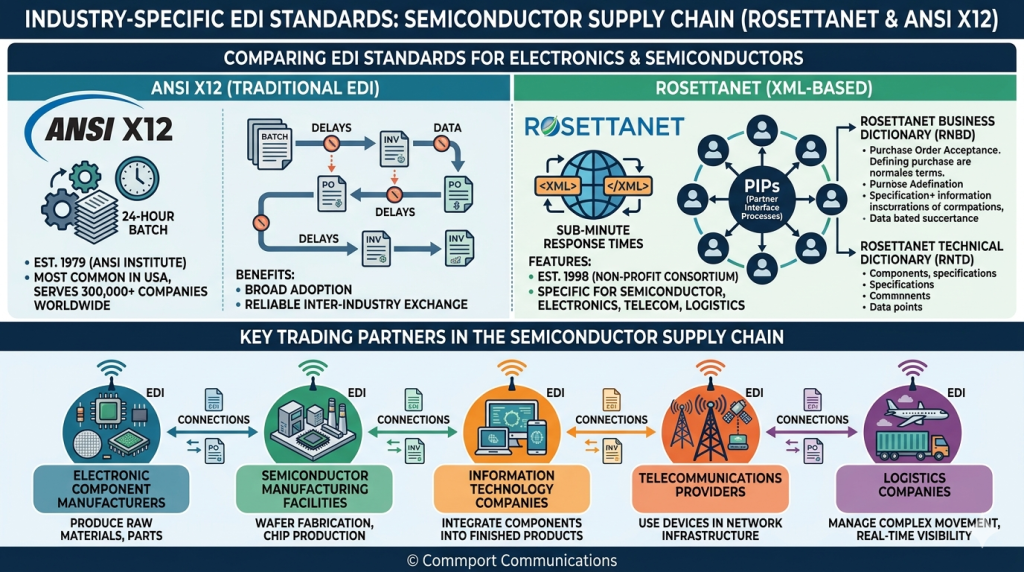
Electronics and semiconductor manufacturers primarily use two EDI standards. ANSI X12, established in 1979 by the American National Standards Institute, serves worldwide in daily business transactions over 300,000 companies. Originally conceived for North American inter-industry exchange, X12 has become the most common standard in the United States.
RosettaNet emerged in 1998 as a non-profit consortium specifically designed for the semiconductor industry, consumer electronics, telecommunications, and logistics sectors. Unlike traditional text-based EDI standards, RosettaNet uses XML-based document exchanges. The standard includes Partner Interface Processes (PIPs) that enable business partners of any size to connect electronically and move information through extended supply chains.
RosettaNet differs from traditional EDI in several ways. Traditional EDI architecture was built around 24-hour batch processing, whereas RosettaNet delivers for critical processes sub-minute response times. RosettaNet created essential business and technical dictionaries that other EDI standards lack. The RosettaNet Business Dictionary (RNBD) defines terms like ‘Purchase Order Acceptance’ to ensure correct process mapping, while the RosettaNet Technical Dictionary (RNTD) ensures consistent product data exchange.
Key Trading Partners in the Semiconductor Supply Chain
The semiconductor supply chain involves multiple trading partner types. Electronic component manufacturers form the foundation, producing the raw materials and parts needed for assembly.
Semiconductor manufacturing facilities handle wafer fabrication and chip production. Information technology companies integrate these components into finished products. Telecommunications providers use semiconductor devices in network infrastructure.
Logistics companies manage the complex movement of components across global operations, requiring real-time visibility and coordination through EDI connections.
Why EDI Implementation is Critical for Electronics Manufacturers
Manufacturing operations in electronics and semiconductors face intense pressure to deliver components precisely when needed while maintaining zero-defect quality standards. EDI systems address these operational demands by automating critical processes that manual methods cannot handle at the required speed and accuracy.
1. Streamlining Just-in-Time (JIT) Production
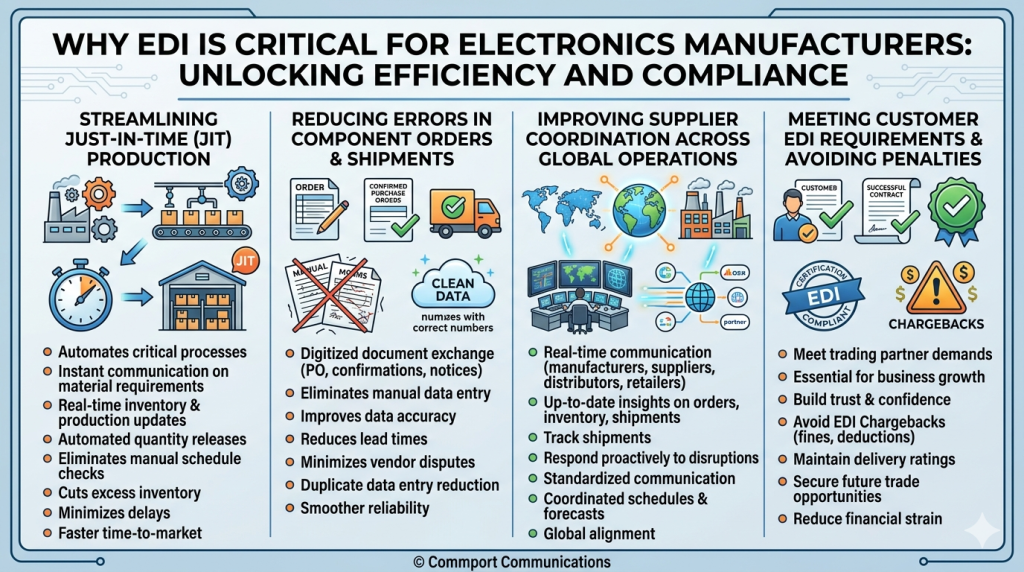
Just-in-Time manufacturing focuses on producing goods exactly when needed to minimize inventory costs. EDI proves indispensable for implementing JIT strategies because it facilitates instant communication with suppliers about material requirements. The system provides real-time updates on inventory and production schedules, reducing the risk of delays by ensuring accurate and timely data exchange.
Maximum precision and considerable time pressure define sophisticated production chains in the automotive and semiconductor sectors. JIT processes revolve around coordinating a complex network of international suppliers with the ultimate goal of having the required parts at the right place and at the right time. By automating quantity releases and inputting them directly into planning systems, EDI eliminates the need for humans to manually check release schedules, which proves critical for satisfying just-in-time deliveries and maintaining high supplier delivery ratings.
Real-time data exchange enables manufacturers to maintain optimal inventory levels, minimizing stockouts and overstocking. With automated workflows, production schedules align with demand forecasts, accelerating time-to-market. EDI supports better visibility into inventory and production schedules in real-time, cutting excess inventory and supporting lean manufacturing principles.
2. Reducing Errors in Component Orders and Shipments
Manual data entry increases the risk of invoicing errors, incorrect order details, and payment disputes. EDI automates the exchange of purchase orders, confirmations, and shipping notices, reducing lead times and improving customer satisfaction. By eliminating manual data entry, EDI significantly reduces errors in data exchange, improving accuracy across processes.
Digitized, real-time document exchange automates error-prone manual processes that can be costly and detrimental to business operations. EDI helps businesses ensure accuracy in transactions, reduce duplicate data entry, and minimize vendor disputes. This increased accuracy leads to smoother, more reliable vendor relationships. Automated transactions cut human interaction, reducing errors and speeding up operations.
3. Improving Supplier Coordination Across Global Operations
EDI enables real-time communication among manufacturers, suppliers, distributors, and retailers. This efficiency minimizes lead times and increases market response, supporting better visibility and collaboration among supply chain partners. Digital tools facilitate seamless communication with suppliers and distributors, ensuring alignment across the value chain.
EDI enables businesses to exchange information instantly between supply chain partners, ensuring that all stakeholders have up-to-date insights into orders, inventory levels, and shipment statuses. This real-time supply chain visibility leads to faster order fulfillment, reduced delays in procurement and shipping, and more accurate demand forecasting. Businesses can track shipments, adjust inventory levels, and respond proactively to disruptions, ultimately increasing efficiency.
Faster communication accelerates decision-making and market responsiveness. By standardizing communication across the supply chain, partners can coordinate schedules, forecasts, and resource allocations more effectively, reducing lead times and minimizing shipment delays.
4. Meeting Customer EDI Requirements
With virtually all major trading partners demanding that businesses be EDI compliant, the importance of building and maintaining EDI compliance cannot be understated. Many large retailers and key suppliers require EDI compliance, making it vital for maintaining and growing business relationships. Solid, trust-based relationships built on being EDI capable foster confidence and business growth.
The cost of being non-compliant comes in the form of EDI chargebacks. Each missed service level agreement, incorrect document, or delayed transaction ultimately shows up as financial penalties, lost trust, and missed opportunities. When EDI issues disrupt orders, customers lose confidence, and failed exchanges erode trust and risk future trade opportunities. Data errors and late messages cause costly deductions and fines, reducing profit and creating avoidable financial strain.
Preparing Your Organization for EDI Implementation
Successful EDI implementation begins well before selecting software or connecting with trading partners. The preparation phase determines whether your system will integrate smoothly or create ongoing operational challenges.
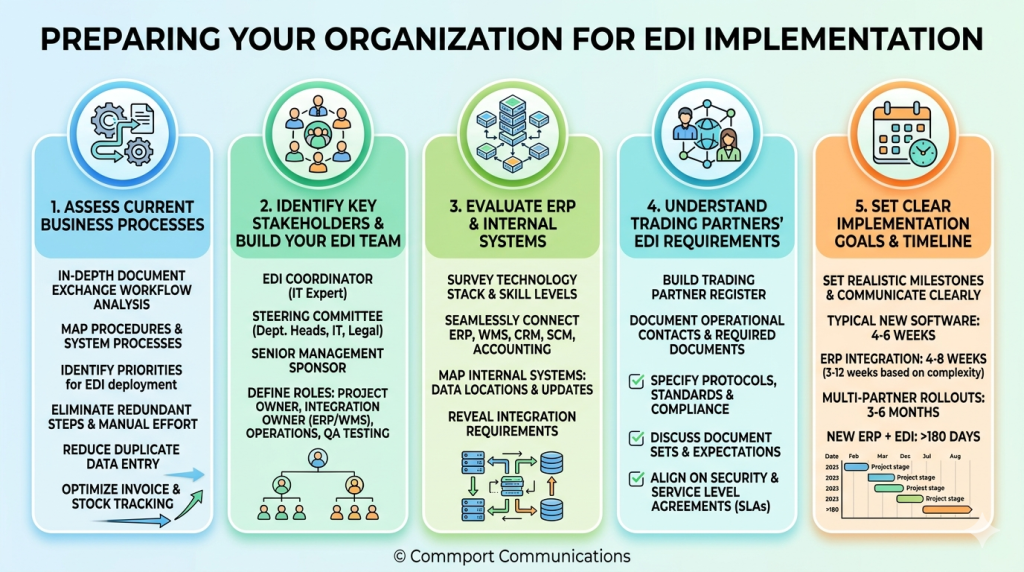
1. Assessing Your Current Business Processes
Start by performing an in-depth analysis of all elements within your document exchange workflows. This analysis identifies which corporate applications will benefit most from EDI deployment and sets priorities for conversion. Map out how each type of business document currently moves through your organization, documenting both human procedures and system processes.
The goal extends beyond automation. Examine whether EDI can eliminate redundant steps from your business cycle, remove duplicate data entry, reduce manual effort, and facilitate larger strategies like Just-in-Time manufacturing. Evaluate your people, technology, and processes to understand what’s working and what needs improvement. Pinpoint specific inefficiencies where EDI delivers the most impact, such as invoice delays from manual processing or stock level tracking issues.
2. Identifying Key Stakeholders and Building Your EDI Team
Form a project team with representatives from all stakeholder groups. Your core structure should include an EDI Coordinator, typically an IT professional with in-depth EDI experience. The Steering Committee consists of department heads from affected business units, the head of IT, and legal representatives. Secure a Senior Management Sponsor to ensure organizational commitment.
Define minimum roles clearly: a project owner from the business side, an EDI lead for platform management, an integration owner for ERP and WMS systems, an operations owner for handling exceptions and daily workflow, and a QA testing owner. This collaborative approach must involve IT, legal, compliance, and business operations from the start.
3. Evaluating Your ERP and Internal Systems
Your EDI solution must connect seamlessly with internal platforms, including warehouse management systems, customer relationship management tools, supply chain management software, accounting applications, or complete ERP systems. Survey your current technology stack and skill levels to ensure the EDI system can be supported across your business partner network.
Map your internal systems by identifying where order data lives, where shipment data resides, where invoicing happens, who owns each dataset, and how updates flow between systems. This mapping reveals integration requirements and potential bottlenecks before implementation begins.
4. Understanding Your Trading Partners' EDI Requirements
Build a trading partner register documenting each partner’s name, EDI, and operational contacts, required documents, specified protocols and standards, and compliance requirements. Understand each trading partner’s needs, technology stack, and document exchange requirements. Discuss EDI standards, document sets, and expectations during initial negotiations. Align on protocols, security measures, and service level agreements.
5. Setting Clear Implementation Goals and Timeline
Implementation timeframes vary considerably based on complexity. A brand new EDI software setup typically takes four to six weeks. Most implementations require 3 to 12 weeks, depending on partners, documents, and integration complexity. Large multi-partner rollouts can extend to three to six months. Adding ERP integration increases the timeline to approximately four to eight weeks. When setting up a completely new ERP system with EDI, expect more than 180 days.
Account for in-house resources, trading partner responsiveness, and system requirements when establishing your timeline. Set realistic milestones and communicate them clearly across your team and with trading partners.
Step-by-Step EDI Implementation Process
Implementation execution transforms preparation into operational reality through six distinct phases.
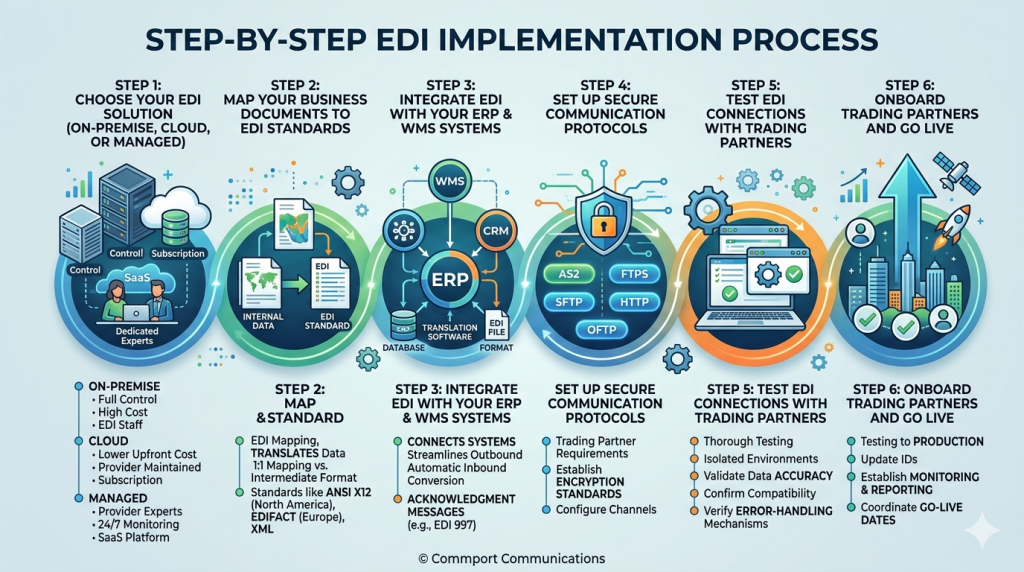
Step 1: Choose Your EDI Solution (On-Premise, Cloud, or Managed)
Your deployment model determines infrastructure control and operational flexibility. On-premises EDI installs software on your company’s servers, providing full control over security, data, and system configuration. This approach suits regulated industries with strict compliance needs but requires dedicated IT staff with EDI expertise and higher upfront costs. Cloud-based EDI shifts to subscription pricing with faster implementation, lower upfront costs, and provider-managed maintenance. Managed EDI combines a SaaS platform with dedicated provider experts who handle daily operations, partner onboarding, and 24/7 monitoring.
Step 2: Map Your Business Documents to EDI Standards
EDI mapping matches your internal data structure to standardized formats your trading partners require. Direct mapping translates data between two EDI formats using a 1:1 approach where each source element maps precisely to its target equivalent. Indirect mapping uses an intermediate canonical master format, first converting data to a common standard before transforming it into the desired target format. Choose the EDI standard your trading partners require: ANSI X12 for North America, EDIFACT for Europe, or XML for flexible customization.
Step 3: Integrate EDI with Your ERP and WMS Systems
Connect your EDI solution directly with warehouse management systems, customer relationship management tools, and ERP platforms. Embedded EDI solutions streamline outbound file preparation and automatically convert inbound documents into ERP data. Data flows from your ERP database through translation software that converts it into an EDI file format before transmission. Configure acknowledgment messages like EDI 997 to confirm successful data transmission.
Step 4: Set Up Secure Communication Protocols
Select transmission protocols based on trading partner requirements. AS2 provides secure transmission for large data volumes. Additional options include FTP, FTPS, SFTP, HTTP, and OFTP, depending on partner preferences. Establish encryption standards and configure communication channels before testing begins.
Step 5: Test EDI Connections with Trading Partners
Conduct thorough EDI testing in isolated environments before production deployment. Both partners must work within the same timeframe during this phase. Validate data accuracy, confirm system compatibility, and verify error-handling mechanisms. Test all document types your partnership requires.
Step 6: Onboard Trading Partners and Go Live
Move from testing to the production environment after successful validation. Update trading partner IDs for live operations. Establish monitoring and reporting systems with automated notifications. Coordinate official go-live dates with each trading partner individually.
Best Practices and Optimization After Implementation
Once your EDI system goes live, ongoing optimization determines long-term success.
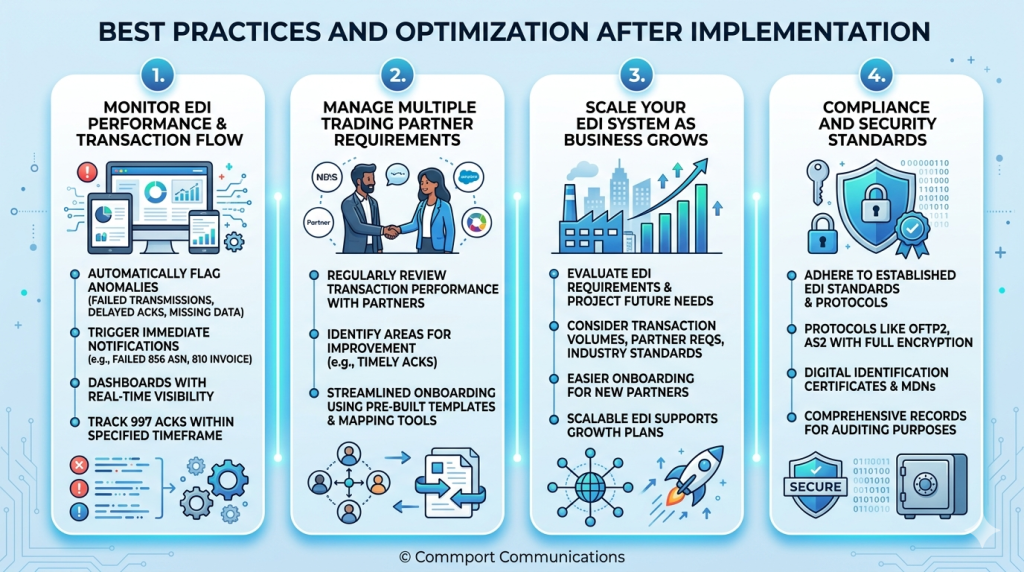
1. Monitoring EDI Performance and Transaction Flow
Configure your EDI platform to automatically flag anomalies such as failed transmissions, delayed acknowledgments, or missing data. Failed EDI 856 Advanced Shipping Notices or EDI 810 Invoices can disrupt order fulfillment and payment cycles, so these should trigger immediate notifications. Implement dashboards that provide real-time visibility into your EDI operations, displaying the status of all current transactions, platform health, and data flow through your systems.
When errors occur, conduct a deeper investigation to determine the underlying cause. Recurring errors may indicate a need for better-defined integration processes or additional training for your team. Track receipt of acknowledgment documents (997) within a specified timeframe after sending each transaction.
2. Managing Multiple Trading Partner Requirements
Regularly review transaction performance with your trading partners to identify areas for improvement. If one partner consistently fails to send acknowledgments on time, work together to optimize their processes. Create a streamlined process for adding new trading partners to your EDI network using pre-built templates and mapping tools.
3. Scaling Your EDI System as Your Business Grows
Evaluate your current EDI requirements and project future needs based on growth plans. Consider factors like transaction volumes, trading partner requirements, and industry-specific standards. Scalable EDI makes it easier to onboard new trading partners and support their specific EDI requirements.
4. Ensuring Compliance and Security Standards
EDI compliance involves adhering to established EDI standards and protocols that dictate how data is formatted and exchanged. Many EDI protocols such as OFTP2 and AS2 come with full encryption capabilities. EDI systems also offer digital identification certificates and Message Disposition Notifications (MDNs) to further enhance data security. Maintain comprehensive records of all EDI processes, compliance efforts, and transactions for auditing purposes.
Conclusion
Right now, you have everything needed to implement EDI in your electronics or semiconductor business and transform your supply chain operations. EDI adoption will significantly reduce manual errors, streamline just-in-time production, and strengthen coordination with global suppliers.
The step-by-step process we covered ensures your implementation stays on track from initial assessment through go-live and optimization. Commport, the #1 EDI Provider in North America, offers cloud-based EDI solutions for both SMBs and enterprise clients that are easy to use, affordable, and scalable, trusted by 6000+ customers.
Without delay, begin your EDI journey by assessing current processes and building your implementation team. Your competitive advantage depends on it.
Commport EDI Solutions - #1 EDI Solutions in North America
Need Help? Download: Commport's EDI Buyers Guide
Unlock the full potential of your supply chain with our comprehensive EDI Buyer's Guide — your first step towards seamless, efficient, and error-free transactions
Frequently Asked Questions
EDI (Electronic Data Interchange) is a system that allows computer-to-computer exchange of business documents in standardized electronic formats between trading partners. It enables automatic transmission of purchase orders, invoices, shipping notices, and other critical documents without manual intervention.
EDI systems operate through four key layers: the application layer that translates business documents into EDI format, the standards layer that defines how documents are structured, the transport layer that manages secure electronic transmission, and the physical network layer that establishes communication connections between trading partners.
Electronics manufacturers commonly use several EDI transactions including EDI 850 for purchase orders, EDI 810 for invoices, EDI 856 for Advanced Shipping Notices (ASN), EDI 940 for warehouse shipping orders, EDI 997 for functional acknowledgments, and EDI 214 for shipment status tracking.
Implementation timeframes vary based on complexity. A basic EDI software setup usually takes four to six weeks, while most implementations require 3 to 12 weeks depending on the number of trading partners and integration requirements. Large multi-partner rollouts can extend to three to six months, and implementations involving new ERP systems may take over 180 days.
Successful EDI implementation involves six main steps: choosing your EDI solution type (on-premise, cloud, or managed), mapping your business documents to EDI standards, integrating EDI with your ERP and warehouse management systems, setting up secure communication protocols, testing EDI connections with trading partners, and finally onboarding partners and going live with production transactions.