EDI via AS2 Technology

The Definitive Guide

In this in-depth EDI via AS2 technology guide, you’ll learn:

  • What is AS2?
  • Why is AS2 the preferred choice for major retailers to send and receive EDI files?
  • How AS2 works
  • AS2 Implementation
  • Use cases
  • Security, compliance, and the future of AS2

Overview

AS2 vs AS3 vs AS4 - Which Protocol Fits Your Needs?

If you have ever placed a purchase order online, checked a shipment’s real-time status, or received an invoice that was already matched to your system before a human even glanced at it, there is a good chance that AS2 was working quietly behind the scenes.

It is one of those technologies that rarely gets a headline but keeps billions of dollars of commerce moving every single day.

EDI, Electronic Data Interchange, has been around since the 1960s.

For decades, it relied on proprietary Value Added Networks (VANs) and batch transfers with a secure mailbox, which works great even today when handling many different trading partners simultaneously.

When the internet grew up, so did EDI, and AS2 emerged as the protocol that finally brought real-time, secure, internet-based EDI to mainstream commerce.

Today, it is one of the dominant communication protocols for direct B2B data exchange, mandated by retail giants like Walmart, Target, and Home Depot for their supplier ecosystems.

This guide was written for supply chain managers, IT decision-makers, operations leads, and business owners who want a genuine understanding of AS2, not a glossary of buzzwords, but a practical, honest look at how the technology works, why it was built the way it was, how to implement it, what it costs, and how it fits into a modern B2B integration strategy. Each chapter builds on the previous one, so whether you are a complete newcomer or someone who already runs an EDI program and wants to sharpen your knowledge, you will find real value here.

Quick Answer: AS2 (Applicability Statement 2) is an internet-based communication protocol used to transmit EDI documents, purchase orders, invoices, and shipping notices, directly between trading partners in real time, with encryption, digital signatures, and delivery receipts built into every message.

Key Takeaways

  1. AS2 is the most widely adopted protocol for direct EDI transmission, preferred by major retailers globally.
  2. It uses HTTPS, S/MIME encryption, and digital signatures to ensure every message is private, tamper-proof, and authenticated.
  3. The MDN (Message Disposition Notification) receipt system provides legally admissible proof that a message was received and accepted.
  4. AS2 reduces transaction costs, eliminates manual data entry errors, and dramatically accelerates order-to-cash cycles.
  5. Implementation requires careful certificate management, trading partner coordination, and an EDI-capable software stack.
  6. Managed AS2 services from providers like Commport eliminate the complexity of self-hosting while delivering enterprise-grade reliability.

Chapter 1

What Is AS2 and Where Did It Come From?

This chapter traces the history of Electronic Data Interchange from its 1960s military roots through the limitations of VANs and into the birth of AS2.

You will understand the specific problems that drove IETF engineers to develop AS2, what the 'AS' family of protocols actually means, and why AS2, rather than AS1 or AS3, became the industry's dominant choice.

A Brief History of EDI

Electronic Data Interchange did not spring up overnight. It grew out of necessity in the 1960s when the United States military and major freight companies realized that paper-based logistics were crippling their ability to move quickly. The Transportation Data Coordinating Committee (TDCC) was among the first bodies to formalize EDI standards for the freight industry, and by the 1970s, large retailers were adopting the approach for purchase orders and invoices.

Throughout the 1980s and 1990s, EDI became the language of big business. Standards like ANSI X12 (dominant in North America) and UN/EDIFACT (dominant globally) were codified, and a rich vocabulary of transaction sets emerged: the EDI 850 Purchase Order, the EDI 856 Ship Notice, the EDI 810 Invoice, and hundreds more.

There was one big problem with all of this: the pipes. EDI data had to travel somewhere, and for most of this era, it traveled through VANs,  Value Added Networks, which were essentially private, heavily managed telecommunications networks. VANs were reliable, but they were also expensive, slow (often batch-processing messages once or twice a day), and closed ecosystems. You could not just plug into a trading partner’s VAN without agreements, fees, and proprietary software. For a deeper look at how VANs fit into the EDI world, see Commport’s guide on Value Added Networks.

The Internet Changes Everything

By the late 1990s, the commercial internet was maturing rapidly. Email was universal, HTTPS was securing web transactions, and S/MIME was providing encryption and digital signatures for electronic messaging. A group of engineers at the Internet Engineering Task Force (IETF) asked a natural question: why are we paying VAN fees and waiting overnight for EDI messages when the Internet can deliver a message in seconds?

The answer, of course, was security and accountability. The open internet was fine for sending an email, but EDI messages represented legal business commitments,  purchase orders with specific quantities and prices, invoices with payment terms, and advance shipping notices with precise delivery windows. You needed to know that the message was not intercepted, not tampered with, and actually received by the right person. VANs provided that assurance through their controlled infrastructure. The internet, left to its own devices, did not.

The IETF working group set out to build a protocol suite that could deliver the security guarantees of a VAN over the open Internet. The result was the Applicability Statement family.

The AS Family: AS1, AS2, and AS3

The Applicability Statement protocols were developed sequentially, each designed for a different underlying transport:

AS1 (RFC 3335): Built on SMTP, the email protocol. AS1 was a reasonable proof-of-concept but inherited all of email’s limitations, no guaranteed delivery timing, potential for queuing delays, and a transport layer never designed for real-time business transactions.

AS2 (RFC 4130): Built on HTTP/HTTPS. This was the breakthrough. AS2 used the same transport protocol that was already powering secure web commerce, giving it real-time delivery, built-in TLS encryption, and near-universal firewall compatibility. It was ratified by the IETF in 2005 and rapidly became the standard of choice.

AS3 (RFC 4823): Built on FTP/FTPS. AS3 was designed for scenarios where batching was preferable or where organizations already had FTP infrastructure. It never achieved the adoption of AS2 because FTP is inherently stateful and less suited to real-time, synchronous transactions.

AS2 won the adoption race for a simple reason: HTTP was already everywhere. Firewalls were already configured to allow outbound HTTPS traffic on port 443. IT teams already understood it. Trading partners could communicate without negotiating VPN tunnels or opening exotic ports. For a broader comparison of EDI types and protocols, see Commport’s detailed breakdown of EDI communication protocols

The Walmart Effect and Industry Mandates

AS2’s adoption was accelerated dramatically by Walmart. In 2002, Walmart began requiring all of its major suppliers to support EDI via AS2, setting an industry precedent that rippled through retail, grocery, healthcare, automotive, and logistics over the following decade. When a company with Walmart’s purchasing power dictates a technical requirement, the market responds quickly.

Other retailers followed: Target, Home Depot, Amazon, Lowe’s, Costco, and hundreds of regional chains, all built AS2 into their supplier compliance programs. Today, if you want to supply a product to most major North American retailers, AS2 is effectively a non-negotiable requirement. Organizations that have not yet made the transition often find themselves losing business or paying chargebacks for non-compliance, a topic explored in more detail in Commport’s guide on chargebacks.

Key Insight: AS2 was not adopted because it was the only option; it was adopted because it perfectly matched what internet-era businesses already had: HTTPS infrastructure, SSL certificates, and firewall rules that allowed port 443. The technology met businesses where they were, rather than asking them to build something new

Chapter 2

How AS2 Works — The Technical Architecture Explained

This chapter goes under the hood of AS2. You will learn exactly what happens when one system sends an AS2 message to another, from the moment a purchase order is generated to the moment a signed receipt arrives back at the sender.

We cover S/MIME encryption, digital signatures, AS2 IDs, certificates, and the Message Disposition Notification (MDN) system that makes AS2 uniquely accountable.

The Core Components of an AS2 Transaction

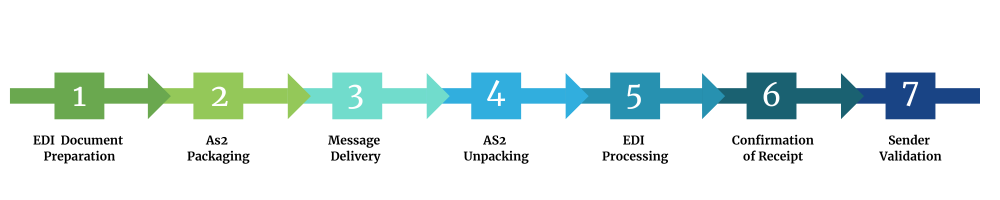
EDI Data Processing using AS2 Network

An AS2 transaction involves several moving parts working in concert. Understanding each one is essential to understanding why AS2 is trusted for mission-critical business documents.

AS2 IDs

Every trading partner in an AS2 relationship has a unique identifier called an AS2 ID. Think of it as the address on an envelope — it tells the AS2 software on the receiving end who the message is from and who it is for. AS2 IDs are typically negotiated during the trading partner onboarding process and must match exactly on both sides; a single character difference will cause a rejection.

Digital Certificates

AS2 uses X.509 digital certificates for two purposes: encrypting the message content (so only the intended recipient can read it) and signing the message (so the recipient can verify it came from the claimed sender and was not modified in transit). Each trading partner generates a certificate, shares the public key with their partners, and keeps the private key secret. Trading partner setup, including certificate exchange, is one of the most detail-intensive parts of any EDI AS2 implementation.

S/MIME Packaging

Before an EDI document is transmitted, it is wrapped in a Secure/Multipurpose Internet Mail Extensions (S/MIME) envelope. This process typically involves two operations: first, the message is signed using the sender’s private key (producing a digital signature that proves authenticity and detects tampering); second, the signed message is encrypted using the recipient’s public key (ensuring confidentiality). The result is a package that is simultaneously authenticated and private.

HTTP/HTTPS Transport

The packaged message is then sent as an HTTP POST request to the recipient’s AS2 server endpoint, a specific URL configured during trading partner setup. Modern AS2 implementations almost universally use HTTPS (HTTP over TLS), adding a transport-level layer of encryption on top of the S/MIME encryption already applied to the message payload. This double-layered security is one of the reasons AS2 is trusted for sensitive financial and logistics data.

The Message Disposition Notification (MDN)

This is the feature that truly sets AS2 apart from simpler protocols. When an AS2 message is received, the recipient’s system sends back an MDN, a signed, structured receipt that confirms the message was received, decrypted successfully, and passed signature verification. The MDN can be delivered synchronously (in the same HTTP connection) or asynchronously (via a separate HTTP request to a URL specified by the sender).

A signed MDN carries real legal weight. It contains the message ID of the original transmission, a timestamp, the recipient’s AS2 ID, and a cryptographic signature. If a trading partner ever disputes whether they received a purchase order, a signed MDN is compelling evidence that they did. This accountability mechanism is one of the primary reasons enterprise trading partners prefer AS2 over alternatives like sFTP for business-critical documents.

Key Insight: The MDN is AS2’s equivalent of a return receipt on a registered letter, except it is cryptographically signed, timestamped, and automatically processed by the receiving system. It eliminates the ‘we never received it’ problem from B2B communication.

A Step-by-Step Walk Through a Complete AS2 Transaction

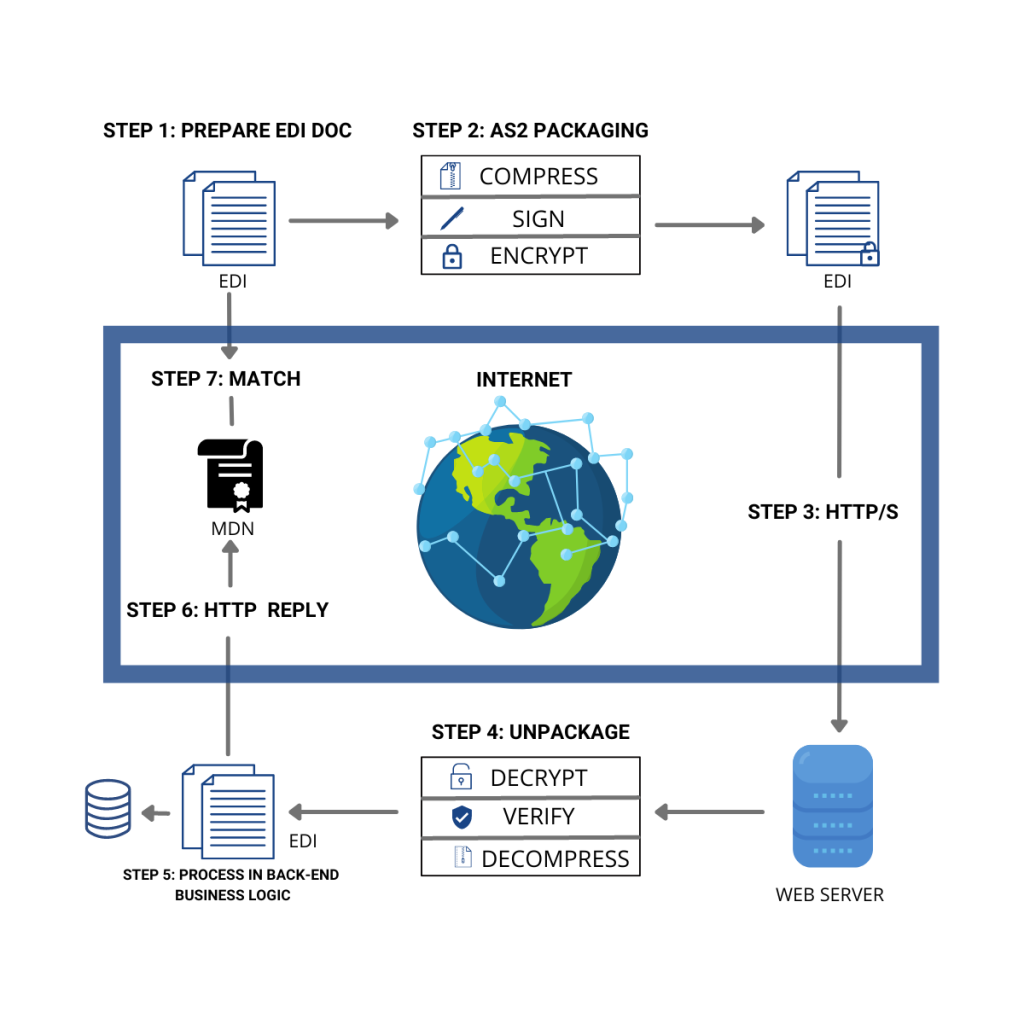
EDI Via AS2 - Complete Workflow Diagram

Let us follow a purchase order from a retailer’s system to a supplier’s system using AS2:

  • Step 1 — EDI Generation: The retailer’s ERP system generates an EDI 850 Purchase Order in ANSI X12 format. For a detailed look at what this document contains, see Commport’s EDI 850 reference.
  • Step 2 — S/MIME Packaging: The AS2 software signs the EDI file with the retailer’s private key and encrypts it with the supplier’s public certificate.
  • Step 3 — HTTPS Transmission: The packaged message is posted via HTTPS to the supplier’s AS2 endpoint URL. The connection is established over TLS, adding transport-layer encryption.
  • Step 4 — Receipt and Decryption: The supplier’s AS2 server receives the message, verifies the TLS connection, decrypts the S/MIME envelope using its private key, and verifies the digital signature using the retailer’s public certificate.
  • Step 5 — MDN Generation: The supplier’s system generates a signed MDN receipt and returns it to the retailer — either immediately in the same connection (synchronous) or via a follow-up POST to the retailer’s MDN URL (asynchronous).
  • Step 6 — EDI Processing: The extracted EDI 850 document is passed to the supplier’s ERP or WMS for processing — all automatically, without a human touching the data.

The entire process, from transmission to MDN receipt, typically completes in under a second on a reliable connection. Compare that to overnight batch processing via a VAN, and the operational advantage of AS2 becomes immediately apparent.

AS2 Message Headers: What Gets Sent

An AS2 HTTP message includes a set of mandatory and optional headers that carry metadata about the transaction. Key headers include: AS2-From (sender’s AS2 ID), AS2-To (recipient’s AS2 ID), AS2-Version (protocol version), Content-Type (describing the S/MIME structure), Message-ID (unique identifier for the transmission), and Disposition-Notification-To (the URL where the MDN should be sent). These headers are inspected by the receiving AS2 software before the payload is even touched, which enables quick rejection of malformed or unauthorized messages.

For organizations working with EDI data pipelines and automated workflows, understanding these headers is valuable. Commport’s guide on EDI workflows provides a detailed explanation

Commport EDI Solutions

100% EDI Compliance Guaranteed!

Chapter 3

AS2 vs. Other EDI Communication Protocols

AS2 is not the only way to transmit EDI documents, and understanding the alternatives helps you make informed decisions about your communication architecture.

This chapter compares AS2 with sFTP, FTPS, VAN networks, and the emerging AS4 protocol, examining speed, security, cost, reliability, and use-case fit for each.

AS2 vs. sFTP

sFTP (SSH File Transfer Protocol) is the most common alternative to AS2 for EDI transmission among mid-market companies. It is well understood, widely supported, and relatively inexpensive to implement. But the comparison reveals important differences.

sFTP is a file transfer protocol; it moves files from one location to another, typically to a shared directory that a trading partner then polls on a schedule. There is no built-in receipt mechanism, no message-level encryption (sFTP encrypts the channel, not the payload), and no guaranteed real-time delivery. If a partner’s system polls hourly, your purchase order could wait up to 59 minutes before it is even seen.

AS2, by contrast, is a synchronous push protocol. The message is delivered directly to the recipient’s system, which processes it immediately and sends back a signed receipt. There is no polling, no shared directory to manage, and the MDN provides cryptographic proof of delivery that sFTP simply cannot match. For organizations that have already implemented sFTP-based EDI and want to understand the technical nuances, Commport’s guide on

That said, sFTP is not worthless. For lower-volume, less time-sensitive exchanges where a retailer or partner does not mandate AS2, sFTP remains a cost-effective option that is simpler to configure for small businesses. For a deeper look at how sFTP compares across security and protocol dimensions, Commport’s blog on the comparison of different communication protocols can help.

AS2 vs. VAN (Value Added Network)

VANs were the original infrastructure for EDI, and they are still widely used today,  particularly in healthcare, where the ANSI X12 ecosystem is mature, and VAN services offer a one-to-many connectivity model. But they are fundamentally different from AS2 in architecture.

A VAN acts as a clearinghouse: your system sends documents to the VAN, the VAN routes them to the appropriate trading partner’s mailbox, and the trading partner picks them up on their schedule. This introduces latency (often measured in hours for batch transmissions), per-transaction fees on top of subscription costs, and a dependency on the VAN provider’s availability and routing accuracy.

AS2 is direct; your system communicates directly with your trading partner’s system, with no intermediary. This eliminates per-transaction VAN fees, reduces latency to near-zero, and removes a potential point of failure. However, VANs offer a genuine advantage for organizations with hundreds of trading partners: the VAN handles the complexity of maintaining connections to all of them. AS2 requires a direct relationship with each partner, which means more initial setup work.

Many sophisticated organizations use a hybrid model: AS2 for their highest-volume, most time-sensitive trading partner relationships, and VAN for long-tail partners where the setup cost of a direct AS2 connection would not be justified. To understand when a VAN makes more sense than direct protocols, read Commport’s article on VAN vs AS2.

AS2 vs. FTPS

FTPS (FTP Secure) adds TLS/SSL encryption to the classic FTP protocol, which helps with transport security but does not address the fundamental limitations of FTP for real-time EDI. FTP is stateful, requiring both a control connection and a data connection, a configuration that causes notorious problems with firewalls and NAT. It was designed for interactive file transfer, not automated, real-time B2B messaging.

AS2’s use of standard HTTPS means it travels over port 443, which virtually every corporate firewall allows outbound. This alone makes AS2 significantly easier to deploy across diverse IT environments than FTPS, which may require firewall exceptions for port 21 (control) and a range of ephemeral ports (data).

AS2 vs. AS4

AS4 is the protocol developed as AS2’s successor, built on SOAP/Web Services rather than raw HTTP. It was designed to address some of AS2’s limitations: AS4 supports multi-hop routing (useful for complex networks like peppol, used in European e-invoicing), better support for attachments, and a more modern web services architecture.

However, AS4 adoption has been slow outside of specific industries and regions, particularly EU government procurement (where Peppol mandates AS4) and parts of the energy sector. For the vast majority of North American retail, grocery, healthcare, and manufacturing EDI, AS2 remains the standard. AS4’s complexity and the massive installed base of AS2 infrastructure mean that AS2 is unlikely to be displaced in the near term.

Protocol Comparison at a Glance

Feature

AS2

sFTP

VAN

FTPS

Real-Time Delivery

✓ Yes

✗ Polling

✗ Batch

✗ Polling

Built-in Receipt (MDN)

✓ Yes

✗ No

Partial

✗ No

Message-Level Encryption

✓ S/MIME

Channel only

Varies

Channel only

Digital Signatures

✓ Yes

✗ No

Varies

✗ No

Firewall Friendly

✓ Port 443

Port 22

Varies

Port 21+

Per-Transaction Fees

None direct

None

Yes

None

Setup Complexity

Moderate

Low

Low-Med

Moderate

Major Retailer Mandated

✓ Most

Some

Some

Rare

Chapter 4

Implementing AS2 — A Practical Roadmap

This chapter walks through the practical reality of implementing AS2, covering software options, the trading partner onboarding process, certificate management, testing, and the decision between self-hosting and managed services.

It includes a realistic assessment of timelines, common pitfalls, and what questions to ask a prospective AS2 provider.

What You Need Before You Start

Implementing AS2 is not a weekend project, but it is also not as daunting as some vendors make it sound. The key inputs are:

  • A trading partner who wants to exchange EDI via AS2 with you (or a compliance requirement driving the implementation)
  • AS2-capable software — either on-premise, cloud-based, or managed service
  • An X.509 digital certificate for your organization (either self-signed or from a commercial CA)
  • Your trading partner’s public certificate
  • Agreement on AS2 IDs, MDN preferences (sync vs. async), EDI document types, and interchange settings
  • An accessible HTTPS endpoint for receiving inbound messages
  • Firewall rules allowing inbound HTTPS traffic to your AS2 server (if self-hosting)

One of the most common early mistakes is underestimating the coordination required between IT and the business team. AS2 is a technical protocol, but the business parameters — which document types, which trading partner specifications, which acknowledgment requirements- come from your operations and procurement teams. Getting both sides of the house aligned early saves significant rework.

Software Options: Self-Hosted vs. Managed Service vs. Cloud EDI

Organizations implementing AS2 face a fundamental architectural choice that shapes everything downstream.

Self-Hosted AS2 Software

Self-hosted AS2 software gives maximum control and avoids ongoing service fees, but it requires internal expertise to manage certificates, server uptime, software updates, and trading partner connectivity. For organizations with dedicated EDI teams and a large volume of direct partner relationships, this can make economic sense.

Cloud EDI with AS2 Support

Cloud-based EDI platforms host AS2 infrastructure in the cloud, eliminating server management but still requiring your team to manage trading partner configurations, certificate renewals, and document mapping. For a thorough comparison of the trade-offs, see Commport’s analysis of

Managed EDI Service Providers

A managed EDI service provider takes responsibility for operating your AS2 infrastructure, certificate management, server uptime, trading partner connectivity, document mapping, and monitoring. For organizations that want the business benefits of AS2 without building internal EDI expertise, this is typically the fastest, lowest-risk path.

The Trading Partner Onboarding Process

Trading partner onboarding is the process of establishing the technical connection between your AS2 system and a specific partner’s AS2 system. It typically involves the following steps:

  • Profile Exchange: You and your partner exchange AS2 IDs, endpoint URLs, and public certificates. This is usually done via email or a partner portal.
  • Configuration: Both parties configure their AS2 software with the other’s profile — ID, URL, certificate, encryption preferences, and MDN settings.
  • Test Transmission: A test message (often a simple text file or a sample EDI transaction) is sent in each direction to verify connectivity, encryption, and MDN receipt.
  • EDI Testing: Partner-specific EDI transactions are tested, including a sample purchase order, invoice, and ship notice, and checked against the partner’s trading guidelines. Commport’s guide to EDI testing covers best practices for this critical phase.
  • Go-Live: After successful testing, the connection is promoted to production. Monitoring is established to catch any transmission failures.

For organizations managing a single trading partner, this process might take a few days. For a retailer onboarding thousands of suppliers, it is a continuous, industrialized operation. Commport offers a dedicated single trading partner setup service. See the overview of the full setup process.

Certificate Management: The Hidden Complexity

X.509 certificates are the foundation of AS2’s security, but they come with an operational burden that surprises many organizations: they expire. A typical certificate has a validity period of one to three years. When a certificate expires and is not renewed in advance, the AS2 connection with every partner using that certificate breaks simultaneously.

Best practices for certificate management include: tracking expiry dates in a central inventory, initiating renewal at least 60 days before expiry, notifying all affected trading partners of certificate changes before they are deployed, and testing the new certificate on non-production connections before replacing the production one. Organizations running large AS2 networks, with dozens or hundreds of partners, should treat certificate management as a formal IT process with assigned ownership and escalation paths.

Timeline and Cost Expectations

A realistic AS2 implementation timeline for a company with a small number of trading partners (one to five) is four to eight weeks from project kick-off to go-live, assuming reasonable responsiveness from all parties. Larger rollouts with more partners scale roughly linearly.

Cost variables include: software licensing or SaaS fees, internal IT staff time, trading partner coordination time, certificate costs (if using a commercial CA), and integration development to connect AS2 to internal systems (ERP, WMS, OMS). For a comprehensive view of EDI cost factors, Commport’s guide on EDI pricing.

Pro Tip: The single most common cause of AS2 go-live delays is not technical; it is waiting for trading partners to complete their side of the configuration. Build partner responsiveness delays into your project timeline and establish escalation contacts at each partner before the project begins

Chapter 5

AS2 in Action — Industry Use Cases and Real-World Benefits

Summary: AS2 is not a technology in search of a problem; it was built to solve specific, painful operational issues, and the industries that adopted it early have quantifiable evidence of the results.

This chapter explores how AS2-powered EDI is used across key industries, what specific document exchanges it enables, and what the measurable business outcomes look like.

Retail and Consumer Goods

Retail is where AS2 achieved its first and most decisive adoption. The retailer-supplier relationship is characterized by high transaction volume, tight deadlines, and severe penalties for compliance failures. An order confirmation that arrives a day late, a ship notice that is missing or malformed, these are not just operational hiccups; they trigger chargebacks that can cost suppliers thousands of dollars per incident.

With AS2, a retailer’s purchase order reaches a supplier’s ERP in seconds. The supplier’s system automatically generates a purchase order acknowledgment (EDI 855), which travels back to the retailer via AS2 within minutes. When the goods ship, the EDI 856 Advanced Shipping Notice goes out, again, instantly, giving the retailer’s receiving team precise visibility into what is coming and when.

The result for well-run AS2 implementations in retail supply chains: order-to-ship cycles shrink, on-shelf availability improves, and chargebacks for late or missing EDI documents drop dramatically.

Healthcare and Life Sciences

Healthcare has some of the most stringent data security and auditability requirements of any industry, which makes AS2’s built-in encryption, digital signatures, and MDN receipts particularly valuable. Hospitals, group purchasing organizations, pharmaceutical distributors, and medical device manufacturers use AS2 to exchange purchase orders, invoices, formulary data, and advance shipping notices.

HIPAA compliance requirements add another dimension: electronic transactions containing protected health information (PHI) must be encrypted in transit. AS2’s S/MIME encryption satisfies this requirement at the message level, while TLS satisfies it at the transport level. This dual-layer approach is not over-engineering; it reflects the reality that any gap in data protection in healthcare can trigger regulatory action.

Logistics and Third-Party Logistics (3PL)

In logistics, timing is everything. A carrier confirmation that arrives two hours late can mean a missed pickup window, a disappointed shipper, and a penalty for the logistics provider. AS2 enables real-time exchange of load tender documents (EDI 204), carrier confirmations, status updates (EDI 214), and freight invoices (EDI 210) between shippers, carriers, and 3PL providers.

For 3PLs specifically, AS2 enables a particularly powerful capability: connecting to dozens or hundreds of shipper and carrier AS2 endpoints from a single platform, creating a unified data exchange network that would be impossible to replicate with manual processes or phone-based communication.

The shipping industry more broadly benefits from EDI and AS2 in ways that extend from freight tendering all the way to customs documentation and real-time shipment visibility

Automotive Manufacturing

Automotive supply chains are among the most complex in the world, with just-in-time manufacturing disciplines that leave almost no tolerance for data delays or errors. AS2 is the primary mechanism for transmitting production forecasts, scheduling agreements, sequenced shipping schedules (EDI 830), and delivery instructions between OEMs and their Tier 1 and Tier 2 suppliers.

The automotive industry also uses proprietary EDI standards like ODETTE (in Europe) and VDA (in Germany) alongside ANSI X12, and AS2 serves as the transport for all of them.

Grocery and Food & Beverage

The grocery industry operates on razor-thin margins and high velocity, with promotions, seasonal demand swings, and perishability all demanding real-time data exchange. AS2 powers the exchange of promotional pricing data, order confirmations, and advance shipping notices between grocery chains and their thousands of CPG suppliers.

In food and beverage, traceability requirements add another layer of importance. Being able to prove when a shipment was sent, when it was received, and what was in it with cryptographic receipts. has become increasingly important in the context of food safety regulations and recall management

The Measurable Business Case for AS2

It is worth being concrete about the numbers, because the business case for AS2 implementation is strong and well-documented across industries. Organizations that move from manual or VAN-based processes to direct AS2 integration typically report:

  • 60–80% reduction in order processing cycle time for direct partner relationships
  • Near-elimination of keying errors (EDI accuracy rates typically exceed 99.9%)
  • Significant reduction or elimination of EDI-related chargebacks
  • Reduced transaction costs compared to VAN per-transaction fees for high-volume partners
  • Improved cash flow from faster invoice processing and payment cycles
  • Better inventory management through real-time order and shipment visibility

Need Help? Download: EDI Buyers Guide

Unlock the full potential of your supply chain with our comprehensive EDI Buyer's Guide — your first step towards seamless, efficient, and error-free transactions

Chapter 6

Security, Compliance, and the Future of AS2

AS2's security architecture was ahead of its time when RFC 4130 was ratified in 2005, but the threat landscape has evolved. This chapter examines AS2's security strengths and weaknesses, best practices for hardening an AS2 implementation, regulatory compliance considerations, emerging developments in AS2 tooling, and the longer-term trajectory of EDI communication protocols.

AS2's Security Architecture: Strengths

AS2 was designed with security as a first-class concern, and its architecture reflects that priority in several ways:

End-to-End Message Encryption

S/MIME encryption protects the message payload from the moment it leaves the sender’s system to the moment it is decrypted by the recipient. Unlike VPN-based approaches (which protect the connection but not the payload), S/MIME-encrypted AS2 messages remain encrypted even if intercepted after the TLS connection terminates, for example, in transit through intermediate proxy servers or logging systems.

Non-Repudiation through Digital Signatures

When a sender signs an AS2 message with their private key, they create cryptographic evidence that they, and only they, sent that specific message with that specific content at that specific time. When the recipient signs the MDN with their private key, they create equally compelling evidence of receipt. Together, these signatures create a legally defensible record of the transaction that neither party can subsequently dispute.

Authentication

AS2’s certificate-based authentication ensures that messages are only accepted from known, trusted partners. An attacker cannot inject a message into an AS2 channel without possessing the sender’s private key, which, if properly managed, never leaves the sender’s systems.

Security Best Practices for AS2 Deployments

Despite its strong security architecture, AS2 implementations can be weakened by poor operational practices. The following represent current best practices for maintaining a secure AS2 environment:

  • Use 2048-bit or 4096-bit RSA keys for certificates (1024-bit is now considered insufficient)
  • Enable TLS 1.2 or TLS 1.3 for transport; disable TLS 1.0 and 1.1, which have known vulnerabilities
  • Require signed MDNs for all business-critical message exchanges
  • Implement IP whitelisting where possible to restrict AS2 connections to known partner IP ranges
  • Rotate certificates proactively do not wait for expiry warnings
  • Log all AS2 transactions (including headers, MDNs, and errors) and retain logs per your compliance requirements
  • Monitor for transmission failures in real time; a broken AS2 connection can silently stall business operations if not detected quickly
  • Apply the principle of least privilege to AS2 server accounts and restrict access to private keys

Regulatory Compliance Considerations

AS2 implementations exist within regulatory frameworks that vary by industry and geography. Key compliance considerations include:

HIPAA (Healthcare)

The HIPAA Security Rule requires covered entities to implement technical safeguards for electronic protected health information (ePHI), including access controls, audit controls, and transmission security. AS2’s encryption and MDN receipts directly support these requirements, but organizations must also maintain transaction logs, conduct regular risk assessments, and have business associate agreements (BAAs) with AS2 service providers.

GDPR (European Union)

For organizations processing personal data of EU residents, the General Data Protection Regulation imposes requirements around data minimization, purpose limitation, and security. AS2’s encryption and authentication mechanisms support GDPR’s technical security requirements, but organizations must also address data residency (where AS2 servers are physically located) and data subject rights.

SOX (Financial Services and Public Companies)

Sarbanes-Oxley requires public companies to maintain accurate financial records and implement internal controls over financial reporting. AS2 transaction logs and MDN receipts contribute to the audit trail for electronic financial documents (invoices, purchase orders, payment advices).

Industry-Specific Standards

Various industry bodies, GS1, the Automotive Industry Action Group (AIAG), and HIBC, publish EDI implementation guides that specify AS2 configuration requirements for their member ecosystems. Organizations must ensure their AS2 implementations conform to the specific guidelines of each trading partner relationship, which can vary substantially even within the same industry.

Common AS2 Implementation Pitfalls and How to Avoid Them

Years of production experience across AS2 implementations reveal a consistent set of failure patterns. Being aware of them in advance is half the battle:

Certificate Mismatch: The most common AS2 connection failure. Occurs when a trading partner updates their certificate without notifying their partners. Solution: implement automated certificate monitoring and establish a formal certificate change notification process with all partners.

AS2 ID Case Sensitivity: AS2 IDs are case-sensitive. ‘MyCompany’ and ‘mycompany’ are different identifiers. Even a single character case difference will cause message rejection. Solution: document AS2 IDs exactly as configured and verify during testing.

Firewall Blocking Inbound AS2: Organizations that implement AS2 for outbound messages often forget to open inbound port 443 for partner connections and MDN deliveries. Solution: verify both inbound and outbound connectivity during testing.

Async MDN Misconfiguration: When asynchronous MDNs are used, the MDN return URL must be reachable from the partner’s network. Incorrect URLs or firewall rules blocking the return path result in missing MDNs and false delivery failures. Solution: test the full MDN round-trip during onboarding, not just the outbound message.

Lack of Monitoring: AS2 connections can fail silently if not monitored. A failed transmission may not trigger any visible error in the sending system, and business processes dependent on the exchange simply stall. Solution: implement real-time monitoring of AS2 transaction logs with alerting for failures.

The Future of AS2 and EDI Communication

AS2 is a mature, proven technology, and its future is not in question for most organizations — it will remain a cornerstone of EDI infrastructure for at least the next decade. But several developments are shaping how it will be used and extended:

AS2 + API Integration

Modern B2B integration strategies increasingly combine AS2 with REST APIs. AS2 handles the structured EDI document exchange with trading partners, while APIs connect those documents to internal systems (ERP, WMS, CRM) and enable real-time data access for portals and analytics. This hybrid approach preserves AS2’s reliability for partner-facing transactions while leveraging modern API capabilities internally.

Cloud-Native AS2 Services

As organizations migrate workloads to the cloud, AS2 infrastructure is following. Cloud-native AS2 services offer advantages in scalability, certificate management automation, and integration with cloud-based ERP and WMS platforms. The shift eliminates on-premise server maintenance while maintaining all of AS2’s security guarantees.

Enhanced Monitoring and Analytics

Next-generation AS2 platforms provide real-time dashboards, SLA monitoring, and anomaly detection that transform AS2 from a black box into a visible, measurable part of supply chain performance management.

Convergence with E-Invoicing Standards

Regulatory mandates for electronic invoicing (e-invoicing) are expanding globally. In many jurisdictions, AS2 is the accepted transmission mechanism for structured e-invoices to government clearing systems. As these mandates grow, AS2’s role in the invoice-to-pay process is expanding alongside its traditional supply chain applications.

Looking Ahead: AS2 is not being replaced; it is being embedded into a richer B2B integration ecosystem that includes APIs, cloud services, and analytics. Organizations that invest in AS2 today are investing in infrastructure that will serve them well for years while remaining compatible with the evolving technology landscape around them.

Conclusion

When you step back and look at what AS2 actually does, it takes a business document, signs it, encrypts it, delivers it in seconds to a trading partner’s system, and returns a cryptographically signed receipt. It is remarkable how elegantly it solves a genuinely hard problem. The founders of the IETF working group that produced RFC 4130 set out to bring VAN-grade accountability to the open internet, and they succeeded.

For businesses operating in today’s supply chain environment, AS2 is not an optional technical nicety; it is increasingly a baseline requirement. The major retailers have mandated it. The healthcare industry’s security requirements all but demand it. The logistics industry’s need for real-time shipment visibility makes it the practical choice. And for any organization that has ever dealt with the operational cost of a lost purchase order, a disputed invoice, or an EDI chargeback, AS2’s signed receipts represent real risk reduction.

The good news is that implementing AS2 is more accessible than ever. Cloud-based platforms, managed service providers, and mature software ecosystems mean that even small businesses can get AS2 up and running without building an internal EDI team from scratch. The questions to answer are not ‘can we do this?’ but ‘which deployment model fits our situation?’ and ‘who is the right partner to help us?’

Whichever path you choose,  self-hosted, cloud-based, or fully managed,  the underlying technology will serve you reliably. AS2 has been battle-tested in some of the world’s most demanding supply chains for more than two decades. It works.

We hope this guide has given you a solid foundation for understanding AS2, evaluating your options, and making confident decisions about your EDI communication infrastructure.

Frequently Asked Questions

AS2 stands for Applicability Statement 2. It was developed by the Internet Engineering Task Force (IETF) and published as RFC 4130 in July 2005. The working group was responding to industry demand for a secure, internet-based alternative to VAN-mediated EDI.

No — AS2 is the communication protocol (how the data travels), while EDI refers to the structured data formats exchanged (what travels). EDI documents like purchase orders and invoices can be transmitted via AS2, sFTP, VAN, or other protocols. AS2 is simply the most secure and real-time option for direct partner-to-partner exchange.

Not necessarily — sFTP may be sufficient for lower-volume, less time-sensitive relationships. However, many major retailers and healthcare organizations mandate AS2 specifically because of its real-time delivery and signed receipt capabilities. If a key trading partner requires AS2, there is typically no practical alternative.

AS2 is highly secure when properly configured. It uses S/MIME for message-level encryption and digital signatures, TLS for transport-layer encryption, and certificate-based authentication to verify sender identity. These combined mechanisms protect against eavesdropping, tampering, and impersonation. The main security risks are operational — certificate mismanagement and misconfigured TLS settings — not inherent weaknesses in the protocol itself.

An MDN (Message Disposition Notification) is a signed digital receipt sent by the receiver back to the sender, confirming that a message was received, decrypted successfully, and passed signature verification. A signed MDN creates non-repudiable evidence of delivery — meaning neither party can later claim the message was not received. For business-critical transactions like purchase orders and invoices, this accountability is invaluable.

A single trading partner onboarding, from initial profile exchange to successful test transmission, typically takes one to three weeks when both parties are responsive and organized. The timeline extends if there are certificate issues, firewall problems, or EDI document mapping work required. Working with an experienced managed service provider like Commport can significantly compress this timeline.

Absolutely. Cloud-based AS2 services and managed EDI providers have made AS2 accessible to businesses of all sizes. You do not need a dedicated EDI team or on-premise infrastructure. A small supplier can be AS2-capable through a managed service for a monthly fee that is a fraction of the cost of VAN-based EDI or the risk of chargebacks from non-compliance.

Any ANSI X12 or EDIFACT document can be transmitted via AS2. The most common in retail supply chains are the EDI 850 (Purchase Order), EDI 855 (Purchase Order Acknowledgment), EDI 856 (Advance Ship Notice), EDI 810 (Invoice), EDI 820 (Payment Order), and EDI 997 (Functional Acknowledgment). Logistics uses EDI 204, 214, and 210. Healthcare uses additional transactions specific to HIPAA-compliant exchanges.

AS2 can handle EDI files of virtually any size, though very large files (hundreds of megabytes) may benefit from compression (AS2 supports ZLIB compression) or splitting into multiple transactions. Most EDI documents are quite small — a typical purchase order is a few kilobytes — so file size is rarely a concern in practice.

If a message fails to deliver (for example, because the recipient’s server is down), the sending AS2 software will typically retry on a configurable schedule. If delivery ultimately fails or no MDN is received within a timeout period, an alert is generated so the operations team can investigate. This visibility into transmission status is one of AS2’s significant advantages over batch-processing alternatives where failures might not be noticed for hours.

CONTACT

Get Started with Commport Today