




Introduction
EDI streamlines B2B transactions by replacing manual processes with automated, standardized electronic exchanges.
Specifically, the EDI 850 and EDI 855 documents work together to create a seamless procurement workflow.
The 850 EDI document type represents the purchase order sent by buyers, while the EDI 855 serves as the purchase order acknowledgement from suppliers, confirming receipt and processing status.
When properly implemented, this EDI workflow creates a foundation for automated procurement that scales with business growth while strengthening trading partner relationships through reliable, transparent communication
What is an EDI 850 Purchase Order?
Purpose and function of EDI 850
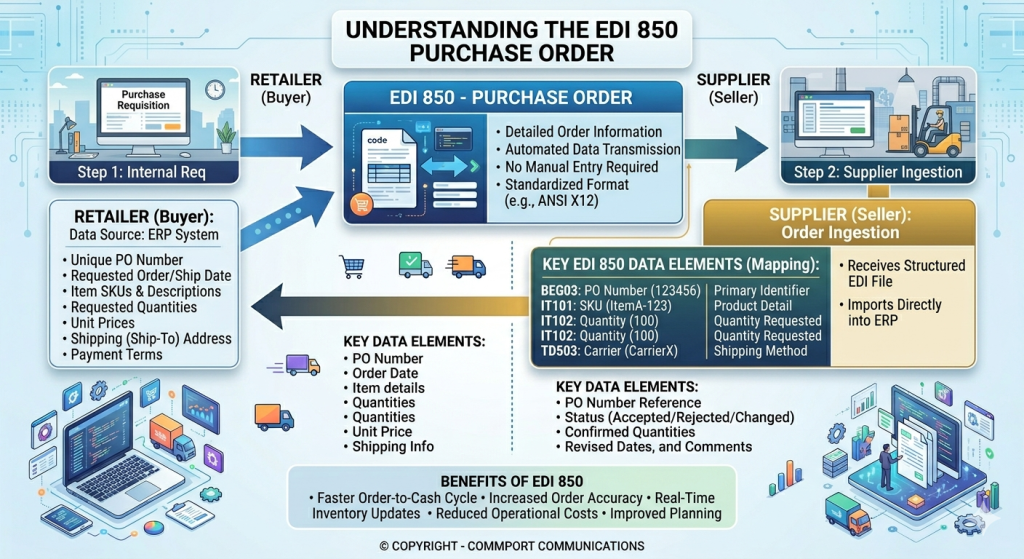
The EDI 850 serves as an electronic purchase order transaction set used to initiate an order from a buyer to a seller. This X12 transaction set contains the format and establishes the data contents of the Purchase Order Transaction Set for use within an EDI environment. The primary function involves providing customary and established business practices relative to the placement of purchase orders for goods and services.
You can use an EDI 850 for single purchases, set up recurring orders, or even modify an existing order based on your instructions. The document provides all the necessary details required by the vendor to properly receive, process, and fulfill the order. Once transmitted, it replaces traditional paper or emailed purchase orders, serving as the first step in the purchasing process.
An EDI 850 should not be used to convey purchase order changes or purchase order acknowledgment information. These functions require separate EDI transaction sets designed specifically for those purposes.
Key components of an 850 EDI document
The 850 EDI document contains all information needed by vendors to fill orders accurately:
- Purchase order number and date: Primary identifier for the transaction
- Seller and buyer information: Names, addresses, contact information for both parties
- Item details: Item numbers, descriptions, quantities ordered, unit prices
- Delivery information: Ship to address, delivery date, carrier information
- Payment terms: Terms agreed upon between trading partners
- Discounts and taxes: Any applicable discounts or tax information
- Total order amount: Complete monetary value of the purchase order
- Additional instructions: Comments or special delivery instructions
EDI 850s can be displayed in two formats: a translated version that’s human-readable, and a raw data format. Your business system or ERP must translate the raw EDI data to initiate the fulfillment process.
What is EDI 855 Purchase Order Acknowledgement?
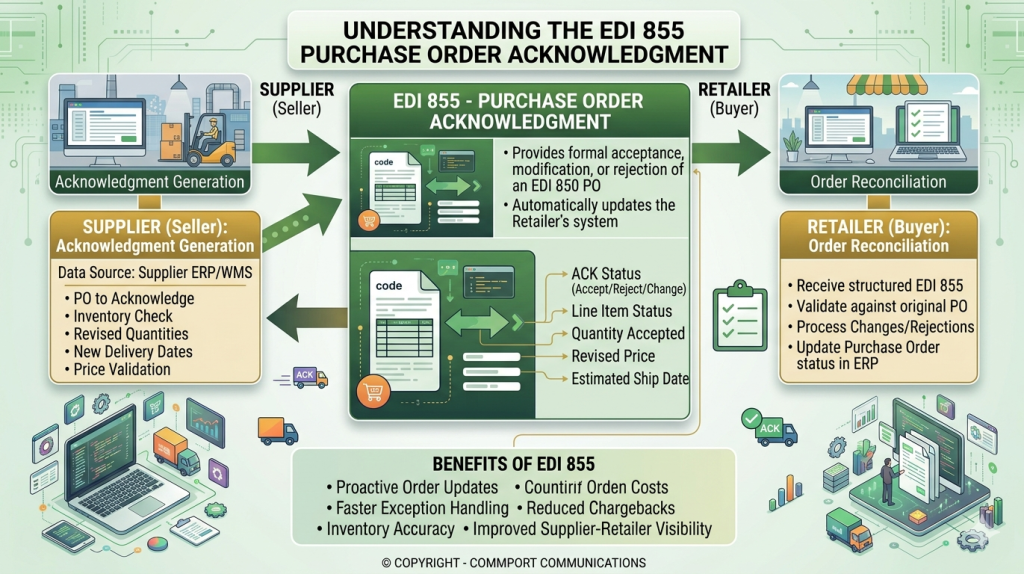
A supplier sends an EDI 855 Purchase Order Acknowledgement as a formal response to confirm a buyer’s EDI 850. This electronic document goes beyond simple receipt confirmation. It communicates whether an order has been accepted, requires modifications, or needs to be rejected entirely. receipt and processing status.
Purpose of the EDI 855
The EDI 855 serves a dual function in procurement workflows. It notifies the buyer that the order has been both received and processed. This distinguishes it from an EDI 997 Functional Acknowledgement, which only confirms receipt of the file. The 855 should be sent in addition to the 997, not as a replacement.
Large retailers and distributors often require suppliers to use EDI 855 at specific steps in the order processing workflow to ensure EDI compliance. The document verifies a seller’s ability to fulfill orders and alerts buyers to any mistakes in the initial purchase order, such as price discrepancies and specified timeframes
In the best scenario, a supplier accepts an EDI 850 as-is, and the 855 becomes a simple affirmation that the order moves forward. However, if the purchase order contains errors or cannot be fulfilled as requested, suppliers use the 855 to alert buyers to any changes or reject the order completely.
How EDI 850 and 855 Work Together in the Procurement Workflow
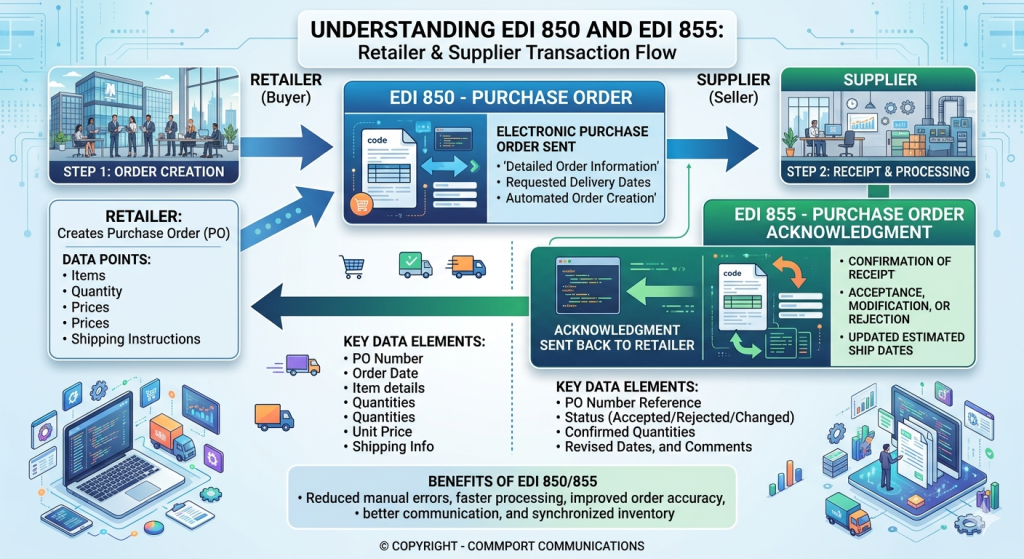
The exchange between these documents follows a specific sequence that forms the backbone of B2B procurement transactions. Each step builds on the previous one, creating a dependency chain where accuracy at every stage prevents downstream complications.
Step 1: Buyer sends EDI 850 Purchase Order
A buyer generates an EDI 850 containing order quantities, item descriptions, pricing, and delivery instructions. The document transmits via an EDI network, such as a Value-Added Network or API-based EDI solutions, directly to the supplier’s system. This electronic transmission eliminates manual data entry on the supplier’s end. The 850 initiates the entire transaction, and all subsequent documents depend on the accuracy and completeness of this initial step.
Step 2: Supplier receives and processes the order
The supplier’s system receives the 850 EDI purchase order and automatically processes it. The system parses the data, validates it against internal records, and routes it to the appropriate fulfillment workflow. During this stage, the system evaluates inventory availability, confirms pricing matches internal data, and verifies ship-to addresses exist in the address master. Line-level validation occurs here, where each PO1 segment gets checked individually against product catalogs and stock levels.
Step 3: Supplier sends EDI 855 acknowledgement
After processing, the supplier sends an EDI 855 purchase order acknowledgement back to the buyer. This document tells the buyer whether the order was accepted as-is, accepted with modifications (partial quantities, substituted items, adjusted dates), or rejected. Timing matters significantly. Retailers often require the 855 EDI specification to be sent within 24 to 48 hours after receiving the original purchase order. Delayed acknowledgements signal unreliability to buyers and can result in compliance penalties or reduced supplier scorecard ratings.
Step 4: Handling modifications and rejections
Not every purchase order can be accepted as submitted. Inventory shortages, discontinued items, or pricing disagreements require the 855 to communicate line-level acceptance or rejection. When the 855 specifies changes, buyers have several options. They can send back an EDI 860 Purchase Order Change Request to formally adjust the order, issue a new EDI 850 with corrected information, or reach out directly to the seller to discuss alternatives.
Integration with other EDI documents (856, 810, 997)
The workflow extends beyond the 850 and 855 exchange. Following order acceptance, the supplier ships products and sends an EDI 856 Advance Ship Notice to inform the buyer about shipment details, packing configurations, and tracking information. The supplier then issues an EDI 810 Invoice, facilitating automated payment processing. Throughout this chain, EDI 997 Functional Acknowledgements confirm receipt of each transmission. Buyers send a 997 in response to the 855, confirming they received the acknowledgement. This layered confirmation system ensures no document gets lost in transmission.
Benefits of Implementing EDI Purchase Orders and Acknowledgements
Automating the exchange between buyers and suppliers delivers measurable improvements across multiple business operations. Companies that implement EDI purchase orders report significant gains in accuracy, speed, visibility, and cost efficiency.
1. Improved order accuracy and reduced errors
Manual data entry introduces mistakes that EDI purchase orders eliminate through direct system-to-system communication. Businesses see a 30-40% reduction in transactions with errors when switching from paper-based methods to EDI. The 850 EDI document type uses predefined formats that ensure product numbers, prices, and quantities are transmitted accurately between trading partners. This precision prevents disputes and returns while building trust in supplier relationships.
The edi purchase order acknowledgement adds another validation layer. When suppliers send the EDI 855, they confirm order details upfront, catching discrepancies before fulfillment begins. This early detection mechanism contributes to an approximate 10% enhancement in order accuracy. Errors from illegible faxes, lost orders, or incorrectly taken phone orders disappear entirely.
2. Faster transaction processing
Speed improvements prove equally substantial. EDI can accelerate business cycles by 61%, transforming order processing from days or weeks into minutes. A major electronics manufacturer calculated their manual order processing cost at $38.00 compared to just $1.35 for EDI-processed orders. This dramatic difference stems from eliminating paper handling, data re-entry, and manual verification steps.
The 855 EDI specification requires suppliers to acknowledge orders within tight timeframes, typically 24-48 hours. This rapid confirmation allows buyers to adjust inventory planning immediately rather than waiting for phone calls or email responses. Moreover, EDI reduces the order-to-cash cycle time by more than 20%, improving cash flow for both parties.
3. Enhanced supply chain visibility
Real-time data exchange creates transparency that paper-based systems cannot match. EDI transactions generate a digital trail supporting tracking and status updates across the entire procurement workflow. Companies gain instant insight into order confirmations, inventory levels, and shipment progress through centralized dashboards.
This visibility enables better demand forecasting and inventory optimization. Businesses can reduce on-hand inventory and potentially decrease safety stock by around 5% since they receive accurate, timely information about incoming shipments.
4. Cost reduction through automation
Financial benefits extend beyond processing speed. Switching to EDI transactions lowers transaction costs by at least 35% by eliminating expenses for paper, printing, storage, filing, postage, and document retrieval. Implementation also reduces invoice reconciliation time by 40-70%, freeing staff to focus on strategic tasks rather than administrative work.
Equally significant, EDI helps avoid retailer chargebacks and penalties for late or incorrect documents, protecting profit margins while maintaining strong trading partner relationships.
Challenges and Best Practices for EDI 850 and 855 Implementation
1. Common implementation challenges
Deploying EDI 850 and 855 transactions presents obstacles that extend beyond technical setup. Organizations frequently underestimate supply chain complexity, selecting EDI solutions that fail to accommodate diverse partner requirements. Specifically, compatibility issues arise when trading partners use different EDI standards or custom data fields, requiring multiple testing rounds and clear coordination.
Data quality disrupts operations considerably. In reality, 60% of B2B transactions experience suspension due to data-related anomalies. Incomplete partner specifications create additional friction during onboarding. Partners often provide inconsistent implementation guides, forcing suppliers to maintain question logs and validate edge cases early.
2. EDI compliance and standardization
EDI compliance involves adhering to established standards that dictate data formatting and exchange protocols. Purchase orders must conform to the ANSI X12 format to ensure proper communications between systems. Compliance ensures all parties use a common language, facilitating seamless integration across diverse platforms.
Trading partners impose their own rule sets beyond general EDI standards, with some retailers enforcing significant fines for violations. For this reason, validation capabilities become non-negotiable. Your EDI implementation must validate composed documents against partner-specified rules before transmission and indicate exact problems when failures occur.
3. System integration considerations
EDI relies on master data accuracy for pricing, product codes, and addresses. Inconsistencies between ERP entries and partner expectations cause integration failures. Data mapping presents particular complexity since every business uses different document formats. Fields must align precisely between EDI documents and ERP systems, with common pain points including optional fields, multi-table population, and varying date formats.
4. Tips for successful EDI adoption
Establish cross-functional implementation teams pairing technical depth with business context. Include purchasing, logistics, finance, and customer service representatives who understand real-life workflows. Clean SKUs, units of measure, and addresses before heavy testing begins. Version control your maps, document changes with effective dates, and schedule quarterly partner reviews. Equally, assign an operations owner and create weekly metrics reviews rather than treating go-live as the finish line.
Bonus Topics
EDI 860
EDI 860 is the Purchase Order Change Request used by the buyer to request changes to an already issued EDI 850 purchase order. It is commonly used to change quantity, price, delivery date, add or delete items, or adjust shipping details. The document typically includes the original purchase order number, buyer and seller identification, line-item details, and the specific changes requested. In practice, it helps buyers correct demand changes without canceling and recreating the full order.
EDI 865
EDI 865 is the Purchase Order Change Acknowledgement/Request, used when the seller responds to a buyer’s change request or initiates changes of its own. Sellers use it to accept, reject, or counter the buyer’s proposed changes, such as revised quantities, delivery dates, or pricing. It can also serve as a seller-initiated request to change order terms, depending on trading partner agreements. This transaction keeps both parties aligned on what was actually accepted before fulfillment continues.
EDI 869
EDI 869 is the Order Status Inquiry sent by a buyer or other inquirer to ask for the status of a purchase order. It is used to request information such as shipment progress, expected delivery dates, or the status of specific line items. Common content includes the purchase order number, order date, reference identifiers, and inquiry details. It is typically part of a paired inquiry-response workflow, where the 869 prompts an EDI 870 response.
EDI 870
EDI 870 is the Order Status Report sent by the supplier in response to an EDI 869 inquiry. It communicates the current status of the order, such as accepted, partially shipped, delayed, backordered, or canceled. It commonly includes order identification, item details, quantities, prices, dates, and an explanation of the status. This transaction gives buyers visibility into fulfillment without needing manual follow-up.
EDI 875
EDI 875 is the Grocery Products Purchase Order, used in the grocery and food industry to place orders for finished goods. It is similar in purpose to the general EDI 850, but it uses grocery-industry structure and conventions. Typical content includes purchase order identification, buyer/seller information, ship-to details, dates, transportation instructions, line-item product data, quantities, unit prices, and shipping requirements. The format is designed to support grocery-specific needs like case packs, shelf-life considerations, and replenishment workflows.
EDI 876
EDI 876 is the Grocery Products Purchase Order Change used to modify a previously submitted EDI 875 order. It is the grocery-industry equivalent of the general EDI 860, but it is intended for food and beverage trading relationships. Common changes include adding or removing products, changing quantities, updating prices, and adjusting delivery schedules. Industry guidance notes that changes are often communicated by restating the revised values, and deletions may be represented with zero or blank values.
Conclusion
EDI purchase orders transform procurement workflows from manual, error-prone processes into streamlined, automated exchanges. The 850 and 855 transaction sets work together to create accountability, with suppliers confirming orders quickly and buyers gaining real-time visibility into order status.
The benefits speak for themselves: reduced errors, faster processing, lower costs, and stronger trading partner relationships. However, successful implementation requires clean master data, thorough testing, and ongoing monitoring rather than treating go-live as the endpoint.
If you start your EDI journey with proper planning and cross-functional teams, you’ll see measurable improvements within months. Choose your implementation partner carefully, as they’ll determine how smoothly your system integrates with existing operations.
Commport EDI Solutions - #1 EDI Solutions in North America
Need Help? Download: Commport's EDI Buyers Guide
Unlock the full potential of your supply chain with our comprehensive EDI Buyer's Guide — your first step towards seamless, efficient, and error-free transactions
Frequently Asked Questions
EDI 850 is an electronic purchase order sent by a buyer to a supplier, containing details like item descriptions, quantities, prices, and shipping information. EDI 855 is the purchase order acknowledgement sent by the supplier back to the buyer, confirming whether they can accept, modify, or reject the order.
An EDI 855 is a digital response from suppliers that confirms receipt of a purchase order and communicates their ability to fulfill it. The acknowledgement indicates whether the order is accepted as submitted, requires modifications due to inventory issues or pricing discrepancies, or needs to be rejected entirely.
Suppliers send an EDI 855 acknowledgement message to buyers after receiving an EDI 850 purchase order. This electronic document communicates whether the order is accepted, rejected, or requires modifications, typically within 24-48 hours of receiving the original purchase order.
An EDI 855 includes the original purchase order number and date, product information with accepted quantities, delivery details, and the seller’s vendor number. It also reports any issues such as inventory shortages, pricing discrepancies, delivery date changes, backordered items, or discontinued products that need addressing.
Implementing EDI purchase orders reduces transaction errors by 30-40%, accelerates business cycles by 61%, and lowers transaction costs by at least 35%. The automated system eliminates manual data entry mistakes, speeds up order processing from days to minutes, and provides real-time supply chain visibility for better inventory management.