



Introduction
The EDI market is projected to reach $58.98 billion by 2030, but here’s the thing: EDI management requires continuous attention to deliver real value.
Data mismatches and inaccuracies cost businesses significantly, while poor ERP and EDI integration create operational bottlenecks. Furthermore, without regular assessment and optimization, your EDI system won’t reach its full potential.
Whether you’re handling EDI in supply chain management internally or considering EDI managed services, we’ll walk you through proven best practices to monitor, maintain, and optimize your EDI system for maximum efficiency
Key Takeaways
- Implement real-time monitoring with automated alerts to detect transaction failures, missing acknowledgments, and processing delays before they disrupt operations or damage trading partner relationships.
- Conduct regular system health checks and maintain data mapping accuracy through quarterly reviews, version control updates, and centralized registries to prevent costly errors from leaking into inventory and invoicing.
- Optimize database performance and resolve bottlenecks by partitioning large tables, using caching strategies, and implementing event-driven processing to handle transaction surges efficiently.
- Consider managed EDI services when rapid growth strains infrastructure or a lack of in-house expertise creates operational risks, as 24/7 expert support reduces costs and downtime.
- Focus on deep ERP integration over middleware solutions to complete more orders per hour, eliminate manual rekeying, and achieve faster processing times with reduced data entry errors.
What is EDI Management and Why It Matters
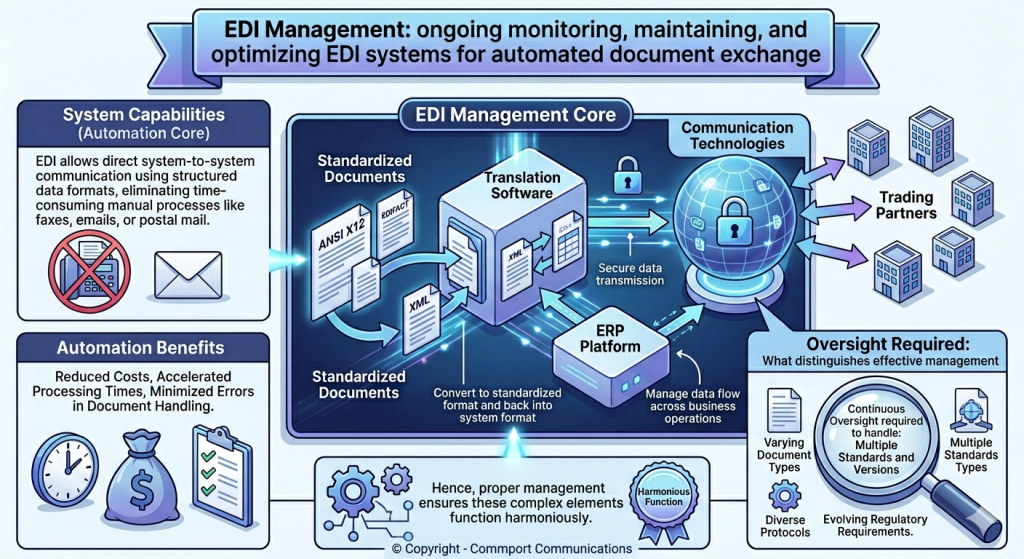
EDI management refers to the ongoing process of monitoring, maintaining, and optimizing electronic data interchange systems that enable automated, computer-to-computer exchange of business documents in standardized formats.
Rather than relying on faxes, emails, or postal mail, EDI allows direct system-to-system communication using structured data formats. This automation eliminates time-consuming manual processes, resulting in reduced costs, accelerated processing times, and minimized errors in document handling.
At its core, an EDI management system encompasses several components working together. EDI Translation software converts documents into standardized EDI formats like ANSI X12, EDIFACT, or XML and back into system format. Communication technologies ensure secure data transmission between trading partners. Furthermore, the system integrates with enterprise resource planning (ERP) platforms to manage data flow across business operations.
What distinguishes effective EDI management from simply having EDI capability is the continuous oversight required. Organizations implementing EDI face challenges, including varying document types, multiple standards and versions, diverse protocols, and evolving regulatory requirements. Hence, proper management ensures these complex elements function harmoniously.
The Role of EDI in Supply Chain Management
EDI is a foundational component of supply chain operations, standardizing business communications among suppliers, manufacturers, distributors, and retailers. When real-time data exchange is implemented through EDI, key players receive updates about inventory levels, shipping schedules, and payment status promptly. This immediate visibility helps reduce lead times, improve inventory management, and streamline decision-making processes.
In traditional systems, business documents like purchase orders or shipping notifications undergo manual processing, leading to delays, miscommunications, and errors. EDI eliminates these inefficiencies by ensuring data is transmitted instantaneously between systems. For instance, a retailer can automatically receive inventory data from a supplier and instantly place replenishment orders without manual intervention.
The technology dramatically improves supply chain operations by automating critical processes and enhancing visibility across the entire network. This improved visibility enables better inventory management, more accurate demand forecasting, and reduced stockouts. By digitizing operations, EDI provides real-time tracking of shipments, efficient warehouse management, and streamlined distribution operations.
Key Benefits of Proper EDI Management
Organizations implementing EDI typically experience a decrease. This decrease stems from eliminating expenses associated with paper-based processes, including printing, storage, filing, and document retrieval minimum 35% reduction in transaction costs
EDI systems dramatically improve business process efficiency by reducing document processing time from days to minutes. Research indicates that EDI implementation can accelerate business cycles by up to 61%. Organizations typically observe a , primarily due to eliminating manual data entry mistakes, illegible handwriting issues, and lost documentation 30-40% reduction in transaction errors
Beyond cost savings, EDI plays a crucial role in maintaining regulatory compliance across various industries. The standardized nature of EDI transactions ensures consistent documentation and audit trails, helping organizations meet industry-specific regulations and reporting requirements. EDI systems incorporate robust security measures, including encryption and authentication, to protect sensitive business information during transmission and storage.
The visibility provided by EDI enables businesses to trace transactions throughout their lifespans, gauge how long each step takes, create error-free audit trails, and notify relevant parties of any changes or issues. This traceability improves observability and reporting by enabling electronic documents to be incorporated with various IT systems, facilitating data collection and analysis.
Essential EDI Monitoring Best Practices
Monitoring your EDI system requires proactive surveillance rather than reactive troubleshooting. Organizations that implement systematic monitoring practices detect issues before they disrupt operations or damage trading partner relationships.
1. Set Up Real-Time Transaction Monitoring
provides insights into the health and performance of your EDI operations, enabling you to identify and address issues proactively. Dashboards offer immediate visibility into your EDI operations by displaying the status of all current transactions, the health of your EDI platform, and the flow of data through your systems. A well-designed dashboard empowers your team to act swiftly and effectively to prevent operational disruptions through real-time monitoring
Configure your EDI platform to track the progress of critical documents using real-time updates on the status of individual EDI transactions. Stakeholders can proactively find potential delays by monitoring documents as they move through the system. For instance, EDI 810 Invoices can disrupt order fulfillment and payment cycles, as well as failed EDI 856 Advanced Shipping Notices
2. Track Performance Metrics and KPIs
Monitor key performance indicators like transaction throughput, processing times, and error rates to gain valuable insights into the efficiency and effectiveness of your EDI transactions. Track trading partners’ performance and measure efficiency based on transaction success rates, error rates, and response times.
Tracking transaction volume reveals efficiency savings across affected departments. Similarly, monthly EDI performance reports for key partners in terms of compliance and on-time transmission of transactions help identify areas needing improvement. Certain partners may impose penalty fines for delays and non-compliance, which adds to operational costs.
3. Implement Error Detection and Alert Systems
Automated error detection improves the process by identifying failed transactions, missing acknowledgements, or formatting errors with clear messages and timestamps. Configure your EDI platform to automatically flag anomalies such as failed transmissions, delayed acknowledgments, or missing data.
Real-time notifications and alerts via email and SMS for failed transactions, missing acknowledgements, or processing delayed beyond defined thresholds prevent operational disruptions. When errors occur, go beyond fixing the immediate problem by conducting a deeper investigation to determine the underlying cause. Recurring errors may indicate a need for better-defined integration processes or additional training for your team.
3. Monitor Trading Partner Connections
Track the status of interchange acknowledgments, batch statuses, AS2/MDN statuses, and other details associated with transactions. A rejected acknowledgement indicates the trading partner did not process the document successfully. Set up alerts to get notified when multiple trading partners reject acknowledgements, helping you take early action.
Regularly review transaction performance with your trading partners to identify areas for improvement. Open communication fosters stronger partnerships and ensures smoother data exchanges in the long term.
4. Use Activity Streams for Visibility
Collect detailed information on transaction logs, such as sender and receiver data, document types, timestamps, and status updates. This helps create a comprehensive audit trail of all EDI activities. Visually mapping the flow of EDI documents between trading partners and stakeholders provides a clear understanding of the data exchange process.
Implementing data mapping and transformation rules enables the alignment of different data structures from diverse systems, ensuring data consistency.
How to Maintain Your EDI System
Treating EDI as an ongoing process rather than a one-time project ensures long-term success. Regular maintenance activities prevent system degradation and keep your operations running smoothly.
1. Conduct Regular System Health Checks
An EDI health check is designed to evaluate the efficiency, accuracy, and compliance of your organization’s EDI systems. This process involves examining your current EDI setup, including processes, integrations, and interactions with trading partners, through a structured assessment.
Before starting, determine the scope of the audit by identifying key areas like data integrity, system security, compliance with industry standards, and partner-specific requirements. Set clear objectives, such as identifying errors in data transmission, evaluating system security, and improving transaction accuracy.
Measure the efficiency of your EDI system by evaluating transmission speed, transaction volume, and error rates. Your EDI system should handle high volumes of transactions without delays or significant errors. Track the percentage of successful versus failed transactions to gauge system performance.
2. Update EDI Standards and Formats
Version control forms the backbone of sustainable EDI operations. Not all companies adopt newer versions simultaneously—one partner might use X12 4010 while another uses 5010. These mismatches can cause data rejection or, particularly in healthcare and finance, where specific EDI versions are mandated, compliance violations
Review whether your EDI setup complies with relevant EDI standards like X12 and EDIFACT and regulations specific to your industry. Ensuring compliance minimizes data errors and helps maintain strong trading partner relationships.
3. Maintain Data Mapping Accuracy
Maintain a centralized registry of item codes, units of measure, locations, and qualifiers, and update them globally. Automated processes should feed this from your ERP. Document all partner-specific tolerances, version requirements, and mapping quirks in one place so map builders are never guessing in isolation.
Mapping errors don’t just fail a file; they leak into inventory, invoicing, and shipping, and then the cleanup becomes a second job. Scheduled map reviews and quarterly trading partner syncs ensure that your mapping rules stay ahead of changing requirements.
4. Ensure Security and Compliance
Security is critical in EDI systems, which handle sensitive transactional data. Verify that encryption protocols, secure communication channels, and authentication measures are in place to protect data. Review access controls to ensure only authorized personnel have access to EDI systems.
Conduct thorough risk assessments covering data, systems, partners, processes, and laws. Install controls like intrusion detection, anomaly detection, and file integrity monitoring. Analyze systems continuously for suspicious activity and policy violations. Schedule recurring external audits to validate security and compliance controls.
5. Test EDI Transactions Regularly
EDI testing ensures that your organization is complying with industry standards and regulations, such as those set by FDA, and other regulatory bodies. Testing ensures that your organization sends and receives error-free transactions, which can help prevent costly errors and delays.
Perform scenario-based and regression testing before every major go-live or mapping change. Cover edge cases like partial shipments, split packs, or new item introductions. Conduct functional testing to ensure that all data elements are accurately formatted and transmitted.
6. Manage Trading Partner Relationships
Your EDI system must be compatible with those of your trading partners and vendors. Ensure that their EDI setups meet your brand’s requirements for seamless data exchange. Foster strong relationships with trading partners by establishing clear communication channels and regularly reviewing EDI performance with key partners.
EDI System Optimization Strategies
Optimization transforms baseline EDI functionality into high-performance operations that support business growth. Companies treating EDI as 20% technology and 80% change management succeed by fixing both code and processes.
1. Optimize Database Performance
The database stores and manages all data driving your business processes. Regular maintenance activities like defragmenting and rebuilding indexes keep your database performing at peak levels. Data partitioning divides information into smaller, manageable pieces stored separately, which significantly improves query performance. Tables larger than 2GB should consistently be considered for partitioning. Caching stores frequently accessed data in memory, speeding up data retrieval and reducing database load. Use specific column names instead of SELECT * in queries, and employ stored procedures rather than heavy queries to reduce network traffic.
2. Identify and Resolve Bottlenecks
Bottlenecks can be physical (insufficient system resources), logical (inefficient data processing algorithms), or operational (uncoordinated activities between business units). Profiling analyzes the system to spot where delays occur, while load testing simulates high user activity levels to highlight performance issues under stress. Track the time between ISA header receipt and the final 997 Functional Acknowledgment, setting automated alerts for transactions exceeding your defined SLA threshold.
3. Improve ERP and EDI Integration
Deep ERP integration enables companies to complete more orders per hour than those using middleware. Automated data transfer eliminates manual rekeying, accelerating processing times and reducing data entry errors. Clean up data before building an integration by checking product codes and pricing tables in your ERP for accuracy. Direct integration offers fast, high-performance options without middleman delays.
4. Scale Your EDI Infrastructure
Flexible modular design allows independent scaling of interconnected modules according to needs. Cloud-based SaaS infrastructure offers resources that adjust to transaction volume, enabling capacity increases or reductions as needed. Message queues create buffers that catch transaction surges and feed data into your ERP at manageable speeds.
5. Enhance Data Processing Speed
Batch processing creates concentrated spikes of API activity when scheduled runs fire. Real-time, event-driven systems distribute load evenly across operations, producing more consistent performance with lower peak loads. Asynchronous processing tells trading partners “Got it” immediately, then handles heavy lifting like mapping and translation in the background.
When to Consider EDI Managed Services
Organizations often reach a tipping point where managing EDI internally becomes counterproductive. Recognizing these moments can prevent costly operational inefficiencies.
1. Signs Your Organization Needs Managed EDI Services
Three indicators signal the need for managed EDI services. First, rapid business growth strains existing EDI infrastructure when order volumes climb quickly. Second, excessive spending on EDI operations without proportional value suggests inefficiency. Third, integration difficulties arise when manually moving messages or struggling to connect with trading partners becomes routine.
Additionally, a lack of in-house expertise or internal bandwidth drives organizations toward managed services. Companies without dedicated EDI personnel face increased responsibility, higher workloads, and reliance on individual employees whose departure creates operational risks.
2. Benefits of EDI Management Services
Managed EDI services reduce costs by eliminating expenses associated with hardware, software, IT personnel salaries, and training. Organizations avoid interviewing candidates, onboarding staff, or maintaining physical infrastructure. Furthermore, 24/7 monitoring ensures less system downtime and quicker error resolution. Expert collaboration provides access to specialists who understand the latest best practices while possessing extensive historical EDI knowledge.
3. Evaluating EDI Management Software and Providers
Service models vary across three types. Self-managed solutions suit organizations with in-house capabilities. Fully-managed options provide end-to-end support, including implementation and mapping. Blended approaches offer support as needed.
Evaluate providers based on standards compatibility, scalability for transaction volumes, and pricing transparency. Correspondingly, verify the provider supports your industry’s EDI formats and can handle projected growth without prohibitive costs.
Conclusion
Effective EDI management is a continuous journey, not a one-time project. We’ve covered everything you need to monitor, maintain, and optimize your EDI system for peak performance.
Start by implementing real-time monitoring and tracking critical KPIs. Keep your system healthy through regular audits, security updates, and data mapping accuracy. Focus on optimization strategies like improving ERP integration and resolving bottlenecks to scale efficiently.
Whether you manage EDI in-house or partner with managed service providers, consistency is key. Apply these best practices systematically, and you’ll see reduced errors, faster processing times, and stronger trading partner relationships. Your EDI system will transform from a basic requirement into a competitive advantage that drives business growth.
Commport Managed EDI Services
Need Help? Download: Commport's EDI Buyers Guide
Unlock the full potential of your supply chain with our comprehensive EDI Buyer's Guide — your first step towards seamless, efficient, and error-free transactions
Frequently Asked Questions
EDI management is the continuous process of monitoring, maintaining, and optimizing electronic data interchange systems that enable automated, computer-to-computer exchange of business documents in standardized formats. It matters because proper EDI management can reduce transaction costs by at least 35%, accelerate business cycles by up to 61%, and reduce transaction errors by 30-40%, while eliminating manual processes and improving supply chain efficiency.
Key signs include rapid business growth straining your existing EDI infrastructure, excessive spending on EDI operations without proportional value, difficulty integrating with trading partners, and lack of in-house EDI expertise. If you’re manually moving messages, experiencing frequent system issues, or relying heavily on individual employees for EDI knowledge, it’s time to consider managed services.
Essential metrics include transaction throughput, processing times, error rates, transaction success rates versus failures, and trading partner response times. You should also monitor the time between document receipt and final acknowledgment, track transaction volumes for efficiency insights, and measure partner compliance with transmission deadlines to avoid penalty fines.
Regular system health checks should be conducted on a scheduled basis to evaluate efficiency, accuracy, and compliance. You should perform quarterly trading partner syncs, scheduled map reviews, and scenario-based testing before major changes. Additionally, conduct continuous security monitoring, recurring external audits, and regular database maintenance activities like defragmenting and rebuilding indexes.
Cloud-based SaaS EDI infrastructure offers flexible resources that automatically adjust to transaction volume, allowing you to increase or reduce capacity as needed without investing in physical hardware. This provides more consistent performance with lower peak loads compared to on-premise solutions, which require upfront investment in hardware and manual scaling efforts when transaction volumes grow.