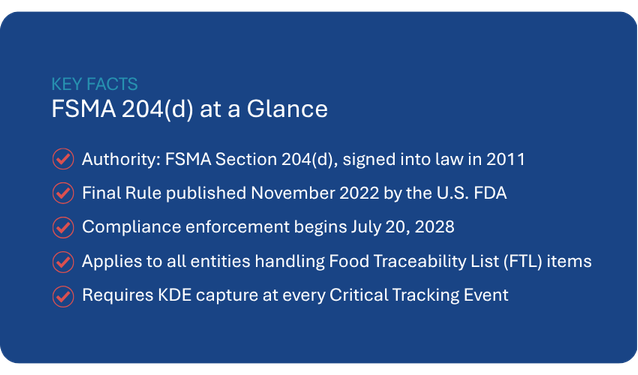
Under Section 204(d) of the FSMA, companies handling foods on the Food Traceability List must capture Key Data Elements at every Critical Tracking Event, and produce traceability records to the FDA within 24 hours of a request. Manual systems can't keep up.
Without automated data systems, compiling KDE records manually in 24 hours is nearly impossible.
Data trapped in disconnected systems makes tracing a product from farm to fork an enormous manual effort.
Without GS1-standard GTINs, Traceability Lot Codes become inconsistent and untraceable across partners.
Without structured data capture, key supply chain events go undocumented, leaving compliance gaps.
Poor traceability forces businesses to recall entire product categories rather than specific affected lots.
Retailers are already requiring FSMA-compliant traceability data. Non-compliant suppliers risk being de-listed.
The FDA’s Food Safety Modernization Act (FSMA) Food Traceability Final Rule, mandated under Section 204(d), establishes enhanced recordkeeping requirements for entities that manufacture, process, pack, or hold foods on the Food Traceability List (FTL).
Finalized in November 2022, the rule requires companies to capture and maintain specific Key Data Elements (KDEs) for each Critical Tracking Event (CTE), and to provide that information to the FDA in an electronic, sortable spreadsheet within 24 hours of request.
Compliance enforcement begins July 20, 2028. Every business along the supply chain, from growers and packers to processors, distributors, and retailers, must be ready to demonstrate end-to-end traceability with consistent Traceability Lot Codes (TLCs).
A Commport specialist will review your trading-partner data flows and flag the fastest path to compliance.
Million Americans affected by foodborne illness each year
Billion Annual U.S. economic cost of foodborne illness
Hours FDA response window required under FSMA 204
Foodborne illness drives massive human and economic cost, and slow recalls multiply both. Modern traceability with structured digital data turns a multi-week investigation into a targeted, hour-scale response, protecting consumers, brands, and the bottom line.
FSMA 204 reaches across the entire farm-to-fork supply chain. If your business manufactures, processes, packs, holds, ships, receives, or sells any item on the Food Traceability List, you fall within the rule's scope. Here are the industries most directly impacted.
Producers of FTL items such as leafy greens, tomatoes, peppers, and sprouts must capture growing-area and harvest KDEs at the source.
Wild-caught seafood operators must record harvest, landing, and first-receiver KDEs for finfish, crustaceans, and mollusks on the FTL.
Initial packers assign the Traceability Lot Code and become the TLC Source, anchoring the entire downstream traceability chain.
Any facility transforming raw FTL ingredients (cutting, cooking, blending, packaging) must record CTEs and link input and output TLCs.
Importers of cheese, seafood, fresh produce, nut butters, and other FTL items must verify foreign supplier KDEs and maintain U.S. traceability.
3PLs, wholesalers, and cold-chain operators must log Receiving and Shipping CTEs and forward the TLC accurately to every downstream partner.
Carriers handling FTL shipments need synchronized data so receivers can reconcile TLCs against ASN, bill of lading, and chain-of-custody records.
Retailers receiving FTL foods must maintain Receiving KDEs and respond to FDA traceability requests within 24 hours during an outbreak.
Restaurants, QSR's, schools, hospitals, and institutional kitchens that serve FTL items are covered as Retail Food Establishments under the rule.
Exemptions exist for very small producers, certain farm operations, and specific transformation scenarios, but they are narrowly defined. Most mid-market and enterprise food businesses are in scope.
The FDA's Food Traceability List identifies 17 food categories with higher associated public-health risk. Any entity that manufactures, processes, packs, or holds these foods is subject to enhanced FSMA 204 recordkeeping requirements.
Food Category | Examples / Notes |
|---|---|
Soft & Semi-Soft Cheeses | Brie, Camembert, Feta, Mozzarella, Queso Fresco (unaged or aged < 60 days) |
Shell Eggs | Eggs in shell from domesticated chickens |
Nut Butters | Peanut, almond, cashew, and other tree-nut butters |
Fresh Cucumbers | All fresh, whole cucumbers |
Fresh Herbs | Basil, cilantro, parsley, and other fresh herbs |
Fresh Leafy Greens | Lettuce, spinach, kale, arugula (including bagged salads) |
Fresh Melons | Cantaloupe, honeydew, watermelon |
Fresh Peppers | Bell peppers, chili peppers, all varieties |
Fresh Sprouts | Alfalfa, bean, clover, and other sprouted seeds |
Fresh Tomatoes | All fresh, whole tomato varieties |
Fresh Tropical Tree Fruits | Mango, papaya, guava, lychee and similar tropical fruits |
Finfish (fresh or frozen) | Species intended for raw consumption — tuna, salmon, etc. |
Crustaceans | Shrimp, crab, lobster — fresh or frozen |
Molluscan Shellfish | Oysters, clams, mussels, scallops (bivalves) |
Smoked Finfish | Cold and hot smoked fish products |
Ready-to-Eat Deli Salads | Egg, potato, pasta, seafood, chicken-based deli salads |
Sandwiches | Ready-to-eat sandwiches and wraps not otherwise processed |
FSMA 204 requires that specific Key Data Elements be captured at each Critical Tracking Event along the supply chain, and delivered to the FDA in an electronic, sortable format within 24 hours of a request.
Food Category | Examples / Notes |
|---|---|
Growing | Location description, commodity, growing area coordinates, harvest date. Required for raw agricultural commodities (RACs) other than eggs. |
Cooling (Before Initial Packaging) | Location of cooling, date and time of cooling, lot identifier, and reference to the growing event. |
Initial Packing (Other Than RAC) | Traceability Lot Code (TLC) assigned, location of packing, quantity and unit of measure, harvest date, and reference to growing/cooling KDEs. |
First Land-Based Receiver (Seafood) | TLC assigned to seafood obtained from a fishing vessel, receiving location, date, quantity, harvest date range, and vessel info. |
Receiving | TLC, location of receiver and sender, date received, quantity, and reference document number for each shipment. |
Transforming | New TLC for transformed product, inputs (with original TLCs), output product description, date of transformation, and quantity. |
Creating | New TLC assigned when producing an FTL food not from another FTL food. Location, product description, date created, and quantity. |
Shipping | TLC, ship-to and ship-from locations, date shipped, quantity, and reference document linking to the receiving CTE downstream. |
Our EDI and GDSN platform records the right data at the right step, with no manual spreadsheets.
The Traceability Lot Code uniquely identifies a lot of food on the FTL. It is the single thread that connects every CTE, growing, packing, shipping, receiving, transforming, into an unbroken chain of custody.
Once assigned, the TLC must travel with the product and remain consistent across every trading partner. A break in the TLC means a break in traceability, and a failed FDA audit.
Assigned by the initial packer for raw agricultural commodities other than eggs.
Assigned when seafood is received from a fishing vessel.
A new TLC is created when an FTL food is transformed into a new product.
GS1 Standards provide the most widely adopted framework for implementing compliant traceability lot codes and ensuring compliance with the Food Safety Modernization Act (FSMA).
Commport unifies your transactional data and your master product data into a single, audit-ready traceability foundation built around GS1 and FSMA 204 requirements.
| EDI Transaction | CTE Supported | Data Captured |
|---|---|---|
| EDI 856 | Shipping (ASN) | TLC, ship-to/from, quantities, lot info |
| EDI 214 | Shipping (Transport status) | In-transit timestamps and location updates |
| EDI 810 | Receiving (Invoice) | Lot-level invoiced quantities and references |
| EDI 850 | Shipping (Purchase Order) | Product GTINs and ordered quantities |
| EDI 855 | Shipping (PO Ack) | Order confirmation and lot availability |
| EDI 830 | Shipping (Planning Schedule) | Forecast and lot allocation data |
| EDI 940 | Shipping (Warehouse Ship Order) | TLC + ship-from warehouse details |
| EDI 944 | Receiving (Warehouse Stock Receipt) | Inbound TLC and quantity confirmation |
| EDI 753 | Shipping (Routing Request) | Carrier and routing for ship event |
| EDI 997 | All CTEs | Functional acknowledgement of EDI receipt |
| Product Attribute | Why It Matters for FSMA 204 |
|---|---|
| GTIN | Global Trade Item Number, unique product identifier |
| GLN | Global Location Number, identifies trading partner locations |
| Item Description | Standardized product name and trade description |
| Country of Origin | Required for many FTL categories |
| Harvest / Pack Date | Drives KDE capture at packing and receiving CTEs |
| Unit of Measure (UOM) | Standardized quantity units |
| Allergens | Major allergen declarations |
| Net Weight | Verified product weight |
| Product Form | Fresh, frozen, smoked, ready-to-eat, etc. |
| Brand | Brand owner identification |
| Packaging Type | Case, pallet, IFCO, clamshell, etc. |
| Regulated Product Indicators | FTL flag, organic, kosher, etc. |
Commport's managed EDI and GDSN data pool gets you live with retailers, distributors, and the FDA-ready format.
Pinpoint affected lots in minutes, not weeks.
Deliver KDE spreadsheets within the FDA window automatically.
Meet retailer mandates and become a preferred supplier.
Eliminate manual paper and spreadsheet workflows.
Synchronized GTIN and lot data across every partner.
Track product status end-to-end from farm to fork.
Win shelf space with proven traceability credentials.
Scale infrastructure easily as FTL expands and regulations evolve
The FDA has published official supply chain examples showing exactly which Critical Tracking Events (CTEs) and Key Data Elements (KDEs) apply at each stage for different categories on the Food Traceability List. The following examples, drawn directly from FDA guidance, illustrate how the rule works in practice, and how Commport's EDI and GDSN solutions automate compliance at every step.
FDA FSMA Supply Chain Example, Seafood (November 2022)
FDA FSMA Supply Chain Example, Produce / Fresh Cucumbers (November 2022 + March 2025 update)
FDA FSMA Supply Chain Example, Soft Cheese (November 2022)
FDA FSMA Supply Chain Examples, Deli Salads (October 2023)
Scenario A, Deli Salad with FTL Ingredients (Fresh-Cut Celery and Onions)
– Processor must maintain Receiving KDEs for all FTL ingredients (fresh-cut celery, fresh-cut onions), including their TLCs from suppliers.
– Processor must maintain Transformation KDEs for the finished deli salad: new TLC, location, date, quantity, and TLCs of all FTL input ingredients.
– Processor must maintain Shipping KDEs when the deli salad is shipped to retail.
– All covered entities must maintain a written Traceability Plan.
Scenario B, Tuna Salad with Canned Tuna (Non-FTL Ingredient)
– Fresh tuna is on the FTL. When the seafood processor cans the tuna, it becomes a non-FTL food. The seafood processor must maintain Receiving KDEs for the fresh tuna but does NOT need Transformation or Shipping KDEs for the canned product.
– The deli salad processor does NOT need Receiving KDEs for canned tuna (not FTL). But since the finished deli salad IS on the FTL, the processor must maintain – – Transformation KDEs and Shipping KDEs for the deli salad.
FDA FSMA Supply Chain Examples, Sprouts (April 2024)
FDA FSMA Supply Chain Examples (June 2023)
Scenario A, Aquacultured Tilapia Transformed into Fillets
– When a seafood processor transforms live tilapia (a RAC not previously packed) directly into fillets, they must maintain Initial Packing KDEs, not Transformation KDEs. The processor assigns the TLC and is the TLC Source. KDEs include: location, commodity (fresh tilapia fillets), quantity, date of initial packing, and harvest/growing location.
Scenario B, Canned Tomatoes (FTL Food Exiting the FTL)
– The produce processor must maintain Receiving KDEs for fresh tomatoes (FTL food).
– Since canned tomatoes are NOT on the FTL, the processor does NOT need Shipping KDEs for the canned product.
– Subsequent receivers of canned tomatoes are NOT subject to the rule.
– Written Agreements Exception: If written agreements are in place stating tomatoes will be canned (per 21 CFR 1.1305(d)(6)), entities do not need to maintain KDEs for the fresh tomatoes, but all must still maintain a Traceability Plan.
– Same rules apply to canned salmon and aquacultured canned salmon.
Scenario C, Fresh Tomatoes in Sandwich Wraps vs. Meal Kits
– Sandwich wraps (sliced fresh tomatoes + other ingredients): Processor must maintain Receiving KDEs, Transformation KDEs, and Shipping KDEs. Processor becomes new TLC Source.
– Meal kits (whole fresh tomatoes shipped directly to consumers): Processor must maintain Receiving KDEs but does NOT need Shipping KDEs, meal kits go directly to consumers, not a covered entity.
Scenario D, Imported Mangoes
– Importer does NOT take physical possession: Not covered by the rule. No KDEs required.
– Importer DOES take physical possession: Covered by the rule. Must maintain Receiving KDEs and Shipping KDEs.
Scenario E, Shell Egg Operations (three types)
– In-line operation (eggs packed where laid, no commingling): Farm is TLC Source. Maintains Initial Packing and Shipping KDEs.
– In-line farm with on-site USDA plant (all eggs processed): Exempt from the rule under 21 CFR 1.1305(d)(2).
– Off-line processor (some eggs to USDA plant, others to table market): Eggs to USDA plant are exempt. Table market eggs require full KDE compliance.
– Commingled eggs with written agreements (21 CFR 1.1305(h)(2)): Exempt from KDE requirements for commingled eggs, but Traceability Plan still required. – Registered food facilities must maintain immediate previous source / subsequent recipient records for 2 years.
– Off-line production, same company management: Not eligible for commingling exemption, full KDE compliance required.
FDA FSMA Supply Chain Examples (March 2025)
Scenario A, Peanut Butter Crackers
– Peanuts and salt are NOT on the FTL. No KDEs required for these inputs.
– Peanut butter processor: Must maintain Transformation KDEs (peanuts → peanut butter = new FTL food), assign TLC, and maintain Shipping KDEs.
– Cracker manufacturer: Must maintain Receiving KDEs for peanut butter (FTL ingredient), and Transformation + Shipping KDEs for the finished peanut butter crackers (also on the FTL because they contain nut butter in the same form).
– Downstream receivers: Standard Receiving KDEs linked to the cracker manufacturer’s TLC.
Scenario B, Fresh-Cut Apples (Non-FTL Ingredient → FTL Finished Product)
– Whole apples are NOT on the FTL. No KDEs required moving through the supply chain.
– When a processor cuts the apples, fresh-cut fruit (FTL food) is created. Transformation CTE is triggered under 21 CFR 1.1350(a)(2).
– Processor must maintain Transformation KDEs and Shipping KDEs, and assign a new TLC.
– All subsequent receivers must maintain Receiving and Shipping KDEs.
Scenario C, Fresh Melons Aggregated at a Food Hub
– Small farms grow, harvest, and cool melons, sending them unpacked to the food hub.
– Farms must maintain Growing and Cooling KDEs.
– Food Hub, Initial Packing CTE: The food hub is the initial packer and TLC Source. Must assign TLC, maintain Initial Packing KDEs, and include growing location descriptions from all farms whose melons were aggregated into each lot.
– Grocery Store, Receiving CTE: Must maintain Receiving KDEs linked to the food hub’s TLC.
Scenario D, FTL Food in a Dual Jurisdiction Facility (FDA + USDA)
– Facility receives soft cheese and makes both a fruit-and-cheese plate (FDA-regulated) and a meat-and-cheese plate (USDA-regulated).
– Single receiving room (not under exclusive USDA jurisdiction): Must maintain Receiving KDEs for ALL soft cheese received.
– FDA-regulated area (fruit and cheese plate): Must maintain Transformation KDEs and Shipping KDEs.
– USDA exclusive jurisdiction area (meat and cheese plate): Exempt under 21 CFR 1.1305(g). No records required for the USDA product.
We'll walk through your specific products and configure Commport to meet every CTE requirement.
Talk with a Commport FSMA specialist about your current data flows, trading-partner requirements, and the fastest path to full FSMA 204 readiness, at no cost.
It is the FDA’s rule under Section 204(d) of the Food Safety Modernization Act, finalized in November 2022, requiring enhanced recordkeeping for foods on the Food Traceability List (FTL). Compliance enforcement begins July 20, 2028.
KDEs are the specific pieces of information (lot codes, locations, dates, quantities, etc.) that must be captured at each Critical Tracking Event and supplied to the FDA on request.
CTEs are defined supply-chain activities — growing, cooling, initial packing, first land-based receiving, shipping, receiving, transforming, and creating — where KDEs must be recorded.
A TLC is a unique identifier assigned to a lot of FTL food at initial packing, first land-based receiving, or transformation. It must remain consistent with the product through every downstream CTE.
EDI automates the exchange of shipping, receiving, and invoice transactions (856, 810, 850 and more) between trading partners, capturing CTEs and KDEs electronically so they are instantly auditable.
GDSN centralizes master product data — GTINs, GLNs, allergens, country of origin, harvest dates — and synchronizes it across all trading partners, eliminating the data inconsistencies that break traceability.
Now. Implementing EDI and GDSN, mapping CTEs to your operations, and aligning with retailer mandates typically takes 6–18 months — well before the July 20, 2028 enforcement date.