



Introduction
EDI VAN services have become a critical backbone for secure business data exchange in today’s digital ecosystem. According to market research, the global Value Added Network (VAN) market was valued at USD 1.73 billion in 2020 and is projected to reach USD 3.51 billion by 2027, with a CAGR of 10.3% during the forecast period (2021-2027). This growth reflects how essential these specialized networks have become for organizations exchanging sensitive information.
When we talk about value-added network EDI systems, we’re referring to private networks that facilitate the secure transmission of EDI files between trading partners. Unlike regular email, an EDI VAN functions as a secure digital “post office” that routes, stores, and tracks EDI documents between business partners. Additionally, VANs provide a single point of connection for organizations that need to exchange EDI messages with multiple trading partners, significantly simplifying the communication process.
By the early 1990s, EDI had already become the standard across all industries, with an estimated 12,000 U.S. businesses adopting its use. However, many professionals still wonder what EDI VAN is and how it differs from regular email for business communications. This distinction is particularly important for businesses handling sensitive information – VANs make a lot of sense for companies managing clients’ bank account information and other financial records.
Key Takeaways
- EDI VAN mailboxes function as secure digital “post offices”that route, store, and track structured business documents with 99.99% uptime and comprehensive audit trails.
- Email lacks the security and validation featuresneeded for business-critical transactions, handling only unstructured data without delivery guarantees or error management.
- Cost structures differ significantly: EDI VANs charge per transaction (3-20 cents) or monthly subscriptions starting at as low as ($250), while email appears free but carries hidden manual processing costs.
- Choose EDI VAN for high-volume transactions, regulated industries, and complex supply chainsrequiring security, compliance, and seamless ERP integration.
- Email suffices for smaller organizationswith limited transaction volumes, but businesses should plan for EDI VAN migration as they scale and face compliance requirements.
Understanding the Basics: What is an EDI VAN Mailbox vs Email?
To understand the fundamental differences between EDI systems and standard communication methods, we need to examine the core components that make each solution unique.
Definition of EDI VAN Mailbox
An EDI VAN mailbox functions as a specialized file storage area within a computer network that can be uniquely identified from connected mailboxes in other locations. Essentially, it serves as a secure digital “post office” that routes, stores, and tracks EDI documents between business partners.
When an organization connects to a Value Added Network (VAN), the provider assigns them a dedicated mailbox where EDI documents are consolidated and stored for retrieval. This virtual mailbox works similarly to a physical postal system – messages are sent, sorted, and delivered to the recipient’s designated space.
Furthermore, these mailboxes operate independently of whether the recipient is online or ready to receive the data. The documents remain securely stored until the recipient connects to the VAN to retrieve them, creating a reliable asynchronous communication channel.
Definition of Email in EDI Context
Email in the EDI context refers to the standard electronic messaging system that transmits unstructured text between users. In contrast to EDI VANs that handle standardized, structured data formats, email primarily transfers free-form messages without the built-in validation and security features of dedicated EDI systems.
While both technologies facilitate electronic communication, email lacks the specialized infrastructure designed specifically for business document exchange. Email systems generally don’t provide the same level of document validation, tracking, or format standardization that VANs offer as core functionality.
Key Purpose and Use Cases
The primary purpose of an EDI VAN mailbox is to simplify complex B2B communications. Instead of managing multiple direct connections with different trading partners (which can become a “tangled web” of connections), a company can establish a single connection to a VAN that provides access to all its partners.
Key use cases for EDI VANs include:
- Organizations with diverse trading partners using different data formats or standards
- Companies exchanging high volumes of business-critical documents like purchase orders and invoices
- Businesses requiring enhanced security, audit trails, and compliance support
- Industries with complex document routing needs or legacy system integration requirements
For many businesses, the value of VAN services extends beyond simple document delivery. Most EDI VAN providers offer additional features such as:
- Message validation and error correction
- Automated notifications when messages are sent or received
- Translation between different EDI standards (e.g., EDIFACT, X12)
- Document tracking and comprehensive audit trails
While email might be sufficient for informal communications, EDI VAN mailboxes provide the structure, security, and reliability needed for mission-critical business transactions that require standardized data formats and guaranteed delivery.
How Data Transmission Works in EDI VAN vs Email
The technical mechanisms behind EDI VAN mailboxes and email represent two fundamentally different approaches to electronic communication, each designed for specific purposes and security requirements.
1. Mailbox Routing vs Direct Delivery
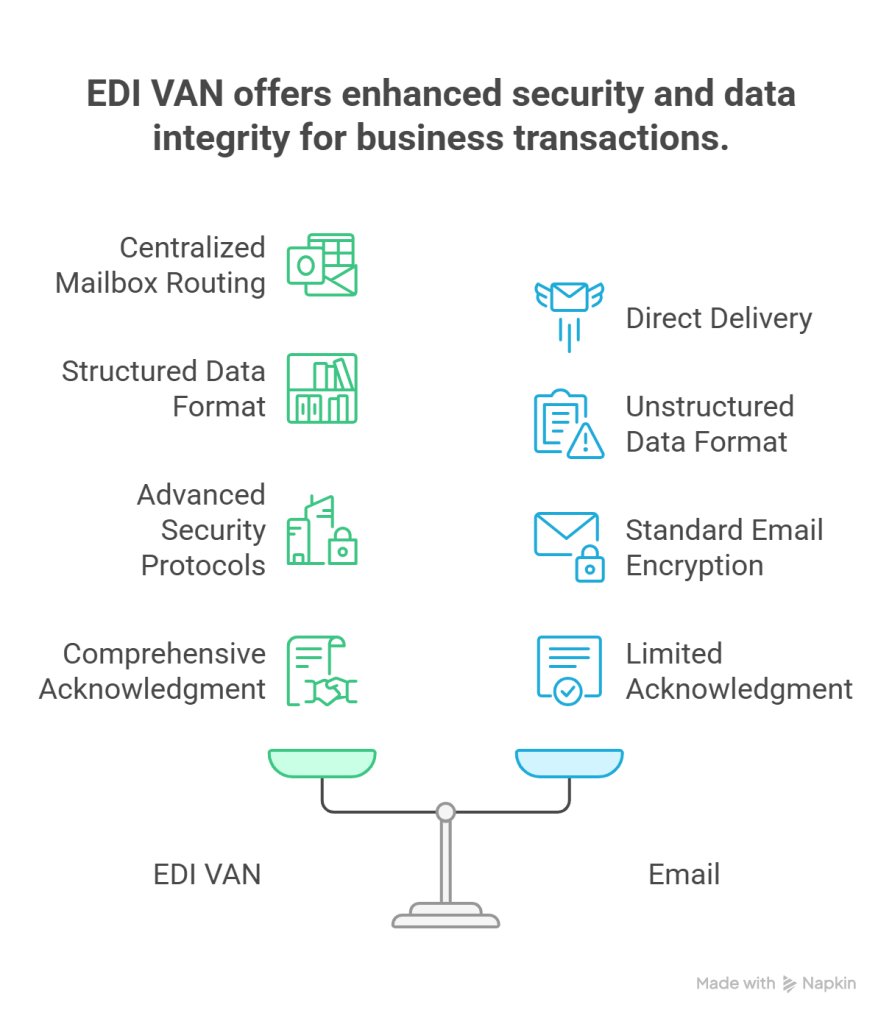
The EDI VAN operates as a secure digital “post office” where messages aren’t sent directly to recipients but routed through a centralized system of virtual mailboxes. In this model, when a company sends an EDI document, it’s first deposited in the VAN, which identifies the recipient, validates the format, and then securely routes the message to the trading partner’s designated mailbox.
Conversely, email uses a direct delivery model where messages travel immediately from sender to recipient without a centralized validation point. Moreover, an EDI VAN holds messages in the recipient’s mailbox until they connect to retrieve them, regardless of whether they’re online at the time of sending. This asynchronous capability ensures business-critical documents are never lost due to timing issues.
2. Data Format Handling: Structured vs Unstructured
One crucial distinction lies in how each system handles data formats. EDI communications use standardized, structured data formats that follow strict schemas and fit neatly into predefined models. This structured nature makes EDI data easily searchable and analyzable with conventional tools.
In comparison, email primarily transmits unstructured data without predefined formats. Consequently, information sent via email lacks the validation rules that ensure data accuracy and consistency in EDI exchanges. Unstructured data requires specialized processing to extract meaningful insights, making it less suitable for automated business transactions.
3. Security Protocols: TLS, AES-256 vs Standard Email Encryption
EDI VANs implement advanced security measures, including:
- Transport Layer Security (TLS) for data in transit
- AES-256 encryption for stored documents
- Digital certificates for authentication
AS2 protocol, often used with EDI, ensures data integrity through encryption and digital signatures. In fact, AS2 commonly uses Triple DES and AES-256 encryption algorithms to protect payload content.
4. Message Acknowledgment and Tracking
As a result of its business-critical nature, EDI incorporates comprehensive acknowledgment systems. When sending via AS2, the recipient sends back a Message Disposition Notification (MDN) that serves as a digitally signed receipt. This MDN includes a Message Integrity Check (MIC) that verifies the received message matches what was sent.
Furthermore, EDI systems support multiple acknowledgment levels:
- Communication-level acknowledgments confirming data transfer
- Functional acknowledgments (EDI 997) verifying syntax correctness
- Business-level acknowledgments confirming understanding of content
Email offers limited acknowledgment options, typically just read receipts that recipients can choose to ignore.
Key Differences in Functionality and Reliability
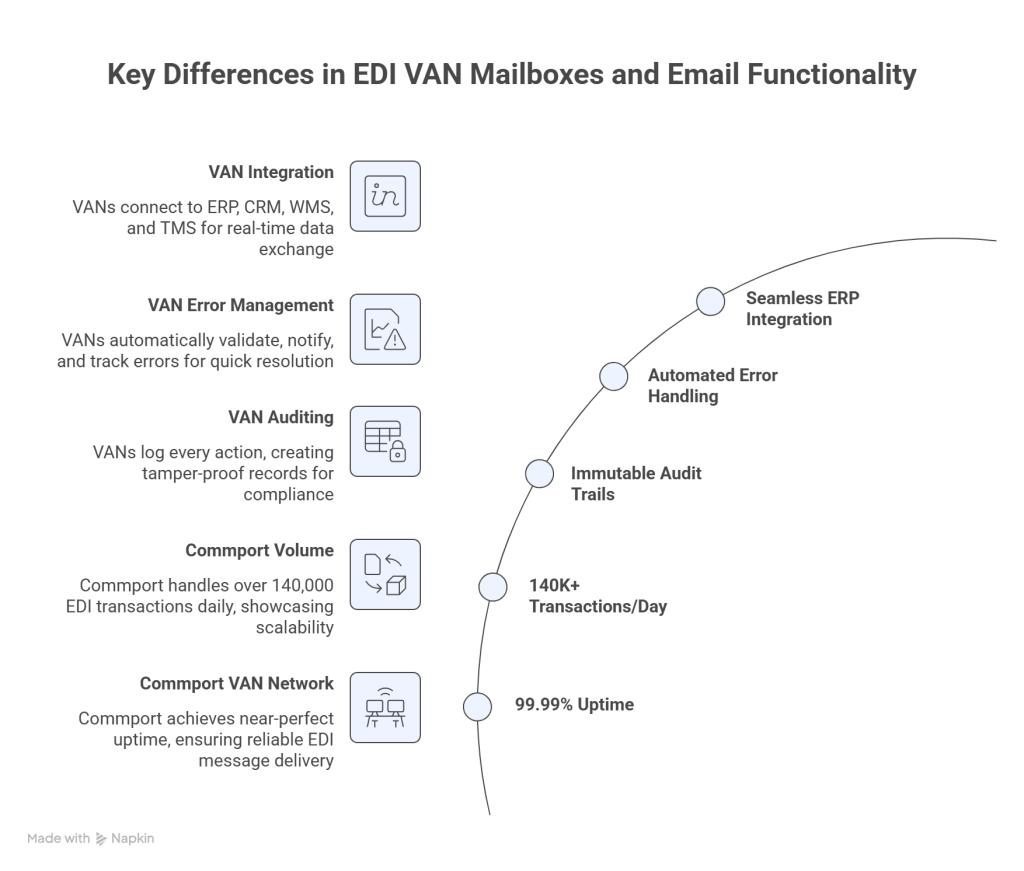
Reliability distinctions between EDI VAN mailboxes and email become apparent when examining their operational capabilities. These differences are critical for businesses that depend on timely, accurate data transmission for their daily operations.
1. Delivery Guarantees and Failover Mechanisms
EDI VAN services excel in message delivery assurance through built-in redundancy systems. If routing fails, the VAN queues the message and automatically retries delivery, ensuring no transaction is lost. Unlike standard email, VANs implement a comprehensive failover architecture—when one server encounters issues, the system seamlessly switches to backup servers without service interruption. This multi-server design minimizes downtime risk, particularly crucial for mission-critical communications.
Commport VAN Network, the #1 EDI VAN provider in North America with 99.99% uptime, delivers 140K+ transactions per day, demonstrating the exceptional reliability these specialized systems can achieve.
2. Audit Trails and Compliance Support
Perhaps the most significant advantage of EDI VANs is their comprehensive auditing capabilities. Every access, edit, file transfer, and permission change is logged with timestamps, creating immutable records protected from deletion or tampering. Hence, VANs provide instant access to every EDI transaction (current or archived) with sender details and processing results—a non-negotiable requirement during audits.
3. Error Handling and Exception Management
When document exchange issues arise, VANs offer sophisticated error management workflows:
- Automated validation that flags missing acknowledgments, invalid formats, or failed transmissions
- Real-time notifications help teams resolve issues as they occur
- Detailed error tracking tools for quick identification of problems
- Visible dashboards showing each step of document exchange lifecycle
Notably, EDI systems provide functional acknowledgments (997/999) that verify successful receipt, creating verifiable audit trails for both sender and receiver.
4. Integration with ERP and Business Systems
Integrating EDI with enterprise systems represents another crucial distinction. EDI VANs connect seamlessly with internal platforms, including ERP, CRM, WMS, and TMS systems. This integration enables real-time data exchange, improves automation, and significantly reduces manual processing errors. Indeed, modern API-based integration allows direct, programmatic communication between EDI and ERP systems, enabling data to flow smoothly from internal systems to external partners without manual input.
For regulated industries, the integration between EDI and business systems creates complete records of data flow, meeting governance requirements under regulations such as GDPR, CCPA, SOX, and PCI-DSS.
Cost, Scalability, and Maintenance Considerations
Financial considerations play a critical role when choosing between EDI VAN mailboxes and email systems for business communications.
1. Pricing Models
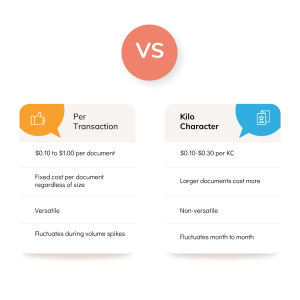
EDI VAN pricing typically follows three primary models. Transaction-based pricing charges per document or kilocharacter (KC), starting at three to twenty cents per document. Subscription-based models offer tiered monthly rates ranging from $250/month for entry-level volumes (up to 3,000 KC) to $3000/month for enterprise usage (up to 75,000 KC). Partner-based pricing charges a fixed fee per trading connection regardless of volume.
2. Scalability for High Volume Transactions
Unlike email systems that struggle with high-volume data exchange, EDI VANs are engineered for 99.998% uptime. Traditional email lacks the infrastructure to handle spikes in transaction volume that frequently occur in supply chains. A scalable EDI VAN effortlessly supports growing volumes without compromising speed or accuracy. Likewise, businesses processing thousands of documents daily benefit from dynamic scaling capabilities that prevent operational bottlenecks during growth phases.
3. IT Maintenance and Vendor Support
Given EDI skills, hiring and managing internal teams often proves prohibitively expensive, especially for smaller businesses. Value Added Networks offer varying support models—from basic troubleshooting to fully managed services that handle everything from technical setup to error resolution. Companies should evaluate response times, with quality providers committing to same-day responses.
Comparison Table
Feature | EDI VAN Mailbox | |
Core Function | Secure digital “post office” for routing, storing, and tracking EDI documents | Standard electronic messaging system for unstructured text transmission |
Data Format | Standardized, structured data formats with strict schemas | Unstructured data without predefined formats |
Delivery Method | Centralized routing through VAN with message validation | Direct delivery from sender to recipient |
Security | – TLS encryption | Standard email encryption (basic) |
Message Tracking | – Communication-level acknowledgments | Limited to basic read receipts (optional) |
Error Handling | – Automated validation | No built-in validation or error handling |
System Integration | Seamless integration with ERP, CRM, WMS, and TMS systems | Limited integration capabilities |
Reliability | 99.99% uptime with built-in redundancy and failover systems | No guaranteed delivery or uptime |
Audit Capability | Comprehensive audit trails with immutable records | Limited or no audit capabilities |
Cost Structure | – Transaction-based (3-20 cents per document) | Generally free, but has hidden costs in manual processing |
Best Suited For | – High-volume business transactions | – Small organizations |
Conclusion
The choice between EDI VAN mailboxes and email ultimately depends on your organization’s specific needs, transaction volumes, and compliance requirements. EDI VAN services clearly offer superior security, reliability, and structured data handling compared to traditional email systems. Their dedicated infrastructure ensures 99.99% uptime, comprehensive audit trails, and seamless integration with business systems.
Companies handling sensitive information, operating in regulated industries, or managing complex supply chains should seriously consider EDI VAN solutions despite their higher costs. The security protocols, delivery guarantees, and compliance support justify the investment for business-critical communications.
Smaller organizations with limited transaction volumes may find email sufficient as a starting point. However, as businesses grow, the limitations of email—including lack of validation, poor tracking capabilities, and insufficient security—become significant operational liabilities.
Before deciding, assess your current requirements while considering future growth. Many organizations start with basic email communications but transition to EDI VAN systems as their transaction volumes increase or compliance needs evolve. Additionally, the hidden costs of manual processing and error handling with email can quickly surpass the structured pricing models of EDI VAN services.
Rather than viewing these options as competing alternatives, consider them complementary tools in your communication strategy. Email works perfectly for day-to-day correspondence, while EDI VAN excels at structured business transactions that require security, validation, and reliable delivery. The right approach often involves strategically using both channels based on the nature and importance of different communications.
Through careful evaluation of your business needs, transaction volumes, security requirements, and budget constraints, you can determine the optimal communication solution that balances cost, efficiency, and compliance—ensuring your organization maintains seamless data exchange with all trading partners.
Commport #1 EDI VAN Provider
Download: VAN Buyers Guide
Maximize your business efficiency with the right VAN provider! Grab your free VAN Buyer's Guide and discover the key features and services that will elevate your EDI transactions to the next level.
Make an informed decision today!
Frequently Asked Questions
Yes, EDI VAN routes POs in seconds to minutes with instant MDNs and queuing, outpacing email’s variable delays from filters and manual checks—ideal for high-volume urgency. Commport VAN Network adds priority processing and real-time status for even faster flows. Verify the speed difference in a free demo.
Select a provider, map documents (e.g., 850 PO), connect via API/ERP, test transactions, and onboard partners—often completed in weeks with support. Commport VAN Network simplifies for SMBs with free guided setup, 100+ pre-built maps, and no hardware needs. Book your demo today.
EDI VANs top the list, followed by direct AS2/SFTP, cloud APIs, and managed services—all superior to email in standards and security. Commport VAN Network is the gold standard, combining VAN reliability with API flexibility at lower costs. Test it versus email in your free Commport demo.
Yes, providers like Commport Communications, offer hybrid VANs with email alerts, fallbacks, and gateways for transitional setups. Commport stands out with integrated EDI VAN, email notifications, GDSN, and cloud EDI in one platform. Explore Commport’s full suite in a free demo.
Pricing is typically volume-based range between ($0.03–$0.20 per KB/document plus mailbox fees). Commport VAN Network delivers transparent, tiered pricing with no surprises, optimized for SMBs to enterprises—unlock your quote via a free demo.
EDI VAN provides end-to-end encryption (AS2, PGP), digital signatures, non-repudiation, and compliant storage, shielding against phishing, breaches, and spam—far beyond email’s basic protections. Commport VAN Network adds SOC 2 compliance, 99.99% uptime, and redundancy for mission-critical data. Protect your operations with a Commport security demo.
Yes, EDI VAN integrates via APIs, gateways, or hybrid tools, sending email notifications for EDI events while handling core transactions securely. Commport VAN Network offers plug-and-play connectors for Outlook, Gmail, SAP, and QuickBooks, bridging email workflows effortlessly. Discover easy integration in a free Commport demo.
EDI VAN enables automated, real-time document exchange with error-checking and visibility, reducing supply chain discrepancies by up to 30%, speeding fulfillment, and minimizing stockouts versus email’s fragmented threads and lost files. Commport VAN Network boosts this with dashboards for order tracking and partner alerts, streamlining your entire chain—schedule your free demo now.
One of the key US and Canada VAN providers includes Commport Communications, delivering secure mailboxes, routing, and compliance for retail, manufacturing, and logistics. Commport VAN Network excels for US and Canada operations with GS1-certified cross-border support, low per-KB pricing, and easy onboarding—perfect for scaling your partnerships. Get started with a personalized Commport demo.