
Introduction
EDI technology trends are reshaping the business landscape, with the global EDI software market projected to soar to $4.52 billion by 2030, marking a Compound Annual Growth Rate (CAGR) of 12.5%. We’re witnessing a fundamental transformation as Electronic Data Interchange evolves from a static, legacy system into a dynamic enabler of digital supply chain collaboration.
As the global economy approaches the 2030 horizon, the convergence of advanced artificial intelligence, distributed ledger technologies, and ubiquitous high-speed connectivity is redefining how enterprises manage their B2B ecosystems. This transformation is not merely technical but is deeply rooted in shifting geopolitical and regulatory paradigms, particularly the rise of digital tax reporting and the harmonization of cross-border trade standards. The following analysis explores the multifaceted trends shaping the EDI sector, providing a comprehensive assessment of the technological and economic forces that will define business communication in the coming half-decade.
As e-commerce continues to expand, businesses increasingly adopt cloud-based EDI solutions that offer enhanced flexibility, scalability, and cost-effectiveness. These EDI trends are particularly significant for small businesses, which are driving the future of EDI technology through wider adoption. Cloud-based solutions enable organizations to scale their operations as needed, while avoiding the expensive setup and maintenance costs associated with traditional on-premises EDI infrastructure.
In this blog, we’ll explore the hidden shifts powering modern business through EDI from 2026 to 2030, including wider adoption among SMBs, AI integration, hybrid EDI-API solutions, and innovative combinations with technologies like OCR for end-to-end automation.
Key Takeaways
- SMBs gain enterprise-level capabilities: Cloud-based EDI solutions with subscription models eliminate barriers, enabling small businesses to access powerful automation previously reserved for large corporations.
- AI transforms EDI from reactive to predictive: Machine learning automates data mapping, handles exceptions intelligently, and enables autonomous supply chain decisions through predictive analytics.
- Hybrid integration maximizes technology strengths: Combining EDI’s standardized reliability with API’s real-time speed creates seamless workflows that satisfy both legacy and modern system requirements.
- OCR bridges the digital-physical gap: Integrating OCR with EDI creates end-to-end automation by converting unstructured documents into standardized digital workflows.
- Strategic advantage through intelligent orchestration: Organizations adopting these advanced EDI frameworks gain competitive advantages through improved efficiency, reduced costs, and enhanced supply chain visibility.
Macro-Economic Analysis and Global EDI Market Projections 2026–2030
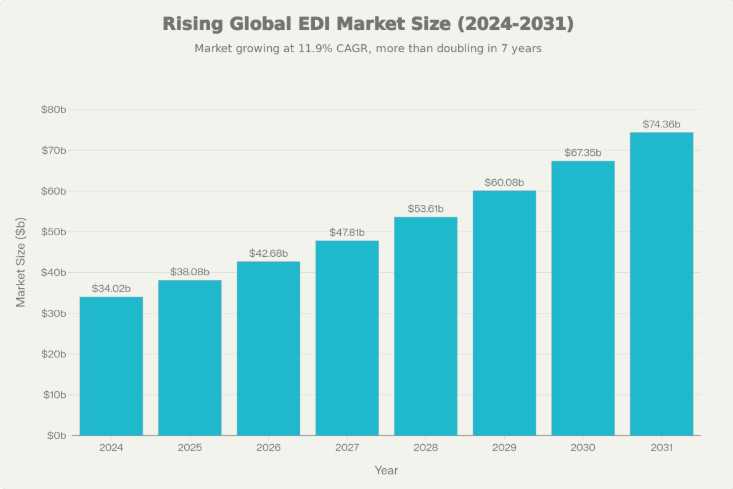
The economic value of EDI remains foundational to global commerce, with current projections indicating robust growth across software, services, and specialized industry verticals. The global electronic data interchange market, valued at approximately USD 34.02 billion in 2024, is anticipated to reach USD 67.35 billion by 2030, exhibiting a compound annual growth rate (CAGR) of 6.94%. Within the software-specific segment, market expansion is even more pronounced, with estimates suggesting a climb from USD 2.60 billion in 2025 to USD 4.54 billion by 2031, representing a CAGR of 11.8%.
Market Segment | 2024/2025 Value (USD Billion) | 2030 Projected Value (USD Billion) | Forecast CAGR (2025-2030) |
Global EDI (Total Market) | 39.91 (2024) | 75.30 (2030) | 6.94% |
EDI Software | 2.60 (2025) | 4.54 (2030) | 11.80% |
Healthcare EDI | 5.20 (2024) | 8.76 (2030) | 9.05% |
Managed EDI Services | 2.20 (2025) | 3.00 (2030) | 12.60% |
SME-Focused EDI Platforms | 1.10 (2024) | 2.10 (2030) | 12.50% |
The increasing demand for real-time visibility and error reduction in supply chains largely propels this growth. In the current environment, over 75% of manufacturing firms process their procurement and shipping data through EDI platforms, with logistics companies reporting an average 33% reduction in document turnaround time through digitization. The retail sector also reports a 21% decline in out-of-stock events as a direct result of improved forecasting driven by timely EDI updates.
1. Regional Market Dynamics: The Ascendance of Asia Pacific
North America continues to dominate the global EDI market, holding a revenue share of approximately 38.31% to 45% as of 2024. This dominance is attributed to a mature ecosystem of healthcare information technology (HCIT) and the presence of major industry players such as McKesson, Optum, and the SSI Group. However, the 2026–2030 period is expected to see a significant shift in growth velocity toward the Asia Pacific (APAC) region. APAC is projected to grow at a CAGR of 14.04% through 2030, the fastest in the world. This acceleration is fueled by massive investments in research and development and the rapid expansion of digital trade corridors in China, India, and Southeast Asia.
Europe, while historically fragmented by differing national standards, is undergoing a rapid consolidation driven by the “VAT in the Digital Age” (ViDA) initiative and the adoption of the Peppol standard. The European market is expected to exhibit strong growth as it transitions toward mandatory B2B e-invoicing, with countries like Germany and France leading the implementation roadmaps.
2. Vertical Industry Analysis: Healthcare and Retail
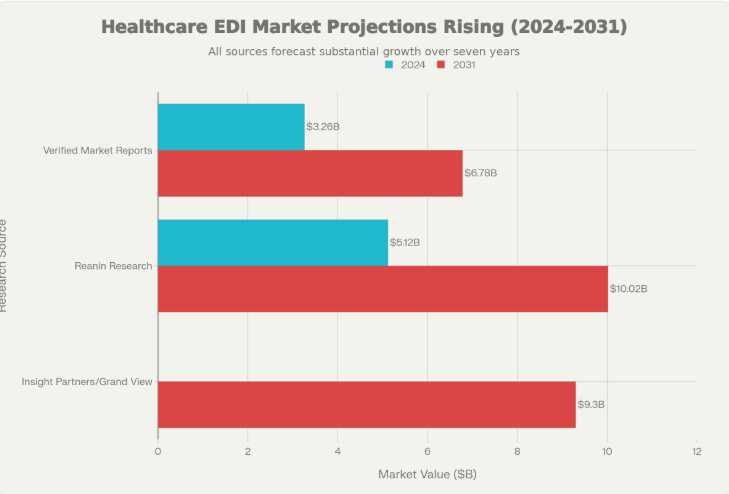
The healthcare sector remains a pivotal driver of EDI innovation. The global healthcare EDI market was valued at USD 5.20 billion in 2024 and is expected to reach USD 8.76 billion by 2030, growing at a 9.05% CAGR.3 Stringent regulations such as the Health Insurance Portability and Accountability Act (HIPAA) in the United States and global serialization mandates for pharmaceuticals are forcing healthcare providers and payers to automate claims processing, eligibility verification, and data reporting.
In the retail sector, the expansion of omnichannel channels and the rise of e-commerce necessitate seamless data exchange for real-time inventory updates and order processing. Retail and consumer goods accounted for 28.02% of the EDI software market share in 2024, utilizing EDI to synchronize data across physical stores, e-commerce platforms, and third-party logistics.
Industry Vertical | 2024 Revenue Share (%) | Projected Growth Focus (2026-2030) |
Healthcare | 34% (Est) | Claims automation, HIPAA compliance, serialization |
Retail & E-commerce | 28.02% | Omnichannel synchronization, real-time inventory |
Manufacturing | 22% (Est) | JIT logistics, IoT integration, supply chain visibility |
Logistics & Transportation | 12% (Est) | Real-time tracking, 214/856 status updates |
Global Regulatory Transformation and the E-Invoicing Mandate
The regulatory landscape is arguably the most powerful catalyst for EDI technology adoption between 2026 and 2030. Governments worldwide are implementing mandatory e-invoicing regimes to reduce the “VAT gap”—the difference between expected and actual tax revenue—and to streamline fiscal administration.
1. The ViDA Initiative and Peppol Harmonization
The European Union’s “VAT in the Digital Age” (ViDA) reform is the most significant change to VAT administration since the inception of the Single Market. Effective July 1, 2030, all intra-EU B2B and B2G (Business-to-Government) invoices must be issued as structured e-invoices using the Peppol standard (EN-16931 format).
Peppol (Pan-European Public Procurement Online) serves as both a technical standard and a network of certified Access Points (APs). It utilizes a “4-corner model” for document exchange:
- Corner 1 (C1): The Sender (Supplier) who generates the invoice.
- Corner 2 (C2): The Sender’s Access Point, which validates and sends the document.
- Corner 3 (C3): The Receiver’s Access Point, which receives and verifies the document.
- Corner 4 (C4): The Receiver (Buyer) who integrates the document into their ERP.
However, many jurisdictions are moving toward a “5-corner model” or Continuous Transaction Control (CTC) model. In this setup, a government tax platform acts as a fifth corner, receiving and clearing the invoice in real-time before it reaches the buyer. This ensures that the tax authority has an immediate, immutable record of every transaction.
2. Global Implementation Roadmap: 2026–2030
The rollout of these mandates is staggered, with 2026 being a defining year for several major economies. Organizations operating internationally must navigate a complex patchwork of compliance dates and technical requirements.
Country | Mandate Effective Date | Target Scope | Platform/Standard |
Belgium | Jan 1, 2026 | All domestic B2B transactions | Peppol / EN-16931 |
Poland | Feb 1, 2026 | Large taxpayers (KSeF) | KSeF National Platform |
Croatia | Jan 1, 2026 | All B2B and B2G | Fiscalization 2.0 |
France | Sep 1, 2026 | Large & intermediate firms | PPF / PDP Certified Platforms |
UAE | Jul 1, 2026 | Nationwide phased rollout | OpenPeppol Network |
Germany | Jan 1, 2027 | Issuing mandatory (>€800k) | XRechnung / ZUGFeRD |
Spain | Jan 1, 2027 | Large taxpayers | Verifactu Requirement |
UK | April 2029 | Mandatory B2B regime | National standardized approach |
Ireland | Nov 2028 | Large corporates (Phase 1) | ViDA Alignment |
South Africa | 2028 | Full implementation target | SARS Digital Reporting |
EU (ViDA) | Jul 1, 2030 | All intra-EU transactions | Full ViDA Compliance |
Failure to comply with these mandates carries significant risks, including administrative fines (e.g., starting at €1,500 in Belgium), blocked invoices, and the loss of VAT deduction rights. Conversely, early adoption offers efficiency gains, with 80% of large enterprises expecting tangible efficiency improvements within two years of implementation due to automated reconciliation and faster payment cycles
Wider EDI Adoption Among Small and Mid-Sized Businesses
Small and medium-sized businesses are increasingly turning to EDI technology as a competitive necessity rather than a luxury. Once considered exclusive to large corporations, modern EDI solutions are now accessible to businesses of all sizes. This significant shift is democratizing supply chain automation, enabling even the smallest companies to compete effectively in today’s interconnected marketplace.
1. Cloud-based EDI for SMBs with Limited IT Resources
Cloud-based EDI has fundamentally changed how smaller businesses participate in electronic document exchange. Unlike traditional systems requiring extensive IT infrastructure, modern cloud solutions eliminate the need for on-premise hardware and software installations. Consequently, SMBs can now implement robust EDI capabilities without dedicated technical teams or significant upfront investments.
These solutions offer several key advantages for resource-constrained businesses:
- Simplified implementation – Modern web EDI platforms require minimal technical expertise, making them manageable even without specialized IT support
- Anywhere accessibility – Cloud solutions ensure employees can access, monitor, and manage EDI transactions regardless of location
- Reduced infrastructure burden – No need for constant hardware purchases or software upgrades—just a web browser and internet connection
“Small businesses with unique needs find EDI software a powerful tool that ensures operational efficiency, seamless integration, and ongoing support,” notes a recent industry report. Furthermore, studies show that SMBs investing in the right EDI service providers can overcome traditional challenges and unlock new business opportunities.
2. Affordable Subscription Models Replacing Legacy Systems
The cost structure of EDI has evolved dramatically, making it financially viable for smaller enterprises. Modern solutions have replaced capital expenses with predictable operational costs through subscription-based pricing. Instead of purchasing licenses, hardware, and paying for constant updates, businesses now access single, scalable platforms that grow with their needs.
Cloud-based and subscription models offer low upfront investment with scalable pricing structures. Notably, many providers now use partner-based pricing rather than per-transaction billing, creating more predictable costs. This approach allows businesses to control EDI expenses effectively while eliminating inefficiencies that make legacy systems expensive to maintain.
Many companies report savings of 40%-60% or more in their first year when shifting from legacy EDI to modern platforms. Despite common assumptions about cost, today’s solutions offer affordable entry points with lower upfront investments.
Commport EDI Solutions offers scalable and affordable EDI Solutions trusted by 6000+ happy customers!
AI, NLP, and Machine Learning Transforming EDI Workflows
Artificial intelligence, natural language processing (NLP), and machine learning are reshaping traditional EDI systems by replacing manual data handling and static rule-based processes that often bottleneck business transactions. These technologies add intelligence to EDI operations, making them more adaptive, proactive, and insightful.
1. AI-Assisted Data Mapping and Exception Handling
Traditional EDI mapping requires extensive manual configuration for each new trading partner. AI dramatically simplifies this process by recognizing patterns in data structures, essentially automating large portions of the EDI mapping process. Machine learning algorithms analyze format specifications, existing mappings, and sample data to recommend optimal field connections between different document formats. This approach reduces onboarding time from weeks to minutes while minimizing errors.
Exception handling, previously one of the most resource-intensive aspects of EDI, has also been transformed. AI-driven platforms now intelligently classify and consolidate errors, auto-generating recommended action plans with guided resolution paths. Additionally, machine learning models flag anomalies in real-time, recognizing unusual transaction patterns before they disrupt operations.
2. Predictive Analytics Using EDI Transaction History
Beyond routine document processing, AI enables organizations to move from retrospective reporting to predictive and prescriptive analytics. By analyzing historical EDI data, machine learning models can identify trends, predict demand fluctuations, and spot potential disruptions before they materialize.
Key capabilities include anomaly detection in transaction patterns, demand forecasting that synthesizes order history with market signals, and risk scoring that quantifies supplier reliability based on performance metrics. Essentially, these tools transform EDI from a passive exchange to a strategic forecasting engine
3. Agentic AI for Autonomous Supply Chain Decisions
The next frontier in EDI intelligence involves agentic AI frameworks that bring autonomous decision-making to supply chains. These systems can execute bounded tasks like reconciling mismatched EDI fields or proposing replenishment orders while escalating complex cases to humans.
Recent tests have demonstrated that generative AI models can now autonomously manage inventory and logistics decisions, signaling a breakthrough. Autonomous agents monitor shipments, validate invoices, analyze trading partner behavior, and even detect compliance issues shifting supply chain management from reactive firefighting to strategic orchestration.
AI Capability | Mechanism | Impact on EDI Operations |
Autonomous Mapping | Pattern recognition in XML/X12/EDIFACT | Reduces onboarding time by >90% |
Anomaly Detection | Historical analysis of transaction velocity | Prevents fraud and costly operational delays |
Document Extraction | OCR and NLP for unstructured data | Bridges gap for non-EDI enabled partners |
Predictive Analytics | Trend analysis of historical delays | Forecasts supply chain disruptions |
Industrial IoT and Real-Time Event Orchestration
The integration of the Internet of Things (IoT) with EDI represents the “physical-to-digital” bridge of the modern manufacturing and logistics sectors. The global IoT in manufacturing market is projected to reach USD 1.51 trillion by 2030, driven by the need for deeper operational visibility.
1. IoT-Enabled Document Triggers
In a traditional setup, EDI documents are triggered by human intervention or scheduled batch jobs. IoT-enabled EDI changes this by utilizing real-time data from physical assets such as machines, sensors, and inventory trackers to trigger transactions.
- EDI 214 (Transportation Status): Smart sensors and RFID tags on shipping containers provide up-to-the-minute information on location and product condition. This data is fed directly into EDI 214 messages, providing shippers and buyers with real-time ETAs and status updates.9
- EDI 846 (Inventory Advice): In manufacturing facilities, IoT sensors monitor bin levels. When the raw material inventory falls below a set threshold, an EDI 850 (Purchase Order) is automatically generated and sent to the supplier without human intervention.
- EDI 810 (Invoice): Machine sensors tracking production completion can trigger automated invoicing as soon as a batch is finished and verified by quality control systems.
2. Predictive Maintenance and Sustainability
Beyond simple logistics, IoT-EDI integration powers “predictive maintenance.” By tracking machine usage and health through connected sensors, systems can proactively trigger EDI work orders and parts replenishment before a breakdown occurs, minimizing costly downtime. Additionally, energy-tracking sensors help businesses monitor resource usage, with the data integrated into EDI documents to meet emerging ESG (Environmental, Social, and Governance) reporting requirements.
IoT Sensor Type | EDI Transaction Set | Operational Outcome |
GPS/Geospatial | EDI 214 (Shipment Status) | Real-time tracking and accurate ETAs |
Weight/Bin Sensor | EDI 846 (Inventory Advice) | Automated JIT (Just-in-Time) ordering |
Temperature/Humidity | EDI 214/856 (Status/ASN) | Quality assurance for perishables/pharma |
Machine Health | EDI Work Order / Replenishment | Predictive maintenance; zero-touch repair |
Hybrid Integration: EDI and API Working Together
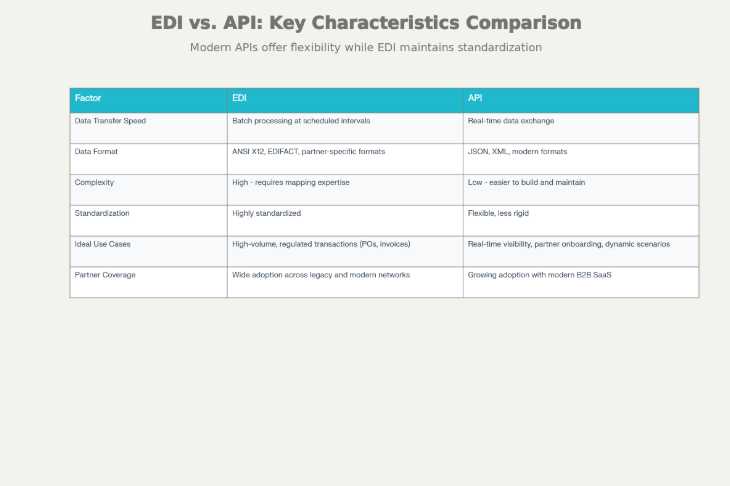
The future of business data exchange lies in combining technologies rather than choosing between them. Modern integration platforms now blend EDI’s standardized reliability with API’s real-time capabilities, creating powerful hybrid systems that maximize the strengths of both approaches.
1. Real-Time Order Processing via API-EDI Sync
Hybrid API/EDI integration enables businesses to maintain EDI’s structured document exchange while adding API-driven speed. In practice, this means a retailer might receive a purchase order via traditional EDI, then use APIs to instantly update inventory and trigger fulfillment processes in real-time. This synchronization creates a seamless connection between legacy processes and modern systems, ensuring trading partners see their preferred format regardless of how data enters the ecosystem.
2. ERP System Integration Using Hybrid Connectors
Modern platforms now offer pre-built connectors that integrate EDI directly with major ERP systems, including SAP, Oracle, NetSuite, and Microsoft Dynamics. These hybrid connectors enable automated workflows where EDI handles standardized transactions while APIs ensure ERP systems always have the most current data available. Moreover, this approach dramatically simplifies partner onboarding, improves visibility, and reduces the complexity of legacy systems.
3. Use Cases in eCommerce and Logistics
In supply chain management, EDI efficiently processes routine documents like orders and invoices, while APIs deliver real-time tracking and inventory updates. Similarly, eCommerce operations benefit from EDI’s batch processing for back-end functions combined with API-powered customer-facing features like dynamic pricing and immediate order status. For logistics companies specifically, this dual approach allows shippers to gain real-time speed without requiring every carrier to retool simultaneously.
Commport EDI Solutions offers The Most Advanced and Modern EDI Solutions With Built in VAN, OCR and API technology.
EDI and OCR: A Powerful Combination for Automated Data Processing
Modern businesses face a critical challenge: many essential documents exist outside standardized digital formats. This gap between structured and unstructured data creates significant friction in automated workflows. Thus, emerging EDI technology trends now highlight the strategic combination of EDI with Optical Character Recognition (OCR).
1. Understanding the Role of EDI in Structured Data Exchange
Electronic Data Interchange excels at handling structured formats, enabling direct computer-to-computer exchange of business documents like invoices and purchase orders. EDI requires standardized formats such as EDIFACT or ANSI X12, eliminating human intervention in document processing. In this realm, information flows automatically between systems according to predefined standards.
2. How OCR Bridges the Gap for Paper and Unstructured Documents
Although EDI streamlines digital document exchange, paper documents and non-standard formats persist throughout business ecosystems. OCR technology addresses this limitation by scanning physical or digital documents and converting text into machine-readable formats. Initially focused solely on character recognition, advanced OCR now processes structured, semi-structured, and unstructured documents—extracting key data from invoices, orders, and shipping documents.
3. Why Combining EDI and OCR Delivers End-to-End Automation
Together, these technologies create a complete document exchange ecosystem. OCR serves as the initial processing step for unstructured documents, subsequently feeding standardized data into EDI workflows. This integration delivers faster processing cycles, minimizes entry errors, and ensures compliance with regulatory requirements. Furthermore, OCR effectively handles one-off documents that would be impractical for full EDI integration.
Commport EDI Solutions offers the most advanced EDI solutions with built-in VAN, OCR, and API technology, everything modern businesses need for seamless document processing.
Critical Implementation Challenges and Barriers
1. Organizations Implementing EDI Face Three Primary Obstacles
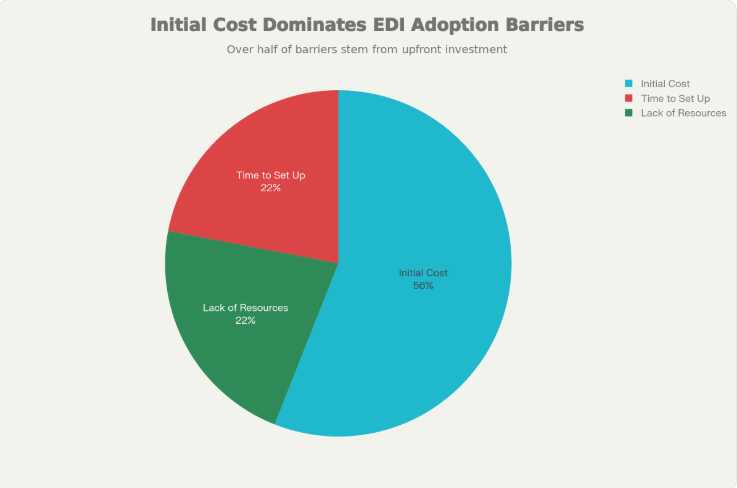
Initial Cost (56%): While cloud has reduced costs, implementation still requires software, professional services, training, and testing investment. Mitigation: subscription-based pricing, phased rollout, and managed services outsourcing.
Time to Setup (22%): Implementation timelines range from 2-4 weeks (single partner) to 6-12 months (100+ partners, complex integration). Acceleration tactics: template configurations, agile methodology, MSP expertise, pre-defined onboarding protocols.
Resource Constraints (22%): EDI specialists are scarce; internal IT teams lack EDI expertise. Solutions: outsource to managed service providers, invest in training, and implement self-service platforms.
2. Beyond Primary Barriers
1. Partner Communication Failures (63% struggle)
Trading partners often conceal EDI specifications until implementation, creating surprises.
Solution: early EDI requirement documentation, standardized onboarding workflows, partner portals for self-service.
2. Testing Deficiencies (60% report failures)
Complex EDI specifications require comprehensive testing, including normal cases, edge cases, error scenarios, and high-volume stress tests. Many implementations fail due to inadequate testing frameworks.
Executive Sponsorship: The single strongest success predictor. Without C-suite commitment, projects compete for resources and lack funding for adequate implementation.
3. Legacy System Integration
Difficulty integrating modern EDI with legacy ERP systems.
Solution: middleware platforms, staged migration, flat-file integration.
3. Key Recommendations for Decision-Makers
- Prioritize Cloud Migration: Eliminates legacy technical debt; enables modern capabilities (AI, real-time, scalability)
- Adopt Hybrid Architecture: Combine EDI reliability for regulated high-volume transactions with APIs for real-time flexibility and rapid partner onboarding
- Invest in Managed Services: Organizations lacking EDI expertise achieve 50% faster partner onboarding and 24/7 support without building internal capacity
- Implement AI from Day One: Modern EDI platforms include AI as standard; immediate value from automated mapping, error detection, and predictive analytics
- Plan for Security Evolution: Advanced threat detection, zero-trust models, and post-quantum encryption readiness are no longer optional
- Build SME Supply Chain Network: Democratized EDI access creates an opportunity to expand the trading partner ecosystem cost-effectively
Market Drivers and Expansion Catalysts
Digital Transformation Imperative: Organizations across industries recognize EDI as foundational to supply chain digitization, delivering 30-40% cost reductions, real-time visibility, and partner enablement.
Regulatory Compliance: HIPAA mandates to drive healthcare EDI; EU e-invoicing legislation creates compliance requirements; FDA pharmaceutical tracking requirements leverage EDI.
SME Democratization (Most significant expansion opportunity): Cloud-based solutions have democratized EDI access:
- Subscription pricing eliminates large capital requirements
- Simplified onboarding reduces technical expertise requirements
- Plug-and-play integration with SME systems (QuickBooks, Shopify, NetSuite)
- European Commission data shows 5.4% SME growth; 85% of SMEs using cloud report competitive improvement
E-Commerce Expansion: Peak-season demand (5-10x typical volume) requires automated supply chain coordination. EDI manages complexity across thousands of suppliers and millions of daily transactions.
Healthcare IT Modernization: EHR expansion (96% hospital adoption), value-based care transition, pharmacy innovation, and processing modernization drive healthcare EDI growth at 9.6-10.1% CAGR.
Conclusion
The EDI landscape stands at a pivotal crossroads as we approach 2030. Throughout this exploration of emerging trends, we’ve seen how EDI technology transcends its traditional role as a mere document exchange system. Small and mid-sized businesses now access powerful EDI capabilities through cloud solutions and subscription models, effectively eliminating barriers that once restricted these tools to large enterprises.
AI and machine learning capabilities undoubtedly represent game-changing developments in the EDI ecosystem. These technologies transform static systems into intelligent platforms capable of predictive analytics, autonomous decision-making, and self-improving processes. Gone are the days of manual exception handling and tedious data mapping.
Additionally, the strategic combination of EDI with complementary technologies creates unprecedented value. Hybrid EDI-API integration delivers both standardized reliability and real-time responsiveness, while the EDI-OCR partnership bridges critical gaps between digital and physical documentation. These powerful combinations enable true end-to-end automation across diverse business environments.
Looking ahead, companies adopting these advanced EDI frameworks will gain significant competitive advantages through improved operational efficiency, reduced costs, and enhanced supply chain visibility. Still, the most profound impact may be how these technologies democratize access to enterprise-grade capabilities, allowing businesses of all sizes to participate in digital ecosystems previously reserved for industry giants.
Therefore, as EDI continues evolving beyond simple document exchange toward intelligent orchestration, we expect to see accelerated adoption across industries. The future belongs to organizations that recognize EDI not merely as a technical necessity but as a strategic asset powering modern business operations.
Commport EDI Solutions - Scalable and Affordable EDI Solutions
Need Help? Download: Commport's EDI Buyers Guide
Unlock the full potential of your supply chain with our comprehensive EDI Buyer's Guide — your first step towards seamless, efficient, and error-free transactions
Frequently Asked Questions
AI is revolutionizing EDI by automating data mapping, handling exceptions intelligently, and enabling predictive analytics. It’s transforming EDI from a reactive to a proactive system, capable of making autonomous supply chain decisions and identifying trends before they materialize.
Cloud-based EDI solutions provide small businesses with simplified implementation, anywhere accessibility, and reduced infrastructure burden. They eliminate the need for extensive IT resources and offer affordable subscription models, making enterprise-level EDI capabilities accessible to businesses of all sizes.
The integration of EDI and OCR creates a complete document exchange ecosystem. OCR bridges the gap between physical and digital documents by converting unstructured data into machine-readable formats, which can then be seamlessly processed through EDI workflows, enabling end-to-end automation.
Hybrid EDI-API integration combines the standardized reliability of EDI with the real-time capabilities of APIs. This approach allows businesses to maintain traditional EDI processes while adding API-driven speed, enabling real-time order processing, seamless ERP system integration, and improved efficiency in e-commerce and logistics operations.
By 2030, EDI technology trends are expected to democratize access to enterprise-grade capabilities, allowing businesses of all sizes to participate in sophisticated digital ecosystems. Companies adopting advanced EDI frameworks will gain competitive advantages through improved operational efficiency, reduced costs, and enhanced supply chain visibility.
While AS2 has been the dominant protocol for decades, AS4 is emerging as the “next-generation” standard because it is built on modern web services (SOAP/XML) and is better suited for cloud-native architectures. Unlike AS2, which is primarily push-based, AS4 supports both “push” and “pull” messaging, which is critical for businesses operating behind restrictive firewalls that cannot easily receive incoming HTTP posts. Furthermore, AS4 is payload-agnostic, allowing it to transmit traditional EDI alongside XML, JSON, and binary files with equal efficiency.
Traditional automation follows rigid, human-defined rules, whereas Agentic AI involves autonomous agents that can perceive, reason, and act toward specific goals with minimal human oversight. By 2030, these agents will likely handle more than 50% of enterprise workflows, autonomously identifying and correcting mapping errors or broken integrations. This reduces partner onboarding time from several weeks to just minutes by using pattern recognition to map disparate data formats without manual configuration.
4-corner model is the standard decentralized framework for secure document exchange between a sender, a receiver, and their respective Access Points. The 5-corner model—also known as Continuous Transaction Control (CTC)—adds a government tax platform as a fifth entity. This model is becoming mandatory in many regions to reduce the “VAT gap” by requiring that invoices be cleared and validated by tax authorities in real-time before they reach the buyer.
IoT devices, such as RFID tags and GPS sensors, provide real-time data that can automatically trigger EDI documents, such as a Status Message (EDI 214) or an Inventory Advice (EDI 846). Blockchain provides the security layer for these automated transactions by creating an immutable, tamper-proof audit trail. This allows stakeholders to instantly verify a product’s entire history—from manufacturing to final delivery—reducing fraud and the prevalence of counterfeit goods.