
Introduction
EDI integration software powers 85% of supply chain transactions today, and that dominance isn’t slowing down.
Organizations rely on electronic data interchange to replace manual processes with automated efficiency, cutting costs to just a third of paper-based operations.
Indeed, the current $2.1 billion EDI market is projected to reach $5.3 billion by 2032, fueled by AI innovations and growing demand for real-time B2B integration software.
Choosing the right EDI solution providers can transform your order-to-cash cycles and trading partner relationships.
In this guide, we’ll compare top EDI software options, break down pricing models, and help you evaluate which EDI integration tools fit your business needs.
Key Takeaways
- EDI reduces operational costs by 35% and errors by 30-40% while accelerating business cycles by 61% through automated document exchange.
- Choose between per-transaction pricing ($0.10-$1.00 per document) or flat per-partner models starting around $149/month for predictable costs.
- Cloud-based solutions deploy in days rather than weeks, with managed services ideal for SMBs lacking IT expertise.
- Ensure your EDI platform supports multiple standards (X12, EDIFACT, XML) and integrates seamlessly with your existing ERP systems.
- Prioritize scalability and fast partner onboarding capabilities to accommodate business growth and changing trading partner requirements.
What Is EDI Integration Software
Definition and Core Functions
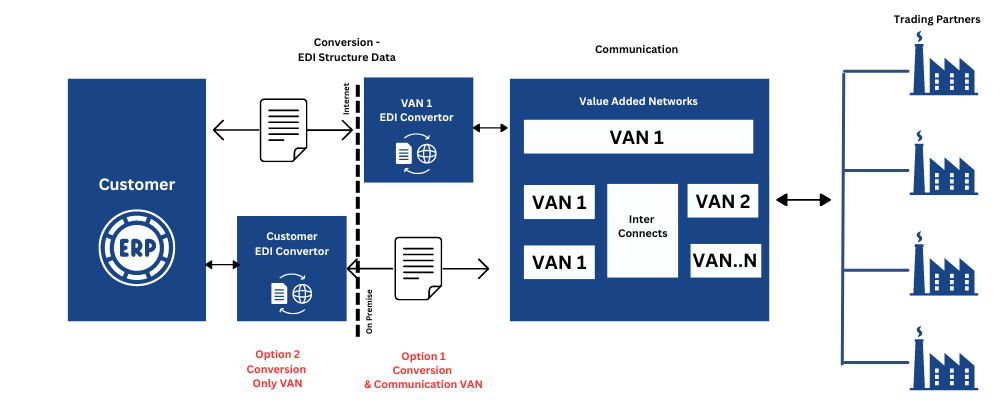
EDI integration software connects your electronic data interchange platform with internal business systems like ERP, supply chain management, and workflow management applications. This connection enables automatic data exchange between your enterprise systems and external trading partner ecosystems without manual intervention. The software transforms business documents into standardized digital formats, defining the exact location and order of information in each document.
Organizations use EDI integration software to share purchase orders, invoices, inventory updates, advanced shipping notices, and pricing quote requests. The core function revolves around automatic transformation and document exchange, eliminating paper-based transactions while reducing human error. By standardizing document formats and automating processes, the software adds reliability and security to data transfers between business partners.
EDI integration completes the data pipeline, creating an automatic flow from a business partner through to your back-end applications and systems. You no longer need to re-key orders or shipping data received through an EDI platform. The information translates automatically from EDI formats into your internal business system’s data structure and posts within integrated applications. This same workflow applies to outbound data, where system information moves automatically from internal systems to EDI software, converts into an EDI standard, and transmits to your business partner.
How EDI Software Connects Business Systems
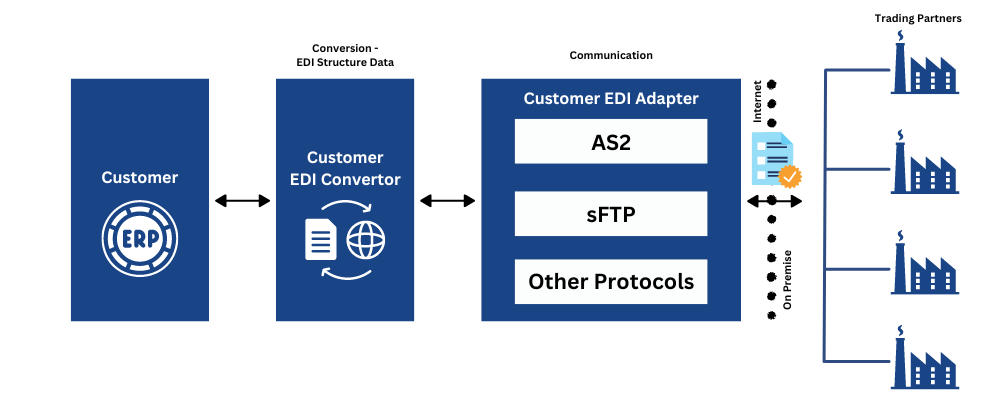
When EDI software receives data from trading partners, it analyzes the EDI document, extracts relevant information, and enters it into the appropriate structure of your database. Because this extraction process runs automatically, EDI documents must follow standardized formats. An EDI translator, typically a third-party software application, automatically pulls data from your internal systems and databases. Your ERP system integrates with this EDI translator, which then converts and structures the data into a chosen standard.
The software supports various integration architectures depending on your organization size, budget, industry standards, security needs, and in-house expertise. A single EDI integration layer can route, validate, and transform messages among internal systems and all trading partners, providing uniform governance and centralized monitoring. Alternatively, EDI logic can be embedded within individual applications or business units for more agility.
Modern EDI systems increasingly combine with APIs and event streaming to capture real-time data from applications. While APIs provide real-time, fine-grained integration, EDI systems deliver standardized, high-volume batch exchange with governance and auditability. This hybrid approach supports microservices architectures and faster internal innovation. The addition of artificial intelligence tools, including AI agents and low-code capabilities to EDI systems and integration platforms, has simplified and accelerated EDI integration while lowering the barrier to entry.
Common EDI Standards and Protocols
EDI standards function as common languages that define how to structure and exchange electronic documents within the digital supply chain. These standards establish what information must be included in each document type, the order and format of data, and the precise meaning of each field. Without unified standards, you would need to adapt to each partner’s proprietary formats, making large-scale automation infeasible.
ANSI X12, created in 1979, serves as the first commercial EDI standard and is used by approximately 300,000 companies worldwide, with widespread adoption in North America. UN/EDIFACT emerged in the 1980s under United Nations oversight to create an international, multi-country, and multi-industry standard commonly used for global trade. ODETTE was developed specifically for the European automotive industry. UBL (Universal Business Language), created in 1998, is based on XML and was initially designed for the financial sector.ANSI ASC X12
RosettaNet for high-tech and semiconductor industries, and regional standards such as VDA for the German automotive industry and TRADACOMS for the UK market. Secure internet protocols, including AS2, SFTP, and HTTPS-based protocols, transmit EDI documents.
How EDI Integration Software Streamlines B2B Operations
Business-to-business transactions drain resources when handled manually. EDI integration software addresses this inefficiency by automating core processes that traditionally consumed staff time and introduced costly errors.
1. Automated Document Exchange
EDI software replaces manual paperwork with automated, standardized document exchange. Your system sends purchase orders, advance shipping notices, and invoices directly to trading partners without requiring employees to type information. Rather than spending hours on clerical work entering purchase orders or invoices, automation handles these transactions in seconds. The software automatically exchanges documents such as purchase orders, invoices, and shipping notices, freeing your employees to focus on higher-value tasks.
2. Reduced Manual Data Entry and Errors
Manual data entry creates costly mistakes that disrupt operations. EDI eliminates the need for re-keying information, ensuring data remains accurate and consistent across all transactions. This accuracy prevents misunderstandings and disputes with trading partners. Organizations using EDI see . The difference becomes stark when comparing error rates: companies integrating EDI and APIs experience less than 1% error rates versus 30% with manual re-keying.at least a 30-40% reduction in transactions with errors
Errors from illegible faxes, lost orders, or incorrectly taken phone orders disappear entirely. Your staff saves valuable time previously spent handling data disputes. Since EDI removes paper-based data entry, businesses benefit from both time and cost savings along with an improved customer experience.
3. Faster Order-to-Cash Cycles
EDI . Transactions exchange in minutes instead of the days or weeks required by postal service. For sellers, this translates to improved cash flow and reduced order-to-cash cycles. EDI can reduce the order-to-cash cycle time by more than 20%, improving business partner transactions and relationships accelerates business cycles by 61%
Quick processing of accurate business documents leads to less reworking of orders, fewer stockouts, and fewer canceled orders. The software enables automatic generation and delivery of invoices once orders ship, reducing the time between product delivery and payment collection. Hours of processing time shrink to minutes.
4. Real-Time Inventory and Order Visibility
EDI provides instant stock updates, ensuring inventory records reflect actual product availability in real time. Businesses checking stocks daily or even hourly receive real-time updates on stock movement. This speeds up order processing and allows for faster delivery by optimizing routes.
Real-time visibility into transaction status enables faster decision-making and improved responsiveness to changing customer and market demands. Organizations can adopt a demand-driven business model rather than a supply-driven one.
5. Improved Trading Partner Compliance
Many retailers require EDI capability before discussing pricing. EDI ensures all transactions comply with industry standards and regulatory requirements, reducing the risk of fines and penalties. Avoiding manually keying orders through EDI reduces the risk of penalties and credits from major retailers.
6. Lower Operational Costs
Expenses associated with paper, printing, reproduction, storage, filing, postage, and document retrieval reduce or disappear when switching to EDI transactions, lowering transaction costs by at least 35%. A major electronics manufacturer calculates processing an order manually at $38.00 compared to just $1.35 for an order processed using EDI. Buyers handling numerous transactions can realize millions of dollars in annual savings due to early payment discounts.
Types of EDI Integration Solutions
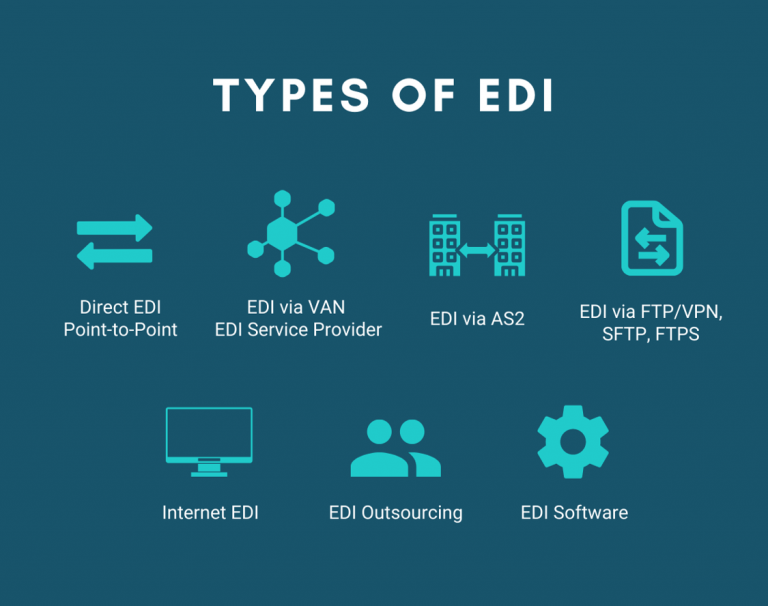
Selecting an EDI integration solution requires understanding four fundamental deployment distinctions that shape costs, control, and operational complexity.
1. Self-Managed vs. Fully-Managed EDI Services
Self-managed EDI solutions suit organizations with in-house capabilities to implement, manage, and run the EDI infrastructure themselves. Your team handles setup, mapping, and trading partner connections independently. Conversely, fully-managed EDI solutions provide end-to-end support from the start, including implementation, mapping, and setting up trading partner connections. The provider handles all EDI tasks, from technical setup and message testing through ongoing operational tasks such as message monitoring and error handling.
Blended approaches offer support as needed, such as helping with initial implementation or setting up new connections with back-end systems. Managed EDI services work well for small to medium-sized businesses lacking in-house IT expertise and enterprises with complex partner networks requiring rapid scalability. In-house solutions suit large enterprises with dedicated IT resources and custom requirements, businesses with highly sensitive data requiring full control over infrastructure, and organizations with stable, long-term trading partner relationships.
2. Cloud-Based vs. On-Premise Deployment
On-premise EDI software installs and runs on your company’s own hardware infrastructure, hosted locally on physical servers. You maintain complete control over security, data, and system configuration behind your corporate firewall. Cloud-based EDI is hosted and managed by a third-party provider, allowing you to access data over the internet. This eliminates capital expenses, as companies only pay for resources they use with predictable subscription pricing[38].
Hybrid EDI solutions support both deployment methods. This approach allows you to manage critical trading partners and sensitive data on-premises while leveraging cloud-based solutions for the rest of your partner community. Hybrid models work particularly well when on-premises systems are aging or internal expertise is becoming scarce.
3. Direct EDI vs. VAN-Based Integration
Direct EDI creates point-to-point connections between trading partners with no third-party network in between. You establish individual connections with each organization as an EDI trading partner, receiving real-time acknowledgments. Direct EDI eliminates per-document fees but requires setup and ongoing IT maintenance. Companies can use direct EDI to reduce costs by as much as 90 percent
VAN-based integration uses a third-party Value-Added Network that acts as a secure intermediary, simplifying document exchange across multiple partners. With VANs, you manage one connection instead of separate lines with each partner. VANs typically charge three to twenty cents per document.
4. Hybrid EDI and API Solutions
Hybrid integration strategies combine the reliability of EDI with the speed and agility of APIs. This approach allows you to modernize supply chain operations without losing compatibility with existing trading partner requirements. An API layer on top of existing EDI systems enables faster onboarding of new trading partners, provides real-time monitoring and alerts, and reduces testing time.
Key Features to Evaluate in EDI Software
Evaluating EDI integration software requires examining technical capabilities that directly affect your operational efficiency and partner relationships.
1. EDI Standards and Protocol Support
Your chosen platform must accommodate , including XML, X12, EDIFACT, HL7, RosettaNet, and Tradacoms. Additionally, verify support for secure transmission protocols such as AS2, SFTP, and HTTPS. Organizations often need to work with most standards, including EDIFACT, X12 standards, and API-based formats. The ability to handle multiple standards prevents compatibility issues as your company expands.various EDI protocols
2. ERP and Business System Integration
Check if your EDI provider has a track record for integrating with ERPs or other relevant business systems. Popular ERP systems supporting EDI integration include SAP, NetSuite, Microsoft Dynamics, Sage, and Acumatica. Assess the expertise level of their project team and how familiar the provider is with your ERP. Integration methods vary from native connectors to middleware solutions, API-based integration, and database-level connections.
3. Data Mapping and Transformation Capabilities
Translation features should convert large file types like X12 into formats easier to work with, such as JSON or XML. Visual mapping interfaces simplify creating rules, while pre-built templates accelerate everyday EDI transactions. Automated validation, error-checking, and real-time visibility let you monitor transactions and quickly spot issues. Drag-and-drop functionality makes the software accessible to users of varying technical expertise.
4. Security and Compliance Features
Ensure the EDI provider follows . Role-based access controls restrict access to authorized personnel only. Look for data encryption, secure access controls, and audit trails to protect sensitive transactions. Encryption methods should protect data in transit and at rest using strong algorithms.industry standards such as GDPR, HIPAA, and PCI DSS
5. Scalability and Partner Onboarding Speed
Choose an EDI solution that can grow with your business and handle increasing transaction volumes. Fast onboarding requires pre-built schemas, rulesets, and business processes for common systems. Providers should offer flexible service offerings, including implementation support, trading partner onboarding, error resolution, and maintenance.
Commport EDI Integration Software Providers Compared to Other EDI Software Providers
Pricing Models: Per-Transaction vs. Per-Partner
Modern cloud-based providers like Commport offer flat per-partner pricing starting around USD 149.00 per month per trading partner. This partner-based model charges a fixed fee associated with each trading partner, keeping costs stable regardless of transaction volume. Compared to other traditional EDI providers, which have hidden charges like setup fees, account management fees, and more.
Implementation Timeline and Technical Support
Cloud-based EDI platforms can be set up in as little as a few days with self-service onboarding tools. Integrated EDI solutions connecting to your ERP or warehouse management system typically take one to three weeks. A brand new EDI software setup takes around four to six weeks. Commport offers varying service approaches, including Self-Service, Managed Services with Transactional Monitoring and Management, and Flexible EDI Services. Other EDI providers only offer managed services, leaving customers with less direct control.
Industry-Specific Solutions and Trading Partner Networks
Commport offers an extensive network of over 180,000 pre-mapped trading partners. maintains connections with major retailers, including Walmart, Target, Amazon, Home Depot, Kroger, Lowe’s, and more.Compared to other EDI providers, who have limited reach and pre-built connections.
Integration Depth and Customization Options
Commport Cloud EDI offers innovative EDI capabilities with routinely updated features. Other providers limit self-service, where customers must submit a service request for every change.
Conclusion
You now have everything needed to select the right EDI integration software for your B2B operations. We’ve covered deployment models, pricing structures, essential features, and top providers in the market.
The decision comes down to your specific requirements: transaction volume, trading partner ecosystem, internal IT capabilities, and budget constraints. Evaluate each provider against these factors rather than choosing based on name recognition alone.
Above all, prioritize solutions that scale with your business and simplify partner onboarding. Start by mapping your current pain points to the features we’ve discussed. Your operational efficiency and trading relationships depend on making this choice carefully.
Commport EDI Solutions - #1 EDI Solutions in North America
Need Help? Download: Commport's EDI Buyers Guide
Unlock the full potential of your supply chain with our comprehensive EDI Buyer's Guide — your first step towards seamless, efficient, and error-free transactions
Frequently Asked Questions
B2B EDI integration enables the automated exchange of critical business documents—such as purchase orders, invoices, shipping notices, and payment confirmations—between trading partners in electronic format. This process eliminates manual data entry, reduces errors, and streamlines communication throughout the supply chain.
EDI integration connects business systems electronically to automate document exchange in a standardized format. The software receives data from trading partners, analyzes the EDI document, extracts relevant information, and automatically enters it into your database structure. An EDI translator pulls data from your internal systems, converts it into the chosen standard, and transmits it to your business partners without manual intervention.
An effective EDI system consists of four core components: an EDI translator (to convert data formats), mapping capabilities (to structure information correctly), a secure network (for safe transmission), and technical support. For full automation and scalability, businesses should also integrate these components tightly with internal systems like ERP or warehouse management software to enable real-time document processing.
EDI integration can reduce transaction costs by at least 35% by eliminating expenses related to paper, printing, postage, and manual processing. Organizations typically see a 30-40% reduction in transaction errors and can process orders for as little as $1.35 compared to $38.00 for manual processing. Additionally, EDI accelerates business cycles by 61% and can reduce order-to-cash cycle time by more than 20%.