Introduction
E-commerce models are transforming retail at an unprecedented pace, with online sales projected to account for about 30% of global retail sales in 2030.
The landscape now offers multiple paths to success, from traditional B2C to business-to-business ecommerce, direct-to-consumer ecommerce, and emerging quick commerce. Each e-commerce business model comes with distinct characteristics, advantages, and challenges.
Understanding the difference between b2b and b2c in e-commerce, along with other types of e-commerce business models, is crucial for choosing the right approach.
We’ll break down each model to help you determine which fits your business goals.
Key Takeaways
- B2B generates the highest transaction values ($10K-millions) but requires 60-120 day sales cycles and committee-based decisions
- D2C offers maximum control and margins (40-60% vs traditional retail) by eliminating intermediaries, though customer acquisition costs rose 222% since 2013
- Quick commerce captures impulse purchases with 15-30 minute delivery, but demands complex hyperlocal infrastructure and dark store networks
- B2C provides the broadest market reach but faces intense competition and lower profit margins due to pricing pressures
- Model selection depends on three factors: your target customer type, available budget/resources, and desired growth trajectory
Understanding Ecommerce Business Models
What are Ecommerce Models?
E-commerce business models define the strategies businesses use to sell products and services online. These models determine who you sell to, how transactions occur, and the operational framework supporting your sales. Six primary e-commerce models dominate the market:
- B2C (business-to-consumer)
- B2B (business-to-business)
- B2B2C (business-to-business-to-consumer)
- B2G (business-to-government)
- C2B (consumer-to-business)
- and D2C (direct-to-consumer)
Each model addresses different market needs and customer types.
The model you select shapes your revenue generation, customer base, marketing approach, fulfillment operations, and long-term growth trajectory. B2C businesses sell directly to individual customers through online platforms, whereas B2B companies focus on selling to other businesses. D2C brands bypass intermediaries to maintain direct customer relationships, while C2C platforms connect individual buyers and sellers through marketplaces.
Why Different Models Matter for Your Business
Your ecommerce business model determines operational complexity and resource allocation. The difference between b2b and b2c in e-commerce extends beyond target customers. B2C transactions feature shorter sales cycles and broader reach but face intense competition and lower average order values. B2B models generate higher order values and recurring revenue through long-term relationships, though they require longer sales cycles and personalized engagement.
B2B digital commerce adoption has accelerated dramatically, with revenue from digital channels projected to reach 56% in 2025. Meanwhile, B2C ecommerce represented 20% of total U.S. retail sales in 2025.
Marketing, customer service, inventory sourcing, and office structure vary significantly based on your chosen model. B2C requires clever marketing due to increased competition, while B2G demands navigating bureaucratic processes and RFP bidding. The technology infrastructure needs also differ, with B2B requiring medium to high tech capabilities compared to lower requirements for C2C models.
Evolution of Ecommerce Business Models
E-commerce evolution occurred in three distinct waves.
Wave 1 (1995-2005) established core online shopping basics with price-driven models focused on convenience. This period birthed the first B2C marketplaces like Amazon and eBay, alongside initial B2B procurement platforms.
Wave 2 (2005-2015) brought mobile commerce and improved user experiences. Broadband adoption expanded, the iPhone launched in 2007, and social media began influencing purchase decisions. Trust, reviews, and social proof became central factors beyond pricing.
Wave 3 (2015-Present) blurs digital and physical boundaries through omnichannel integration. Cloud computing, AI, and APIs enable personalized, seamless experiences. Modern consumers expect channel-agnostic shopping with features like Buy Online, Pick Up In-Store.
Three forces now shape e-commerce models. AI-driven personalization has become non-negotiable, as 71% of consumers expect personalized interactions and 76% experience frustration without them.
Hyper-localization builds fulfillment closer to customers, with nearly two-thirds of U.S. consumers willing to pay extra for premium delivery. Composable and headless commerce allows businesses to integrate best-of-breed tools for checkout, CMS, CRM, and analytics rather than relying on monolithic systems.
B2C Ecommerce Model Explained
How B2C Ecommerce Works
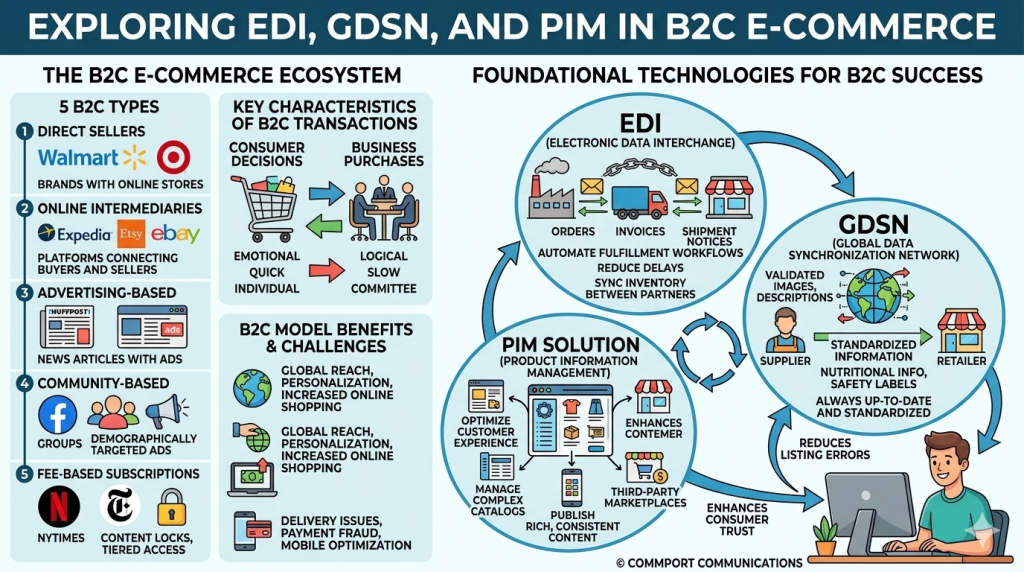
B2C ecommerce involves direct sales between businesses and consumers through online marketplaces. When you purchase an item from Amazon or Etsy, you participate in this business model. The transaction eliminates intermediaries, connecting companies with individual customers who make purchasing decisions for personal use.
Five distinct B2C types serve different market approaches:
- Direct sellers: Companies sell products through their own websites or retail platforms. Walmart and Target operate this way, where customers buy directly from the brand’s online store.
- Online intermediaries: Platforms like Amazon, Etsy, and eBay connect buyers with sellers without owning inventory. These companies provide the marketplace infrastructure while taking commissions.
- Advertising-based models: Free content attracts visitors who encounter ads for products and services. Media outlets like HuffPost generate revenue through advertising rather than product sales.
- Community-based platforms: Facebook and similar networks allow businesses to target ads based on user demographics and shared interests within online communities.
- Fee-based subscriptions: Netflix and The New York Times charge access fees for their content, offering limited free options while requiring payment for full features.
Opening an online store requires relatively small investments in time, supplies, and marketing. Companies often skip renting office space or hiring large staff teams. B2C platforms can offer both physical products (clothes, computers, household items) and intangible goods (online courses, ebooks, music files).
Key Characteristics of B2C Transactions
B2C transactions operate through simple, direct processes. Unlike business purchases requiring committee approval, consumer decisions happen quickly, often completing within minutes to days. Emotional factors drive these choices more than logical ROI calculations. Brand identity and appeal frequently outweigh technical specifications.
Competition remains fierce in B2C markets. Consumers face thousands of similar products, creating price wars among businesses. Since most online sales start with searches, competition for high-value keywords can make it easy for stores to get lost in crowds. Correspondingly, B2C companies must engage potential customers through interesting content and varied promotion methods.
The model emphasizes openness and demand-driven products. News about company offerings spreads easily worldwide. Businesses create products based on customer needs, with prices adjusting automatically to market demands.
In B2C e-commerce, where retailers serve millions of end consumers across multiple platforms, the pressure to deliver accurate, fast, and consistent experiences is immense. EDI plays a critical role behind the scenes, automating order fulfillment workflows between retailers and their logistics or supplier partners, reducing delays and keeping inventory levels in sync. GDSN ensures that product data flowing from suppliers into the retailer’s systems, images, descriptions, nutritional information, or safety labels is always up to date and standardized, reducing the risk of listing errors that can erode consumer trust. PIM then takes that data and optimizes it for the customer-facing experience, enabling retailers to publish rich, consistent product content across their website, app, and third-party marketplaces simultaneously.
Examples of Successful B2C Businesses
Amazon dominates as the quintessential B2C platform, hosting vast arrays of merchants offering staggering numbers of physical products. The global B2C ecommerce market is expected to reach $53.23 billion by 2030, expanded from $33.20 billion in 2025. The broader B2C platform market will hit $7.50 trillion by 2030.
Other successful examples include Alibaba Group with platforms like Taobao and Tmall, integrating social commerce and livestream shopping. JD.com gained recognition for automation and supply chain innovation. Zalando established itself as Europe’s online fashion authority through AI-powered recommendations and virtual try-ons.
Benefits and Challenges of B2C Model
B2C ecommerce provides several advantages. Businesses can market to customers worldwide without expensive storefronts or monthly rent payments. More than 70% of customers expect personalized experiences, which e-commerce software can deliver by recognizing loyal customers. According to research, 70% of Britons now prefer buying online and on mobile phones, up from less than 50% before the pandemic.
Challenges include delivery complications. After checkout, customers expect quick shipments, but relationships fall apart when items never arrive or suffer damage. Security remains critical, as payment gateways can experience data breaches. In fact, payment fraud could amount to $343 billion by 2027. Customer loyalty proves difficult when third parties like Amazon complete transactions, as shoppers may remember only the platform name rather than individual brands. Mobile optimization has become essential, with 70% of buyers using mobile devices to browse online shops during the first quarter of 2024.
B2B Ecommerce Model Breakdown
Understanding Business to Business Ecommerce
Business-to-business ecommerce operates fundamentally differently from consumer transactions. B2B involves online buying, selling, and exchanging goods, services, and information between companies rather than selling to individuals. These digital platforms streamline procurement, enable real-time visibility, and foster collaboration across interconnected supply networks.
The B2B ecommerce market has experienced explosive growth. Site sales and expect to surpass $3.00 trillion by 2028, reaching $2.30 trillion in 2024. Grand View Research estimated the broader market at $18,665.50 billion in 2023, with projected growth of 18.2% annually through 2030. Another projection places global B2B ecommerce at $20.90 trillion by 2027.
Several B2B ecommerce business models exist. Wholesale ecommerce involves purchasing goods in large volumes at discounted prices for resale. Manufacturer-to-business models allow producers to sell directly to distributors or other manufacturers, increasing margins and control. B2B marketplaces function as multi-vendor platforms where businesses buy and sell across industries. The B2B2C hybrid model enables companies to sell to other businesses that then serve consumers. SaaS ecommerce delivers digital products and services through subscriptions rather than physical goods.
Vertical vs Horizontal B2B Models
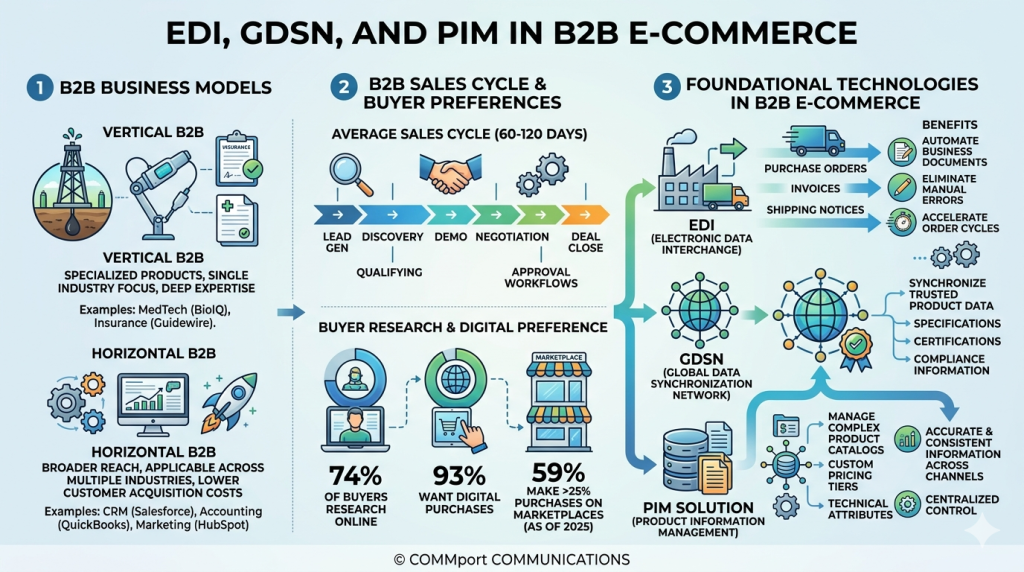
B2B business models are split into vertical or horizontal categories. A vertical B2B model focuses on a single industry, providing specialized products tailored to that sector’s unique needs. Health Assurance Plan offers dental software, while BioIQ serves MedTech, and Guidewire targets insurance. These solutions address industry-specific problems with deep expertise.
Horizontal B2B models offer products applicable across multiple industries. QuickBooks provides accounting software, Salesforce delivers CRM solutions, and HubSpot handles marketing for various sectors. This broader approach lowers customer acquisition costs by reaching diverse markets. Office supplies and general business services typically follow horizontal models, serving companies regardless of their vertical.
B2B Sales Cycle and Decision Process
B2B sales cycles average 60 to 120 days, substantially longer than B2C transactions. Enterprise deals involving multiple buyers often stretch further due to legal approvals, procurement workflows, and team-based decision-making. The process involves lead generation, discovery calls, lead qualifying, engagement, product demos, negotiation, deal closing, and follow-up.
Multiple stakeholders participate in B2B purchasing decisions, requiring approval workflows and consensus-building. Research shows 74% of buyers research purchases online, and 93% want to make those purchases digitally. As of 2025, 59% of B2B buyers complete more than a quarter of their purchases on marketplaces.
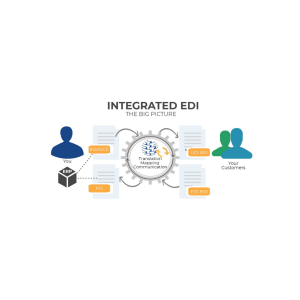
In the B2B e-commerce model, where transactions happen at scale between manufacturers, wholesalers, and retailers, EDI, GDSN, and PIM solutions are foundational. EDI automates the exchange of high-volume business documents — purchase orders, invoices, shipping notices — eliminating manual processing errors and accelerating order cycles between trading partners. GDSN complements this by ensuring that product data, such as specifications, certifications, pricing, and compliance information, is synchronized and trusted across every supplier and buyer in the network. PIM rounds out the trio by giving B2B sellers a centralized hub to manage complex product catalogues, custom pricing tiers, and technical attributes, ensuring that every buyer, regardless of channel, receives accurate and consistent product information at all times.
Advantages and Limitations of B2B Ecommerce
B2B ecommerce generates significant operational benefits. Automation across ordering, fulfillment, and invoicing reduces manual tasks and error rates. Companies can empower customers to manage orders independently, freeing sales teams to focus on closing new deals. Commport B2B Network Solutions Supporting Electronic Commerce Since 1985 demonstrates how established platforms help thousands of customers achieve data accuracy, efficiency, and compliance through EDI, VAN, GDSN and PIM solutions.
However, user adoption remains a primary concern. Companies worry that customers accustomed to traditional account managers won’t embrace digital platforms. B2B faces longer sales cycles compared to B2C’s counterparts, making revenue forecasting more challenging. Customer dependence creates concentrated risk when revenue comes from a few large clients. Complex service delivery requirements demand coordination between sales, product, and support teams, potentially slowing operations and inflating costs.
Download: GDSN Buyers Guide
Empower your business with global data synchronization; download our GDSN Buyer's Guide today and take the first step towards streamlined, accurate, and compliant product data management.
Direct-to-Consumer (D2C) Ecommerce Model
What Makes D2C Different from Traditional Models
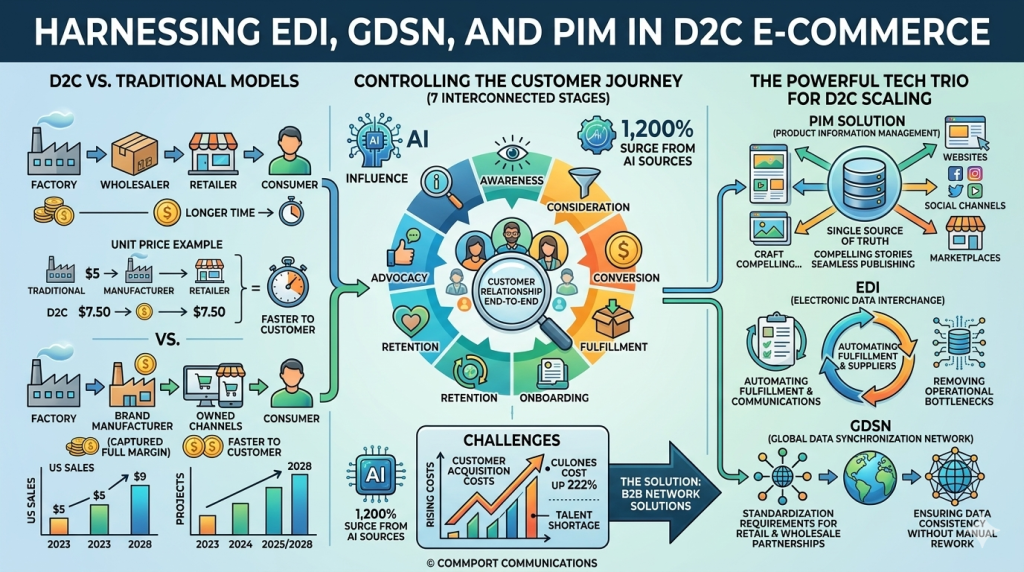
Direct to consumer ecommerce refers to products sold by brand manufacturers directly to consumers via owned websites, apps, and physical stores, bypassing traditional retail intermediaries. When you purchase from a manufacturer’s website rather than Amazon or a department store, you engage in D2C commerce. This model fundamentally cuts out wholesalers, distributors, and retailers from the equation.
The supply chain becomes shorter with no intermediaries, reducing the time for products to reach customers. In contrast to traditional retail, where brands sell to retailers who markup products by 50-100%, D2C allows manufacturers to capture the full margin. If your product sells through a retailer for USD 10.00 per unit, you receive USD 5.00 while the retailer takes USD 5.00. Selling directly at USD 7.50 per unit creates higher profit margins and lower prices for customers.
US D2C ecommerce sales will plateau at around 19% of total retail ecommerce sales by 2025 and remain flat through 2028. The US reported approximately in 2023, with expectations to reach USD 186.00 billion by 2025 USD 135.00 billion in D2C ecommerce sales. Nevertheless, D2C no longer distinguishes a brand, as nearly every major consumer brand now sells direct.
How D2C Brands Control the Customer Journey
D2C brands own the customer relationship end-to-end, controlling every touchpoint from product design to post-purchase care. This ownership enables better customer insights to guide product decisions while avoiding marketplace fees. Brands can hyper-personalize products to service various customer types rather than catering to mass markets.
Modern D2C success depends on optimizing seven interconnected stages: Awareness, Consideration, Conversion, Fulfillment, Onboarding, Retention, and Advocacy. Improvements in one stage amplify the others. Stronger onboarding accelerates retention, while better fulfillment directly impacts advocacy. Brands that optimize every stage as part of a unified system don’t just grow, they compound.
D2C Success Stories and Market Trends
Gen Z is pushing D2C into its next phase, with 28% reporting regularly purchasing D2C compared with just 13% of the total population. Frank Body grew rapidly through Instagram marketing and user-generated content with the hashtag #frankeffect. Gymshark experienced growth over 200% year-on-year for three consecutive years through influencer partnerships.
AI is reshaping product discovery. Traffic from AI-driven sources to brand sites surged 1,200% between July 2024 and February 2025. More than 80% of consumers trust generative AI search results as much as or more than traditional search.
Challenges D2C Businesses Face
Customer acquisition costs increased 222% between 2013 and 2025. Many digitally native brands face stalled growth, rising acquisition costs, and persistent profitability challenges. Margin compression hits from multiple directions simultaneously: shipping costs, platform fees, payment processing cuts, returns, and pressure to offer free shipping.
The talent problem remains underreported. Finding people who understand paid media, retention, supply chain, unit economics, creative strategy, and data analysis at affordable salaries proves incredibly difficult. Retention tools that worked three years ago have degraded significantly, with email open rates declining and SMS hitting regulatory friction.
To overcome these challenges, D2C brands should invest in B2B Network Solutions.
This is where PIM becomes the most powerful tool in the stack. A PIM solution serves as the single source of truth for all product content, enabling brands to craft compelling, consistent product stories and push them seamlessly across their websites, social commerce channels, and marketplaces. EDI supports D2C operations by automating fulfillment and supplier communications as order volumes grow, removing the operational bottlenecks that can stall a scaling brand. GDSN becomes increasingly relevant as D2C brands expand into retail partnerships or wholesale channels, ensuring their product data meets the standardization requirements of larger trading networks without manual rework.
Quick Commerce: The Emerging Model

What is Quick Commerce?
Quick commerce represents the evolution of online shopping into immediate gratification. Customers order essentials and receive them, sometimes within 60 minutes within 15 to 30 minutes. This business model focuses on delivering goods within minutes of placing an order, powered by small fulfillment nodes close to customers, referred to as dark stores.
These compact warehouses function solely for picking and packing orders without public access. Ranging between 3,229 and 7,500 square feet, dark stores typically stock upwards of 1,000 unique products. The model prioritizes high-demand, fast-moving products with near-zero tolerance for stockouts. Inventory gets replenished multiple times daily based on local demand patterns.
How Q-Commerce Differs from Traditional Ecommerce
Traditional e-commerce typically promises delivery within 2 to 5 business days, whereas quick commerce delivers in mere minutes. The primary differentiator lies in hyperlocal fulfillment, with dark stores and micro-fulfillment centers strategically positioned in urban areas. Delivery radii usually stay within 5 to 8 kilometers of the fulfillment center.
Q-commerce taps directly into impulse purchase behavior. When consumers satisfy cravings or urgent needs within minutes, they make spontaneous purchases that traditional ecommerce loses during days-long waiting periods. Orders on platforms like Instamart and Blinkit increased from $3.24 billion in 2024 to ₹6.3 billion in 2025.
Technology Powering Quick Delivery Models
Quick commerce operates on razor-thin time margins, promising deliveries in under 30 minutes, which means that data accuracy and operational automation are not just conveniences; they are survival requirements. EDI is mission-critical here, enabling real-time communication between dark stores, micro-fulfillment centers, and suppliers to trigger rapid replenishment the moment inventory levels dip. GDSN ensures that product data across thousands of fast-moving SKUs remains accurate and synchronized with supplier systems, preventing mismatches that could cause fulfillment errors or compliance issues at speed. PIM supports the customer-facing side of quick commerce by ensuring that product listings, names, images, allergen information, and substitutions are always available.
Real-time inventory management updates stock levels in milliseconds. AI-based route planning ensures every second saved boosts performance and reduces costs. Platforms require multi-node order management systems supporting multiple hubs and micro-stores. Geofencing capabilities enable dynamic delivery zones and service level agreements.
Light vehicle fleets, predominantly bikes or scooters operated by gig workers, dominate last-mile delivery. Advanced algorithms predict demand, optimize routing, and ensure rapid fulfillment.
Market Growth and Future of Quick Commerce
The global quick commerce market reached USD 111.00 billion in 2024 and is expected to hit USD 352.80 billion by 2030, growing at 21.3% annually. Another estimate placed the market at USD 170.8 billion in 2024, projecting USD 337.59 billion by 2032 at 9.01% CAGR. North America accounted for over 33.5% of total sales in 2024.
In India, quick commerce was valued at USD 3.34 billion in 2024 and expects to reach USD 9.95 billion by 2029. Quick commerce orders made up 40% to 50% of online grocery expenditures in India during 2024. Nearly 68% of consumers prioritize fast delivery, driving expansion beyond groceries into fashion, electronics, and beauty products.
Conclusion
Choosing the right ecommerce model isn’t about finding a universal winner. Each model serves different business needs and customer expectations. B2B offers higher transaction values but requires patience through longer sales cycles. B2C provides wider reach with intense competition. D2C gives you complete control over customer relationships, though customer acquisition costs continue rising. Quick commerce captures impulse purchases but demands complex hyperlocal infrastructure.
Here’s how I’d approach your decision:
If you need predictable revenue and serve businesses, B2B makes sense. If you want direct customer relationships and higher margins, consider D2C. If immediate delivery drives your value proposition, quick commerce fits best.
Your specific product type, budget, and growth goals should guide your final choice.
Commport B2B Network Solutions
Need Help? Download: Commport's EDI Buyers Guide
Unlock the full potential of your supply chain with our comprehensive EDI Buyer's Guide — your first step towards seamless, efficient, and error-free transactions
Frequently Asked Questions
B2B (business-to-business) involves selling products or services to other businesses, typically with higher transaction values ($10,000 to millions), longer sales cycles (60-120 days), and committee-based purchasing decisions. B2C (business-to-consumer) sells directly to individual consumers with smaller transaction values ($10-$500), shorter sales cycles (minutes to days), and emotion-driven purchase decisions made by individuals.
D2C (direct-to-consumer) allows manufacturers to sell directly to customers without intermediaries like retailers or wholesalers. This benefits businesses through higher profit margins (40-60% compared to traditional retail) and complete control over the customer experience. Customers benefit from lower prices since there’s no retailer markup, and they receive products directly from the source with more personalized service.
Quick commerce delivers products within 15-60 minutes of ordering, compared to the 2-5 business days typical of traditional ecommerce. It operates through small “dark stores” located close to customers (within 5-8 km), stocks high-demand products, and uses light vehicle fleets like bikes or scooters for rapid delivery. This model targets impulse purchases and urgent needs rather than planned shopping.
D2C brands typically achieve the highest gross profit margins at 40-60% by eliminating intermediaries and selling directly to consumers. B2B companies generally see margins of 10-30% depending on industry and supply chain efficiency, while B2C businesses face lower margins due to competitive pricing pressures and the costs associated with reaching mass consumer markets.
Start by identifying your target customer (businesses or individual consumers), product type (physical goods, digital products, or services), and available budget. B2B works best for predictable revenue with business clients, D2C suits those wanting direct customer relationships and higher margins, B2C fits businesses targeting mass consumer markets, and quick commerce is ideal if immediate delivery is your key value proposition. Consider your growth goals, technical capabilities, and resource availability when making your decision.