The GS1 Global Data Model simplifies how businesses exchange product information across supply chains, enabling seamless shopping experiences across every channel. Consequently, this standardization improves data accuracy and completeness for consumers while increasing operational efficiency for brand owners and retailers.
Paired with the Global Data Synchronization Network (GS1 GDSN), high-quality product content is uploaded, maintained, and shared automatically, ensuring trading partners have immediate access to current information needed for both local and global markets.
We’ve created this comprehensive implementation guide to walk you through each step of adopting these GS1 data standards, from understanding the fundamentals to managing your GDSN data pool effectively.
Start small with testing: Begin with minimum product sets in test environments with one or two trading partners to identify issues before full-scale deployment.
So if you’re ready to go “all in” with GS1 Global Data Model and GDSN, this guide is for you.
In this chapter, we will talk about the importance of the GS1 Global Data Model, understanding the foundational attributes required to manage a product's complete lifecycle, and also the fundamentals of GDSN.
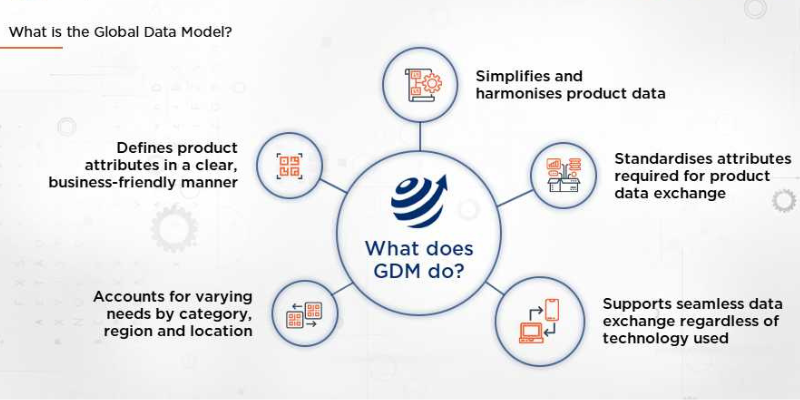
The GS1 Global Data Model identifies and defines the foundational attributes needed to manage a product through its complete lifecycle. Specifically, the GDM establishes a globally consistent framework for listing, ordering, moving, storing, selling, and discontinuing products in both digital and physical environments. This standardization addresses the complexity of product data exchange by harmonizing foundational information across industries and geographical boundaries.
The GDM provides a list of data attributes without assumptions about implementation technology. This technology-agnostic approach means businesses can exchange data through various methods, including spreadsheets, solution provider APIs, or the GDSN itself. Each attribute in the model carries a unique GS1 Business Message Standard Identifier (BMS ID), which serves as the gateway to all technical and business elements across GS1 standards, guidelines, solutions, and tools.
The model focuses on fast-moving consumer goods product categories, including food, near food, pet food, alcoholic beverages, and tobacco. Beyond basic product identification, the GDM encompasses attribute groups for financial information, compliance and regulatory data, import classifications, nutrition facts, product lifecycle dates, digital assets, and category-specific requirements.
The Global Data Synchronization Network operates as an internet-based network of interoperable data pools that facilitate standardized product data exchange between trading partners. This infrastructure enables brand manufacturers, retailers, distributors, wholesalers, foodservice operators, and healthcare providers to access consistent product information through a publish-subscribe mechanism.
As of June 2025, the network encompasses 125,000 locations shared across 245 countries through 44 GDSN-certified data pools. These certified data pools serve as intermediaries, providing validation, transformation, and transmission services for product information. Each data pool connects to the GS1 Global Registry, which functions as the central directory matching subscriptions with publications while maintaining network integrity.100 million items
Trading partners must use a GS1-certified data pool to synchronize data within the GDSN. The network ensures secure, accurate, and efficient sharing of attributes such as weight, description, brand name, Global Trade Item Number (GTIN), and manufacturer information. This continuous flow of updated information eliminates manual re-keying and establishes an authoritative data source for aligning product information across internal systems and external partnerships.
GS1 standards provide a common language that allows businesses to identify, capture, and share supply chain data consistently worldwide. This standardization ensures information remains accessible, accurate, and easy to understand across different systems and organizations. Research indicates that standard harmonization can increase product-level trade flows by 67%.
The BMS ID functions as the key connecting element across multiple GS1 resources, including the Global Data Dictionary, GDM Interim Navigator, GDM Attribute Analysis Tool, Verified by GS1, and the Trade Item Implementation Guideline. This unified identification system enables businesses to reference the same attributes across various platforms and documentation.
In order to resolve situations where specific attributes or code values are not immediately available in the GDM, users can reference the Global Data Dictionary and GDSN standards, which contain all GS1 standard attributes and maintained code lists. This extensibility ensures the framework adapts to evolving product requirements while maintaining global consistency.
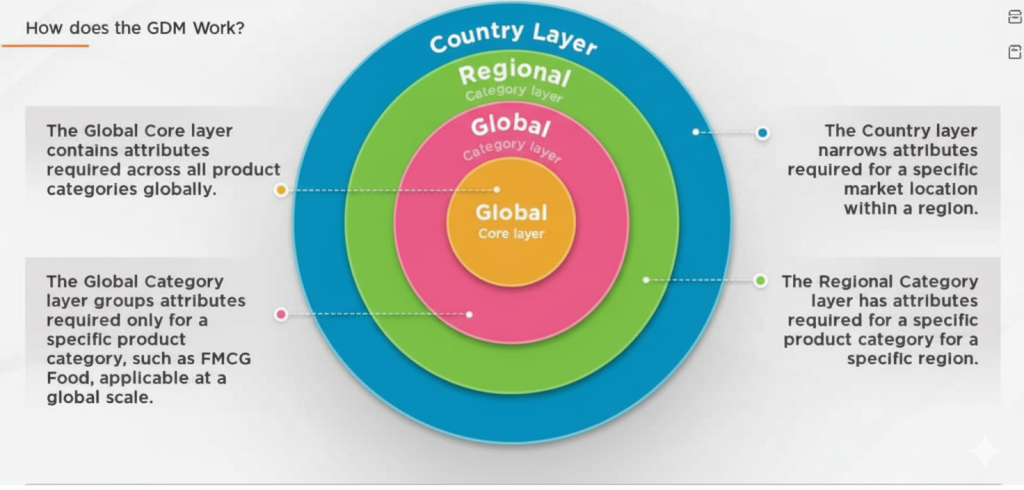
The GDM employs a hierarchical architecture designed to accommodate regional requirements while maintaining global consistency through four distinct layers:
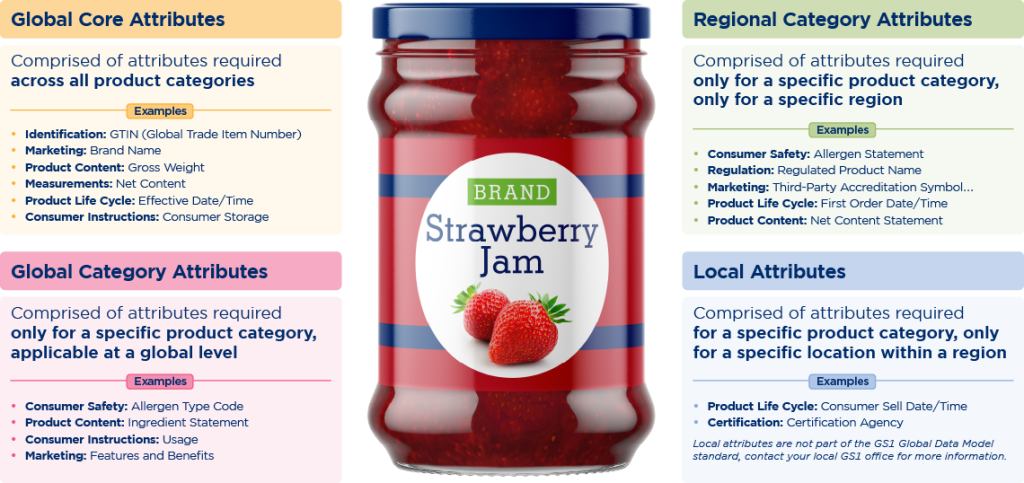
This layered structure allows businesses to implement the appropriate level of detail based on their market scope while ensuring foundational data remains consistent across the global supply chain. Here is an example of the product using the GDM attributes.
Understanding the technical infrastructure behind global data synchronization requires examining the core components that enable real-time product information exchange across trading partners worldwide. The GDSN operates through a sophisticated architecture connecting certified data pools, a central registry, and standardized identification systems that work together to maintain data integrity throughout the supply chain.
Data pools function as standards-based repositories for item information, serving as your single point of entry for accessing the GDSN. Certification assures that all data pools in the network employ a common basic set of validation rules supporting data integrity. These repositories are not specific to one type of supply chain partner or role, which means data pools can be utilized by trading partners to both share and receive product data.
To participate in the Global Data Synchronization Network and register or subscribe to items in the GS1 Global Registry, trading partners must make use of a GDSN-certified data pool. A certified data pool is a solution built to comply with GS1 standards which has been tested to have interoperability within GDSN. Data pools must pass the GS1 GDSN Interoperability Tests for mandatory functionality as contained in the GDSN Certification Event process. Each certified data pool must maintain production-level connections to all other certified data pools post-certification, ensuring a fully interoperable GDSN landscape to meet the business needs of retailers and manufacturers globally.
While all data pools offer GDSN storage and synchronization, they differ by additional information managed, supportive services, and pricing models. Data pools can be run by a GS1 Member Organization, supplier, customer, exchange, or service provider.Currently, there are 44 GDSN-certified data pools
The GS1 Global Registry serves as the GDSN’s source and recipient directory, providing validation services to ensure uniqueness. This central directory enables the registration and distribution of party information, identifying the source and the recipient. The registry enables the registration of all product information through a small set of core information including GTIN, GLN of the information provider, target market, and the Global Product Code.
The registry efficiently guarantees the uniqueness of the Catalogue Item (GTIN + GLN + target market) for a particular data source. Without this functionality, GTIN, GLN, and target market uniqueness cannot be guaranteed. To achieve a global uniqueness check without the registry, the source data pool would have to check with all the other data pools in the network, which would be inefficient.
The GS1 Global Registry performs the item/subscription matching process and enables data pool interoperability. It will only register data from GDSN-certified data pools, ensuring that all data pools in the network comply with the standard set of validation rules that support data integrity in the system. The registry holds information about who has subscribed to Trade Item or Party data, acting as a central repository. Manufacturers, distributors, providers, or other entities wishing to share data with trading partners access the GS1 Global Registry through their GDSN-certified data pool.
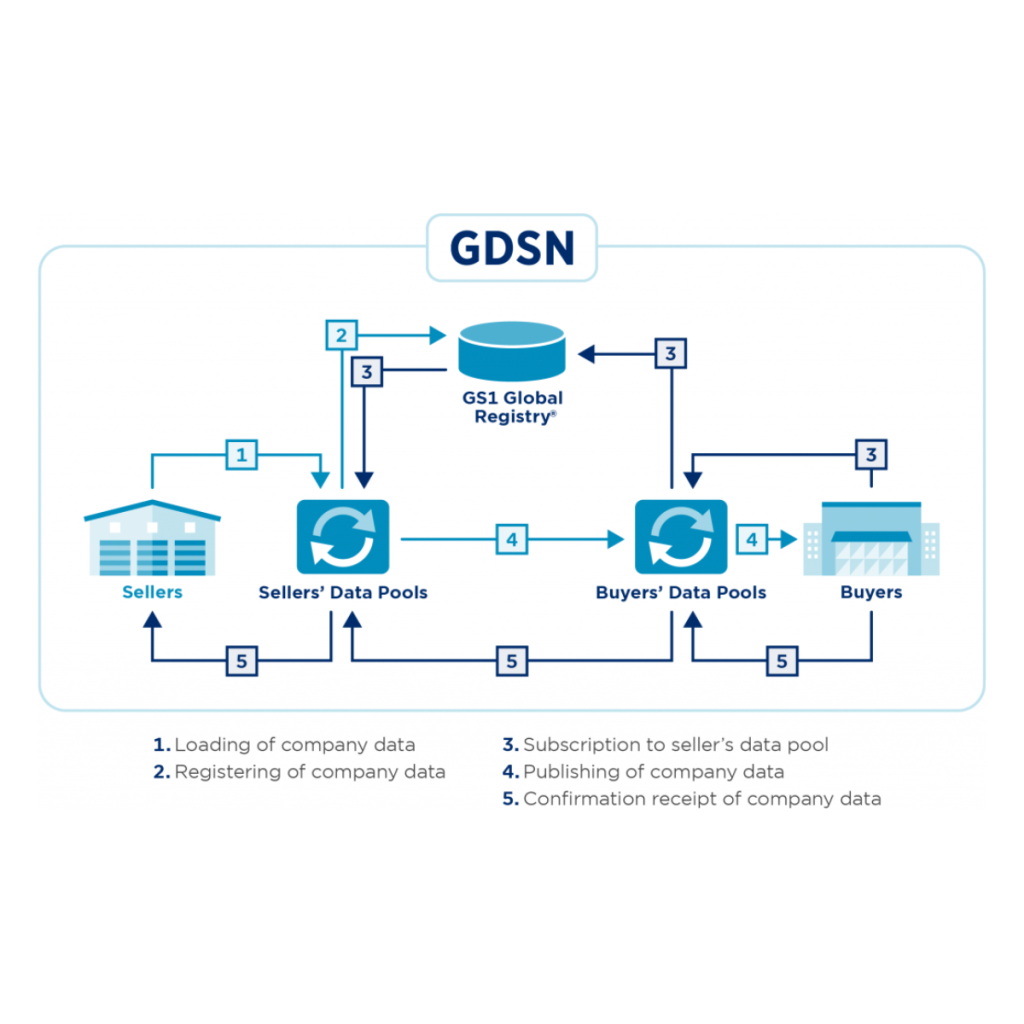
The GDSN operates using a publish-subscribe pattern between two trading partners, each of which are registered with and access the GDSN via a data pool. The data synchronization process involves five basic steps:
When one supplier updates its product information, all its trading partners receive the product data simultaneously. This means everyone has access to the same continuously refreshed data.
The GDSN uses GS1 identification and data standards as the common language for product information. For identification, the GDSN uses the Global Trade Item Number for products and the Global Location Number for supply chain parties and locations.
A GTIN is a unique product ID based on an EAN.UCC number that identifies a specific product at a specific level of packaging, such as each, carton, or pallet. Companies use GTINs to uniquely identify all of their trade items, defined as products or services that are priced, ordered, or invoiced at any point in the supply chain. Brand owners assign GTINs to all of their products and define the master data (attributes) to be associated with that product GTIN, such as size, color, and brand information.
A GLN is a unique entity identification for use in the GS1 system based on a company’s EAN.UCC company prefix, consisting of 13 digits. Companies can identify their locations using GLNs, giving them complete flexibility to identify any type or level of location required. All data sources and data recipients must have a GLN to operate in the GDSN. The GLN serves as the identifier for legal entities, trading partners, and locations within the supply chain, such as warehouses and cargo vessels.
With these foundational elements in place, GTINs and their associated attributes can be stored in a GDSN-certified data pool and shared with authorized supply chain partners via the GDSN.
Empower your business with global data synchronization; download our GDSN Buyer's Guide today and take the first step towards streamlined, accurate, and compliant product data management.
Moving from technical architecture to practical execution requires methodical preparation across multiple organizational functions. Implementation success depends on establishing clear processes, securing stakeholder commitment, and verifying data readiness before connecting to any GDSN data pool.
Implementing GDSN represents a business process change rather than just a technology project. Success factors begin with engaging a visible and supportive executive sponsor who can drive organizational commitment. Creating internal and external communication plans that share project status and timelines helps align expectations across departments and trading partners.
Understanding your internal data quality management process stands as a critical readiness component. Performing sample audits for data accuracy and consistency with GDSN formatting reveals gaps that need addressing before synchronization begins. In addition to data quality, you need to validate your data accuracy management process for post-synchronization dispute resolution with trading partners.
Your implementation scope must account for internal data publication capabilities relative to trading partner requirements. For instance, some retailers expect full catalog publication while others only need products currently sold. Identifying your New Product Introduction and item change management process reveals all business implications across logistics, features and benefits, nutritionals, marketing, and sales functions.
Before commencing implementation steps, investigate whether GDSN has been implemented anywhere in your company. Other divisions may already utilize the network for foodservice or janitorial supplies, providing valuable experience that could expedite your startup.
Form a cross-functional team specific to your organizational makeup, including members from areas most impacted by implementation. Key functional areas to consider include Supply Chain, Information Technology, Quality Assurance, Operations, Product Management, Sales Operations, Customer Service, Legal and Public Relations, Specs and Labeling, along with Research and Development, Packaging, and Product Development teams.
Define clear roles and responsibilities for the Executive Sponsor, project team members, and process owners. This clarity prevents confusion during implementation phases and ensures accountability for deliverables. Teams should also include representatives from Branding, Marketing, Regulatory, and Finance departments depending on your product categories and market requirements.
Your databases may already contain many GTINs, but at this point you need to verify they are correctly formatted and accurately assigned. Coordinate with your company’s internal item team to gather all GTINs for your products. Assess current GTIN assignments for omissions or mis-assignments, then determine if additional GTINs need allocation.
When reviewing current GTIN assignments, compare the GS1 Company Prefix of the GTIN to the GS1 Company Prefix for the brand owner. You may find the GTIN has been assigned by the manufacturer rather than the brand owner. In such cases, work with the brand owner to agree on the correct GTIN and coordinate any necessary changes.
Clearly define your organization’s GTIN product hierarchy and packaging levels as a critical implementation step. Recognize the packaging levels your GTIN numbering system needs to accommodate for operations and trading partners. Conduct random sample testing to validate that currently-assigned GTINs match what appears on the corresponding item label and barcode. Coordinate with customers to verify successful matching of GTINs to current item identification codes.
You may choose any GDSN-certified data pool, not necessarily the same data pool as your trading partner. You only need to select one data pool to connect with all trading partners. Review the GS1 website for the list of GDSN-certified data pools and examine statistics of data pool activity.
When evaluating options, ask if the data pool is ready to support your particular customer’s requirements and attribute specifications. Determine their capabilities to support and educate on GS1 system fundamentals, including how many successful implementations they have completed. Solutions like Commport’s GS1 certified GDSN datapool enable you to sync all your product data in real time to any trading partner and marketplace, providing the connectivity and validation services needed for seamless synchronization.
Consider the data pool’s experience with your specific sector or multiple industries, their geographic connections, and whether they support local or global requirements. Understand their support coverage, community awareness programs, supplier enablement programs, and whether they charge for support services. Confirm the subscription fee process, including whether fees are usage-based or revenue-based, and whether implementation fees are incremental to the data pool subscription fee.
A trade item hierarchy consists of multiple GTINs linked together to represent a product’s packaging hierarchy levels. Each level receives a unique GTIN representing that specific unit, pack, case, or pallet. The lowest level must be designated as the base unit, which has no smaller units identified by a GTIN contained within it.
At least one level must be designated as a consumer unit, representing the levels designated for sale to the customer. At least one level should be designated as a shipping unit, with exceptions for services and empty returnable assets. Additionally, at least one level must be designated as an orderable unit, which does not need to be the same as the shipping unit but often is.
Understanding packaging level codes becomes essential, as they describe whether the unit is an each, case, pack, or other configuration without implying consumer, shipping, or orderable status. Equally important, track the number of different products within items and the total count of all products regardless of GTIN to maintain accurate hierarchy relationships.
Empower your business with global data synchronization; download our GDSN Buyer's Guide today and take the first step towards streamlined, accurate, and compliant product data management.
As a data source, you bear responsibility for the accuracy of product attributes you publish through the GDSN. Your implementation efforts differ from data recipients, focusing on preparing, loading, registering, and publishing information rather than receiving it. The effort to implement GDSN varies depending on supply chain role, making it important that you understand your organization's specific requirements before proceeding.
Data sources must have GTINs assigned to their products and GLNs assigned to their publishing locations before beginning GDSN implementation. If your company has already assigned GTINs to its products, you are well on your way to implementing the GDSN. Obtain a Global Trade Item Number from GS1 if you do not already have one, as for each product.GTINs serve as unique identifiers
Collect all necessary product information including name, description, dimensions, weight, packaging, and relevant attributes. Map your product information to GDSN attributes using the GS1 Global Data Dictionary, ensuring you use correct codes and formats for each attribute to maintain compliance with industry standards. Before sending information to the GDSN, improve the product data internally through validation and standardization.
The seller or brand owner loads GTIN product information into its data pool, known as the Source Data Pool. Use a GDSN-certified data pool provider to create product data records in the GDSN. Your data pool will process trade data from your organization, validate it against GDSN Validation Rules, and prepare it for registration as a Catalog Item in the GS1 Global Registry. Solutions like Commport’s GS1 certified GDSN datapool enable you to sync all your product data in real time to any trading partner and marketplace.
The Source Data Pool sends a small subset of product data to the GS1 Global Registry. This subset includes core attributes such as GTIN, GLN, target market, and Global Product Code. Registration enables the GDSN community to locate data sources and manage ongoing synchronization relationships between trading partners.
Once your data pool validates product data to ensure it meets GDSN standards, you can publish it to the GDSN. The brand owner’s data pool publishes requested product information to the data recipient’s data pool. This published data flows through the global registry to authorized subscribers.
The data recipient sends a confirmation to the seller via each company’s data pool, informing you of actions taken using the information. Your source data pool receives item confirmation from the recipient data pool, completing the synchronization cycle. Modifications and updates to product details synchronize in real time once trading partners subscribe.
Receiving product information through the GDSN requires a different implementation approach than publishing data. Your role focuses on defining requirements, subscribing to supplier data, and integrating received information into your internal systems.
Part of your business process roadmap should include an assessment of each business process to identify necessary data elements. For each business process, your project team needs to define the data elements that support that process. You will probably see a core set of product attributes crossing many of your roadmap processes.
 are critical for business processes including verify, list/order, move/store, and sell product digitally and physically. Your attribute requirements will vary based on your industry sector and specific operational needs. Consider which attributes are mandatory versus optional for your trading relationships, and document these requirements clearly for suppliers.Approximately 180 GDSN attributes
Setting up your recipient data pool requires providing specific configuration information. You need to supply an ID and name for the data pool, the GLN of the data pool provider, and the GLN of your organization as the recipient. Select your data pool format, typically 1WorldSync or GS1 BMS, and designate folders for incoming and outgoing GDSN messages.
Create target markets by specifying the GDSN target market name and linking to the relevant context. Add provider GLNs by entering the unique 13-digit identification number for each supplier you will receive data from. The GDSN receiver requests data from a data pool by creating a subscription based on target market and one or more criteria including data provider GLN, product GTIN, or GPC hierarchy.
The data recipient makes a subscription request through its data pool using a Catalog Item Subscription (CIS). When subscription criteria match items registered in the GS1 Global Registry, your recipient data pool receives notification through a Catalog Item Notification (CIN) message, enabling synchronization. Share master product information automatically by subscribing to a certified GS1 GDSN data pool.
Determine your organization’s technology readiness for implementation, including accurate definitions of placeholders in item master files and downstream business systems. Map how data moves internally between systems such as Item Masters, ERP, Clinical Inventory Systems, and Supply Chain/Inventory Systems.
Synchronization between trading partners is essential for using GDSN to share data. Start by sharing a minimum set of products in a test environment to work out bugs on a limited basis before sharing large files. Experiment on a single business process with one or two business partners, starting small to avoid disrupting day-to-day processes.
Empower your business with global data synchronization; download our GDSN Buyer's Guide today and take the first step towards streamlined, accurate, and compliant product data management.
Data quality forms the backbone of successful GDSN implementation, requiring structured governance programs that formalize accountability across your organization. Synchronizing incorrect or improperly classified data creates problems, delays, and costs in the supply chain, making quality management processes necessary from the start.
Data governance programs manage the actions, methods, timing, and responsibilities for supporting master data within your organization. These programs set parameters for data management and usage, create processes for resolving data issues, and enable business users to make decisions based on high-quality data. A cross-functional data governance team comprised of key stakeholders from both business and technical areas should be established, with clearly defined owners of attribute data from initial setup through the product lifecycle.
GDSN data quality is measured by completeness and accuracy. Completeness refers to whether data is populated, while accuracy measures conformity to GS1 GDSN standards, validation rules, and Package Measurement Rules. Many retailers implement scorecards measuring completeness of required attributes, adherence to GS1 standards, and availability within required timeframes. These scorecards help identify and resolve data discrepancies while fostering opportunities for both parties to improve their data processes.
The entire set of data attributes assigned to a GTIN may vary depending on who provides the information and in which target market the data is relevant. The combination of GLN of information provider, GTIN, and target market identifies a unique set of values for the trade item’s attributes. Attribute values can vary for a GTIN when GLN of information provider or target market change, such as ordering lead times varying by geographical location or catalog prices differing between manufacturers and distributors.
When data recipients identify that information received from the GDSN does not match the physical product, issues should be resolved through the GDSN rather than manual corrections. Data sources must resolve any issues found in published data to assure GDSN remains the current, authoritative source. Establishing clear workflows for data validation allows systematic review, rejection, or synchronization of product information.
Standard operating procedures should be established for ongoing maintenance and timely sharing of product information. SOPs should include periodic audits of master data files to ensure no duplicate GTINs exist, proper hierarchy structure is maintained, and inactive GTINs are flagged. These procedures address data validation, updates, and communication protocols with trading partners to ensure long-term implementation success.
We’ve walked through each critical component of GS1 Global Data Model and GDSN implementation, from understanding foundational architecture to managing ongoing data quality. This comprehensive guide equipped you with practical strategies for pre-implementation planning, step-by-step processes for both data sources and recipients, and proven solutions for common challenges.
Success with GDSN delivers measurable returns: , 50% supply chain cost reductions, and 25% fewer data errors. These improvements stem from automated synchronization that eliminates manual processes and establishes your organization as an authoritative data source. Your cross-functional team now has the roadmap needed to transform product information exchange across your entire trading partner network.30% operational efficiency gains
The GS1 Global Data Model (GDM) is a standardized framework that defines the attributes needed to manage products throughout their lifecycle, while the Global Data Synchronization Network (GDSN) is the internet-based network infrastructure that enables automated exchange of this standardized product information between trading partners through certified data pools.
No, you can choose any GDSN-certified data pool regardless of which data pool your trading partners use. You only need to select one data pool to connect with all your trading partners, as all certified data pools are interoperable and connect through the GS1 Global Registry.
GTINs (Global Trade Item Numbers) are unique identifiers for products at specific packaging levels, while GLNs (Global Location Numbers) identify companies, locations, and legal entities. Both are required for GDSN because they serve as the foundation for data synchronization—GTINs identify what products are being shared, and GLNs identify who is sharing and receiving the information.
Implementation time varies depending on your organization’s data readiness, the number of products, and your supply chain role. Key factors affecting timeline include GTIN assignment accuracy, data quality, internal system integration requirements, and coordination with trading partners for testing. Starting with a minimum set of products in a test environment helps work out issues before full-scale deployment.
Organizations typically experience a 30% increase in operational efficiency, up to 50% reduction in supply chain costs, and a 25% reduction in data errors. Specific benefits include reduced ordering discrepancies, faster product information exchange, elimination of manual data entry, and improved data accuracy across trading partner relationships.