Introduction
Between 60% to 80% of businesses use EDI one way or another, and a strong EDI strategy can speed up your business cycles by as much as 61%.
Organizations save up to $50 or more per document when they transition to electronic formats.
Impressive results, right?
But achieving these benefits requires careful planning.
You need to understand your requirements, choose the right EDI ERP integration approach, and follow EDI best practices to make B2B EDI integration work.
We’ll walk you through everything you need to build a working EDI strategy that drives real business results in this blog.
Key Takeaways
- Start with strategic assessment: Evaluate transaction volumes, trading partner requirements, and integration needs before selecting EDI solutions to avoid costly rework.
- Prioritize high-volume partners first: Begin with your most important trading relationships to achieve faster ROI and refine processes before scaling.
- Choose cloud-based solutions for scalability: Cloud EDI eliminates upfront hardware costs while providing seamless scalability and professional maintenance support.
- Invest in robust testing procedures: Validate data mapping, connectivity, and end-to-end transactions to prevent costly disruptions once your platform goes live.
- Plan for complexity and change management: Real integration costs often reach 3-4 times initial quotes, so budget accordingly and ensure proper staff training.
What is an EDI Strategy and Why Does It Matter?
Defining EDI Strategy in the B2B Context
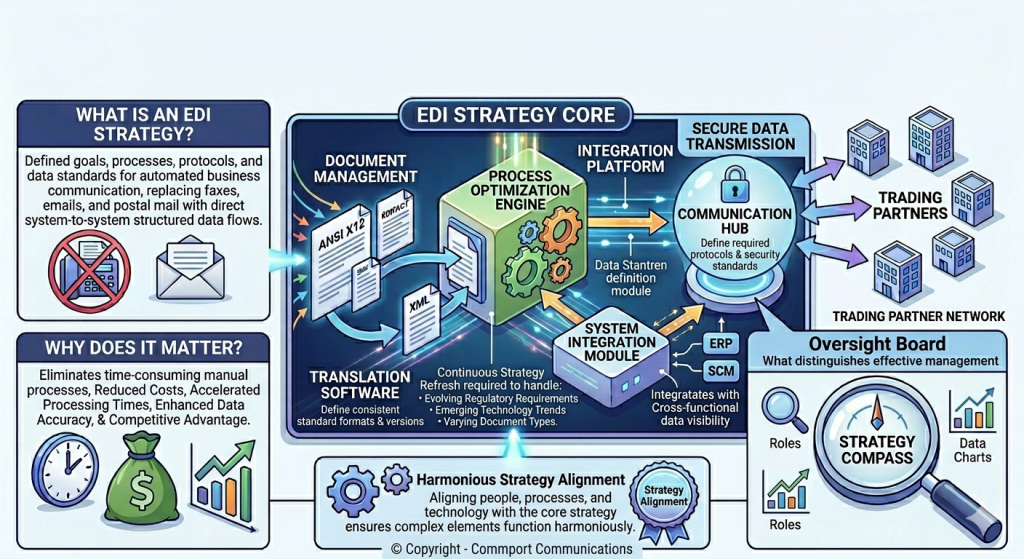
EDI integration connects an electronic data interchange platform with internal systems like ERP, supply chain management, or workflow management systems. This allows automatic data exchange between enterprise systems and external trading partner ecosystems. Your EDI strategy defines how you’ll structure these connections to exchange business documents such as purchase orders, invoices, advanced shipping notices, and inventory updates with your trading partners.
The standardized method transforms data into EDI documents using digital formats like X12, EDIFACT, and HL7. This standardization removes the need for employees to re-key data from EDI platforms into internal business systems. Your EDI ERP integration strategy determines whether you’ll use direct connections between partners, value-added networks (VANs), hybrid approaches, or web-based EDI solutions.
Strategic EDI planning also addresses how you’ll handle data mapping and validation. Data mapping converts external EDI formats into internal application schemas. Validation ensures compliance with standards and partner-specific implementation guidelines. Organizations risk creating inefficient point-to-point connections without a clear strategy. These connections require separate negotiation and configuration with each trading partner.
The Business Case for Strategic EDI Planning
EDI remains critical for high-volume, mission-critical B2B transactions in retail, e-commerce, manufacturing, logistics, healthcare, energy, and government sectors despite the rise of APIs and cloud-native integration.Annual global EDI transaction volumes exceed 20 billion
Manual processing creates operational friction. Studies show manual processing of paper-based orders can cost as high as $70, while computer processing costs less than $1. One major electronics manufacturer calculated the cost of processing an order manually at $38 compared to just $1.35 for an order processed using EDI.
Modern business partnerships just need rapid, reliable communication, workflow transparency, security, and agile expandable workflows. Manual processing is slow, cumbersome, error-prone, and no longer sustainable. Strategic EDI planning addresses these demands. It automates B2B interactions, eliminates paper-based exchanges, and reduces the chances of error and inefficiency associated with manual entry.
How EDI Strategy Impacts Your Bottom Line
A well-planned EDI strategy delivers measurable financial returns across multiple areas:
- Transaction cost reduction: Expenses associated with paper, printing, reproduction, storage, filing, postage, and document retrieval are reduced or eliminated when switching to EDI transactions, .lowering transaction costs by at least 35%
- Error reduction: EDI improves data quality and delivers at least a 30-40% reduction in transactions with errors. It eliminates issues from illegible handwriting, lost faxes or mail, and keying or re-keying errors.
- Cash flow improvement: EDI can reduce the order-to-cash cycle time by more than 20%. This improves business partner transactions and relationships. Quicker invoice processing improves cash flow and reduces days sales outstanding.
- Labor cost savings: Organizations reduce labor costs related to manual data entry, document handling, and error correction by integrating EDI platforms with internal systems. Automating paper-based tasks allows staff to concentrate on higher-value work.
EDI provides up-to-the-minute visibility into transaction status. This supports faster decision-making and improved responsiveness to changing customer and market demands. Organizations can adopt a demand-driven business model rather than a supply-driven one. This shortens lead times for product enhancements and new product delivery. Then, EDI simplifies the ability to enter new territories and markets by providing a common business language that aids business partner onboarding anywhere in the world.
Essential Components of Your EDI Strategy

1. Understanding Your Business Requirements
Getting a full picture of your needs is the foundation of your EDI strategy. You need to gather specific data about document types requiring exchange and scalability requirements from both trading partners and internal teams. This original evaluation determines which EDI solution aligns with your budget and objectives. Think about how many documents you’ll exchange monthly, which business processes require automation, and how quickly your partner network might expand. Your requirements assessment should also get into existing workflows to identify where EDI can eliminate manual intervention and reduce processing time. transaction volumes
2. Identifying Your Trading Partner Ecosystem
Your trading partners drive many EDI decisions. Determine how many partners are already ready to start. Geographic coverage matters because ANSI X12 dominates North America while EDIFACT serves as the global standard, and most providers should support both. Walmart exemplifies complex partner requirements and mandates specific file naming protocols, including vendor ID, file creation date in YYYYMMDD format, and unique sequence numbers. They require continuous AS2 connections and demand EDI 997 Functional Acknowledgments within 24 hours of receiving purchase orders. Other major retailers maintain intricate specifications that are just as complex. Some partners may mandate specific providers or charge per-document fees. Understanding these requirements upfront prevents rework that gets pricey and failed onboarding. EDI-compliant
3. Evaluating EDI Standards and Protocols
EDI standards provide the common language for document exchange. ANSI X12, created in 1979, serves around 300,000 companies worldwide with widespread North American adoption. EDIFACT emerged in the 1980s under UN auspices and became Europe’s predominant standard. Industry-specific standards like ODETTE serve automotive manufacturers.
Communication protocols are just as important. AS2 became the most popular protocol after Walmart required suppliers to use it, and offers better security than HTTP with real-time acknowledgments. OFTP2, designed for automotive B2B exchange, allows both push and pull information transfer with only 14 commands. SFTP uses SSH to secure file transfers. Your protocol selection depends on industry norms and partner priorities.
4. Assessing ERP and EDI Integration Needs
Integration with existing systems determines EDI effectiveness. Your provider should offer proven, plug-and-play integrations with your ERP system. Platforms with 20-year-old support for NetSuite, SAP, Oracle and other leading systems accelerate partner onboarding and lower per-connection costs. Data mapping translates formats between your business systems and the standardized EDI formats that partners require. Providers manage mapping and confirm that outbound data complies with partner requirements while converting incoming data into formats your ERP can process. Smooth integration eliminates the need for custom development work that adds to system costs.
5. Planning for EDI Security and Compliance
Security approaches with multiple layers protect sensitive data. Secure protocols include SFTP, HTTPS, AS2 with digital certificates, and VANs that confirm transactions. Authentication systems like digital certificates, multi-factor authentication and token-based access control prevent unauthorized entry. Role-based access limits functionality by job role, while audit logging tracks activities.
Compliance requirements vary by industry. Businesses handling credit card information need PCI DSS compliance. GDPR applies to EU data processing. Pharmaceutical companies face FDA 21 CFR Part 11 requirements. Trading partner agreements should formalize security expectations, data handling procedures, and breach protocols.
6. Determining Budget and Resource Allocation
Total EDI costs depend on business size, requirement complexity, partner count, and provider choice. Key components include software licenses, implementation services, ongoing maintenance, VAN or AS2 fees based on data volume, and potential trading partner fees. Cloud-based solutions prove affordable and expandable while eliminating hardware and infrastructure investments as providers host and maintain services. Set aside a contingency fund of 10-20% of the total budget for unexpected costs in complex integrations. Calculating implementation costs confirms positive ROI.
Building Your EDI Integration Roadmap

Establishing Clear Goals and Milestones
Choosing Between Cloud, On-Premise, or Hybrid Solutions
Selecting the Right EDI Provider
Planning for EDI ERP Software Integration
Creating a Partner Onboarding Process
1. Establishing Clear Goals and Milestones
A detailed implementation plan prevents costly missteps. Conduct an internal risk and needs assessment first to identify challenges and opportunities associated with your EDI b2b integration. Define the specific ERP interfaces that need integration with your EDI system, establish testing and acceptance criteria, and create a launch schedule. Your project plan should include specific timelines and milestones for each phase. Account for data migration, testing, and training requirements. Assign a project manager internally to outline detailed checklists and review progress at regular intervals. This brings structure and accountability to your EDI strategy.
2. Choosing Between Cloud, On-Premise, or Hybrid Solutions
Cloud-based EDI providers charge a single monthly price instead of requiring businesses to purchase and install large data servers. The provider handles all hardware maintenance aspects, including server component replacement costs, while maintaining IT professionals to ensure smooth transaction flow. Scalability happens easily and allows adjustments to your package as needed. Cloud solutions change spending from capital expenditure to operational expenditure. You avoid infrastructure investments while subscription costs grow with usage.
On-premises EDI eliminates upfront hardware costs, data, and system configuration. This makes them ideal for regulated industries with strict compliance needs. But this approach requires dedicated IT staff with EDI expertise and involves higher upfront costs for software, hardware, and maintenance. On-premises deployments offer complete control over security
Hybrid EDI allows management of critical trading partners and sensitive data on-premises while using cloud-based solutions for the rest of your partner community. This approach suits enterprises with existing infrastructure investments that face increasing demands for scalability.
3. Selecting the Right EDI Provider
Focus on business requirements over technical capabilities when you select your provider. Determine whether you need simple EDI services or value-added features like training support, rapid partner onboarding, and automatic rejection of documents with bad data. Assess the provider’s reach by examining how many of your partners already use their network and whether they maintain a strong presence in your industry sector. Assess their pricing structure and consider factors like kilo-character charges, delivery requirements, and transaction volumes.
4. Planning for EDI ERP Software Integration
Integration represents the greatest development task for most EDI systems. Your staff must extract and load data from in-house business systems. They create EDI documents by mapping extracted data to proper segments and data elements and install communication software. Choose providers that offer proven, plug-and-play integrations with systems like Sage 100 Cloud, Oracle Cloud, and SAP.
5. Creating a Partner Onboarding Process
Use pre-built templates for requirements intake to capture EDI document types, communication protocols, expected data flow, security needs, and compliance mandates upfront. Use mapping libraries for recurring partner types rather than starting custom mapping from scratch. Set up a centralized dashboard to track every step from intake through connectivity tests and go-live readiness. Run full-cycle tests between your systems and each partner. This proves connectivity right and tests real-life data scenarios.
EDI Best Practices for Implementation Success
1. Start with High-Volume Trading Partners
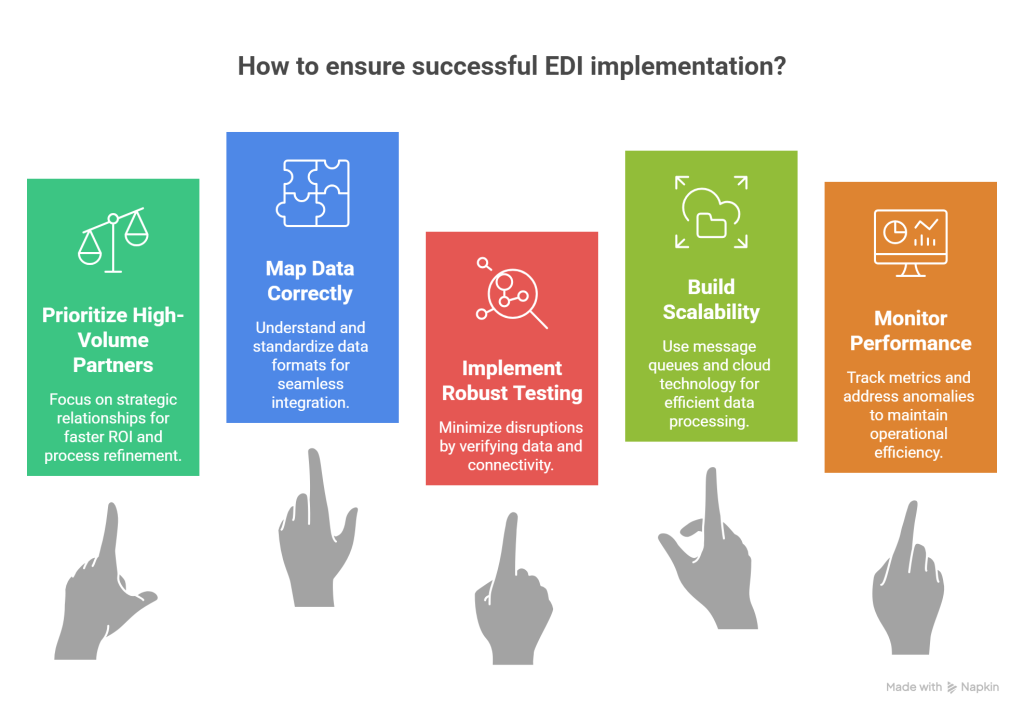
Base your priorities on strategic importance rather than tackling all connections at once. Conduct pilot tests with a few suppliers or partners before you roll out EDI to everyone if you manage numerous relationships. You can refine your processes this way and identify potential issues while you build confidence before scaling. High-volume relationships, to name just one example those in e-commerce and manufacturing, deliver the fastest ROI.
2. Prioritize Data Mapping and Transformation
Your solution decisions depend on how well you understand trading partner EDI requirements from the start. Different industries use varying standards and formats based on what they need operationally. Standardize naming conventions internally and arrange them with the right EDI standard such as ANSI X12 in North America or EDIFACT for global use. Verify that documents conform to agreed-upon formats and that all fields map correctly. Automation tools reduce manual effort and enable custom adjustments as needed. You can update maps proactively when you review partner implementation guides on a regular basis.
3. Implement Robust Testing Procedures
Testing minimizes the risk of costly disruptions once your platform goes live. Start by verifying that exchanged data meets required standards. Mimic ground processes and end-to-end transactions to uncover problematic data flows. Connectivity testing verifies that communication protocols like AS2 and SFTP function as expected. Assess whether your system can handle high transaction volumes without lag or downtime during testing. Proper testing mechanisms let you identify and address errors before they affect live operations.
4. Build Scalability into Your Strategy
Use message queues like Kafka or Azure Service Bus to create buffers that collect data and let your system process it at a safe speed. Auto-scaling with cloud technology spins up extra resources only when needed and keeps costs low while it maintains speed. Isolate errors by moving broken files to a Dead Letter Queue so one bad order doesn’t block thousands of good orders.
5. Monitor and Measure Performance
Configure your platform to flag anomalies such as failed transmissions and delayed acknowledgments automatically. Implement dashboards that provide live visibility into operations. Conduct deeper investigations to determine why it happens rather than just fix immediate problems when errors occur. Track transaction latency between receipt and final acknowledgment and set automated alerts for anything that exceeds your SLA threshold. Review transaction performance with partners on a regular basis to identify improvement areas.
Common Pitfalls to Avoid in EDI Strategy Planning
1. Underestimating Implementation Complexity
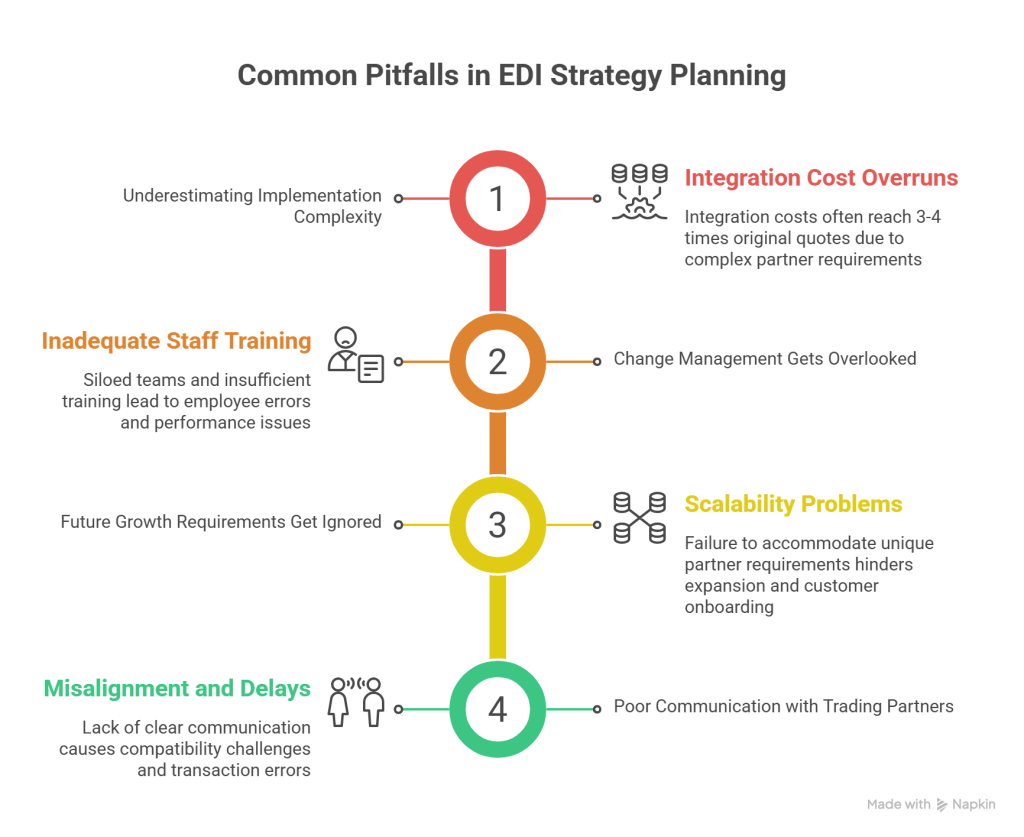
Poor EDI implementation creates inefficiencies and disrupts operations instead of improving them. Communication breakdowns between trading partners, misaligned data formats and unexpected costs lead to delayed order processing, missed shipments and strained relationships. Integration costs often reach 3-4 times original quotes once you face complex partner requirements. 60% of B2B transactions are affected or suspended because of data-related anomalies. Supply chains involve many stakeholders with unique requirements and processes. You risk adopting an EDI solution that doesn’t meet specific needs of all parties involved if you fail to account for this complexity.
2. Change Management Gets Overlooked
Siloed project teams and inadequate staff training undermine even well-designed EDI strategies. Employees just need proper training on new systems to execute transactions correctly. Performance issues compound when you neglect post-go-live monitoring.
3. Future Growth Requirements Get Ignored
Trading partners often have their own flavor of EDI transaction sets. Accommodating unique requirements and business rules becomes problematic when you add more customers. Your biggest customer will demand format changes shortly after go-live.
4. Poor Communication with Trading Partners
Poor communication with vendors and partners creates misalignment on requirements, timelines and expectations. Compatibility challenges cause delays and errors in transactions without establishing common standards upfront.
Conclusion
A successful EDI strategy requires careful planning, but the payoff is worth the effort. We’ve covered everything you need, from understanding your trading partner ecosystem to choosing the right integration approach and following EDI best practices.
Start with a clear assessment of your requirements. Prioritize high-volume partners and avoid common pitfalls like underestimating complexity or neglecting change management. Your EDI integration will deliver real-life results as long as you focus on resilient testing and flexible architecture.
Organizations that invest time in strategic planning see cost reductions, fewer errors, and improved cash flow. Build your roadmap with these insights and watch your B2B operations transform.
Commport Professional EDI Consulting Services
Need Help? Download: Commport's EDI Buyers Guide
Unlock the full potential of your supply chain with our comprehensive EDI Buyer's Guide — your first step towards seamless, efficient, and error-free transactions
Frequently Asked Questions
EDI (Electronic Data Interchange) is a standardized method that connects electronic data interchange platforms with internal systems like ERP to enable automatic data exchange between enterprise systems and external trading partners. It transforms business documents such as purchase orders, invoices, and shipping notices into standardized digital formats like X12 or EDIFACT, eliminating the need for manual data entry and paper-based processes.
Organizations can save $50 or more per document by transitioning from paper to electronic formats. Manual processing of paper-based orders can cost as high as $70, while computer processing through EDI costs less than $1. Additionally, EDI reduces transaction costs by at least 35% by eliminating expenses related to paper, printing, postage, and document storage.
Cloud-based EDI eliminates upfront hardware costs with a single monthly subscription, includes provider-managed maintenance, and offers seamless scalability as your needs grow. On-premise deployments provide complete control over security and data, making them ideal for regulated industries, but require dedicated IT staff, higher upfront costs, and ongoing maintenance responsibilities.
Start with high-volume trading partners rather than attempting to connect all partners simultaneously. Prioritize relationships based on strategic importance and transaction volume, particularly those in e-commerce, manufacturing, and retail supply chains, as these deliver the fastest return on investment and allow you to refine processes before scaling to additional partners.
The most critical pitfalls include underestimating implementation complexity (real costs often reach 3-4 times initial quotes), neglecting staff training and change management, failing to plan for future growth and partner-specific requirements, and poor communication with trading partners about standards, timelines, and expectations. Additionally, 60% of B2B transactions are affected by data-related issues due to inadequate testing and validation procedures.